Advertisements
Advertisements
प्रश्न
With the help of a neat circuit diagram, explain the transistor as an amplifier?
Advertisements
उत्तर
Working of an amplifier:
- The circuit of an amplifier using an n-p-n transistor in CE configuration is shown in the figure.
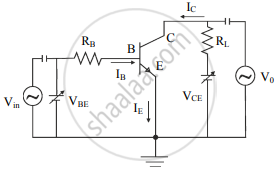
- When the input voltage Vin is not applied, applying the Kirchhoff’s law to the output loop, we can write, VCC = VCE + ICRL
- Similarly, for input loop,
VBB = VBE + IBRB - When the input AC signal is applied, Vin is not zero. Thus, the voltage drop across the input loop will now be,
VBB + Vin = VBE + IBRB + ΔIB (RB + ri) ....(1) - The AC signal applied adds the current of ΔIB to the original current flowing through the circuit. Therefore, the additional voltage drop in the input loop will be across resistor RB (= ΔIBRB) and across the input dynamic resistance of the transistor (= ΔIBri).
- From equation (1),
Vin = ΔIB (RB + ri)
As, RB is very small, we can consider,
Vin = ΔIBri - The changes in the base current IB cause changes in the collector current IC. This changes the voltage drop across the load resistance because VCC is constant. We can write,
ΔVCC = ΔVCE + RLIC = 0
∴ ΔVCE = -RLIC - The change in the output voltage ΔVCE is the output voltage Vo hence we can write,
Vo = ΔVCE = `beta`ACRLΔIB
APPEARS IN
संबंधित प्रश्न
In a BJT, the largest current flow occurs ______.
In a common-base connection, the emitter current is 6.28 mA and the collector current is 6.20 mA. Determine the common-base DC current gain.
In a common base configuration, the transistor has an emitter current of 10 mA and a collector current of 9.8 mA. The value of base current is ______
For a transistor β =75 and IE = 7.5 mA. The value of α is ______
Draw the circuit symbol for NPN and PNP transistors. What is the difference in the Emitter, Base, and Collector regions of a transistor?
Draw the circuit diagram to study the characteristic of the transistor in common emitter mode. Draw the input and output characteristics.
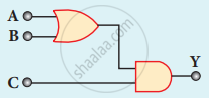
The output of the following circuit is 1 when the input ABC is
Give the Barkhausen conditions for sustained oscillations.
Sketch the static characteristics of a common emitter transistor and bring out the essential features of input and output characteristics.
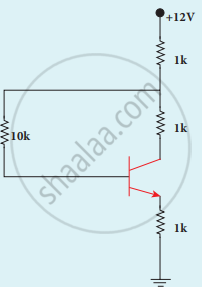
A transistor of α = 0.99 and VBE = 0.7 V is connected in the common-emitter configuration as shown in the figure. If the transistor is in the saturation region, find the value of collector current.
A transistor has a voltage gain A. If the amount βA of its output is applied to the input of the transistor, then the transistor becomes oscillator, when ______.
A common emitter amplifier is designed with n-p-n transistor (α = 0.99). The input impedance is 1 kΩ and the load is 10 kΩ. The voltage gain will be ______
For a transistor, the current ratio 'βdc' is defined as the ratio of ______.
In the symbol for a transistor, the arrow head points in the direction of the ____________.
Least doped region in a transistor ____________.
In switching circuit, transistor is in ON state. Values of IC and IB are 5.2 mA and 10 µA respectively and value of RC is 1 k`Omega`. If Vcc is at 5.5 V, then VCE is ______.
If `alpha`-current gain of a transistor is 0.98. What is the value of `beta`- current gain of the transistor?
ln switching circuit, transistor is in ON state and values of IC and IB are 4.2 mA and 5 µA respectively and RC= l k`Omega` and RB= 300 k`Omega`. If VBE = 0.5 V, find the value of VBB.
In a common emitter amplifier circuit using an n-p-n transistor, the phase difference between the input and the output voltages will be: ____________.
In case of npn transistors, the collector current is always less than the emitter current because ______.
In a transistor, a change of 8.0 mA in the emitter current produces a change of 7.8 mA in the collector current. Then change in the base current is ____________.
In the case of transistor, the relation between current ratios αdc and βdc is ______.
In common emitter mode of transistor, the d.c. current gain is 20, the emitter current is 7 mA. The collector current is ______.
For a transistor, αdc and βdc are the current ratios, then the value of `(beta_"dc"-delta_"dc")/(alpha_"dc".beta_"dc")`
The base current in common emitter mode of the transistor changes by 10 µA. If the current gain of the transistor is 50, then change in collector current is ______.
In a CE amplifier, the current gain is 80 and the emitter current is 9 mA. The base current is ______.
Explain the output characteristics of common emitter configuration of n-p-n transistor.
Define β
