Advertisements
Advertisements
प्रश्न
Transistor functions as a switch. Explain.
Advertisements
उत्तर
In saturation and cut-off region transistor works as an electronic switch that helps to turn ON or OFF a circuit.
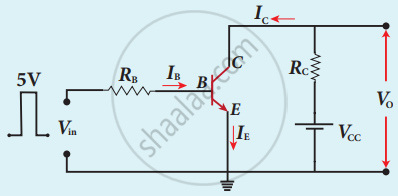
Transistor as a switch
presence of dc source at the input (saturation region):
- When high input voltage (Vin = + 5V) is applied, IB increases and in turn increases IC.
- Transistor will move into saturation region (turned ON)
- Increase in IC increases the voltage drop across Rc lowering the output voltage close to zero.
- Transistor acts like a closed switch (ON condition)
Absence of dc source at the input (cut-off region):
- At low input voltage (Vin = 0V), decreases the IB and in turn decreases IC.
- Transistor moves to cut off region (turned ON)
- Decrease in IC decreases voltage drop across Rc, increasing output voltage + 5V transistor acts as an open switch (OFF condition)
- It is manifested that high input gives low output and low input gives high output.
APPEARS IN
संबंधित प्रश्न
In a common-base connection, a certain transistor has an emitter current of 10mA and a collector current of 9.8 mA. Calculate the value of the base current.
In a common-base connection, the emitter current is 6.28 mA and the collector current is 6.20 mA. Determine the common-base DC current gain.
For a transistor β =75 and IE = 7.5 mA. The value of α is ______
Draw the circuit symbol for NPN and PNP transistors. What is the difference in the Emitter, Base, and Collector regions of a transistor?
In switching circuit, transistor is in ON state. Values of IC and IB are 5.2 mA and 10 µA respectively and value of RC is 1 k`Omega`. If Vcc is at 5.5 V, then VCE is ______.
In switching circuit, transistor is in ON state, values of IE and lB are 10 mA and 0.8 mA respectively and RL is 2 k`Omega`. If VCE is 7.6 V, then VCC is ____________.
For an ideal diode, the current in the following arrangement is ______.

The transfer ratio of a transistor is 50. The input resistance of the transistor when used in the CE configuration is 1K Ω. The peak value for an AC input voltage of 0.01 V of collector current is ______.
Define α.
Define β
