Advertisements
Advertisements
प्रश्न
Transistor functions as a switch. Explain.
Advertisements
उत्तर
In saturation and cut-off region transistor works as an electronic switch that helps to turn ON or OFF a circuit.
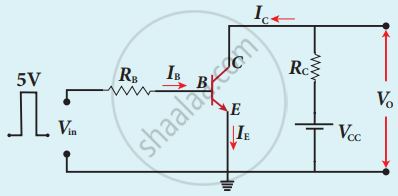
Transistor as a switch
presence of dc source at the input (saturation region):
- When high input voltage (Vin = + 5V) is applied, IB increases and in turn increases IC.
- Transistor will move into saturation region (turned ON)
- Increase in IC increases the voltage drop across Rc lowering the output voltage close to zero.
- Transistor acts like a closed switch (ON condition)
Absence of dc source at the input (cut-off region):
- At low input voltage (Vin = 0V), decreases the IB and in turn decreases IC.
- Transistor moves to cut off region (turned ON)
- Decrease in IC decreases voltage drop across Rc, increasing output voltage + 5V transistor acts as an open switch (OFF condition)
- It is manifested that high input gives low output and low input gives high output.
APPEARS IN
संबंधित प्रश्न
In a BJT, the largest current flow occurs ______.
In a transistor amplifier, IC = 5.5 mA , IE = 5.6 mA. The current amplification factor β is ______
A transistor has a voltage gain A. If the amount βA of its output is applied to the input of the transistor, then the transistor becomes oscillator, when ______.
In the symbol for a transistor, the arrow head points in the direction of the ____________.
Least doped region in a transistor ____________.
In transistor amplifier, base-emitter junction is forward biased and collector emitter junction is reverse biased. The current gain is ______.
A transistor is connected in C - E mode. If collector current is 72 × 10-5 A and α = 0.96, then base current will be ______.
How is a transistor biased for operating it as amplifier?
Explain the output characteristics of common emitter configuration of n-p-n transistor.
For a common emitter transistor configuration the ratio of `I_c/I_E` = 0.96, then the current gain in this configuration is ______.
