Advertisements
Advertisements
Question
Transistor functions as a switch. Explain.
Advertisements
Solution
In saturation and cut-off region transistor works as an electronic switch that helps to turn ON or OFF a circuit.
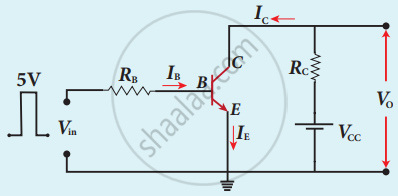
Transistor as a switch
presence of dc source at the input (saturation region):
- When high input voltage (Vin = + 5V) is applied, IB increases and in turn increases IC.
- Transistor will move into saturation region (turned ON)
- Increase in IC increases the voltage drop across Rc lowering the output voltage close to zero.
- Transistor acts like a closed switch (ON condition)
Absence of dc source at the input (cut-off region):
- At low input voltage (Vin = 0V), decreases the IB and in turn decreases IC.
- Transistor moves to cut off region (turned ON)
- Decrease in IC decreases voltage drop across Rc, increasing output voltage + 5V transistor acts as an open switch (OFF condition)
- It is manifested that high input gives low output and low input gives high output.
APPEARS IN
RELATED QUESTIONS
Why is the base of a transistor made thin and is lightly doped?
Explain the working of the PNP transistor?
Assuming VCEsat = 0.2 V and β = 50, find the minimum base current (IB) required to drive the transistor given in the figure to saturation.
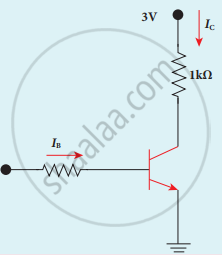
A transistor of α = 0.99 and VBE = 0.7 V is connected in the common-emitter configuration as shown in the figure. If the transistor is in the saturation region, find the value of collector current.
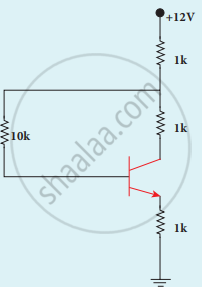
A common emitter amplifier is designed with n-p-n transistor (α = 0.99). The input impedance is 1 kΩ and the load is 10 kΩ. The voltage gain will be ______
The condition to convert an amplified signal into an oscillating signal is ______
In switching circuit, transistor is in ON state, values of IE and lB are 10 mA and 0.8 mA respectively and RL is 2 k`Omega`. If VCE is 7.6 V, then VCC is ____________.
In common emitter amplifier, a change of 0.2 mA in the base current causes a change of 5 mA in the collector current. If input resistance is 2K `Omega` and voltage gain is 75, the load resistance used in the circuit is ______.
For a transistor, αdc and βdc are the current ratios, then the value of `(beta_"dc"-delta_"dc")/(alpha_"dc".beta_"dc")`
Define peak value of alternating signal.
