Advertisements
Advertisements
Question
Describe the function of a transistor as an amplifier with the neat circuit diagram. Sketch the input and output wave forms.
Advertisements
Solution
i. Amplification is the process of increasing the signal strength (increase in the amplitude)
ii. NPN transistor is connected in CE configuration
iii. To start with, the Q point is fixed to get a maximum signal swing at the output.
iv. RC – to measure the output voltage
C1 allows only AC signals to pass,
Bypass capacitor CE provides a low resistance path
Coupling capacitor CC is used to couples the next stage amplifier.
Vs input source signal
IC = BIB `(∴ "B" = "I"_"C"/"I"_"B")`
VCE = VCC – ICRC

Transistor as an amplifier

Input and output waveforms showing 180° phase reversal.
Working of the amplifier:
a. Working of the amplifier:
- Input signal Vs increases the forward voltage across the emitter-base. IB increases. also increases IC also increases β times.
- This increases the voltage drop across Rc which decreases VCE.
- Therefore input signal in the positive direction produces an amplified signal in the negative direction at the output. Hence output signal is reversed by 180°.
b. During negative half cycle:
- Input signal Vs decreases the forwarded voltage across the emitter-base. As a result, IB decreases IC increases.
- Increase in IC decreases potential drop across Rc and increases VCE.
- Input signal in negative direction produces an amplified signal in the positive direction at the output.
- Therefore 180° phase reversal is observed during the negative half signal.
APPEARS IN
RELATED QUESTIONS
Explain the working of the PNP transistor?
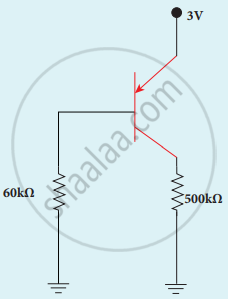
In the circuit shown in the figure, the BJT has a current gain (β) of 50. For an emitter-base voltage VEB = 600 mV, calculate the emitter-collector voltage VEC (in volts).
In a common emitter amplifier, the input resistance is 1000 Ω, the peak value of Input signal voltage is 5 mV, and β = 60. The peak value of output current is
A transistor having α = 0.8 is connected in common emitter configuration. When the base current changes by 6 mA, then the change in collector current is ______.
In the symbol for a transistor, the arrow head points in the direction of the ____________.
A transistor when connected in common emitter mode has a ____________.
The current gain `alpha` of a transistor is 0.95. The change in collector current corresponding to a change of 0.4 mA in the base current in a common emitter arrangement is ______.
In common emitter mode of transistor, the d.c. current gain is 20, the emitter current is 7 mA. The collector current is ______.
In a transistor (common emitter configuration) the ratio of power gain to voltage gain is (α and β are current ratios) ______.
For a common emitter transistor configuration the ratio of `I_c/I_E` = 0.96, then the current gain in this configuration is ______.
