Advertisements
Advertisements
Question
In a BJT, the largest current flow occurs ______.
Options
In the emitter
In the collector
In the base
Through CB junction
Advertisements
Solution
In a BJT, the largest current flow occurs in the emitter.
Explanation:
Emitter is a thick, heavily doped layer. This supplies a large number of majority carriers for the current flow through the transistor
APPEARS IN
RELATED QUESTIONS
Why is the base of a transistor made thin and is lightly doped?
In a common-base connection, the emitter current is 6.28 mA and the collector current is 6.20 mA. Determine the common-base DC current gain.
Derive the relation between α and β.
For a transistor β =75 and IE = 7.5 mA. The value of α is ______
Explain the working of the PNP transistor?
Draw the circuit symbol for NPN and PNP transistors. What is the difference in the Emitter, Base, and Collector regions of a transistor?
With the help of a neat diagram, explain the working of the npn transistor?
The output of the following circuit is 1 when the input ABC is
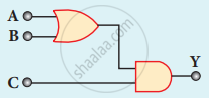
Explain the current flow in an NPN transistor.
Transistor functions as a switch. Explain.
In an npn transistor, the base current is 100 µA and the collector current is 10 mA. The emitter current is ______.
In case of npn transistors, the collector current is always less than the emitter current because ______.
In an npn transistor circuit, the collector current is 10 mA. If 90% of the electrons emitted reach the collector, the emitter current (IE) and base current (IB) are given by ____________.
In a transistor, a change of 8.0 mA in the emitter current produces a change of 7.8 mA in the collector current. Then change in the base current is ____________.
A pnp transistor is used in common-emitter mode. If a change of 40 µA in base current brings a change of 2 µA in collector current with 0.04 V in base-emitter voltage, then the input resistance is ____________.
In a transistor, doping level in base is increased slightly, the collector current and base current respectively ______.
In the case of transistor, the relation between current ratios αdc and βdc is ______.
A change of 9.0 mA in the emitter current brings a change of 8.9 mA in the collector current. The value of current gain β will be ______.
For an ideal diode, the current in the following arrangement is ______.

In common emitter amplifier, a change of 0.2 mA in the base current causes a change of 5 mA in the collector current. If input resistance is 2K `Omega` and voltage gain is 75, the load resistance used in the circuit is ______.
A transistor having α = 0.8 is connected in a common emitter configuration. When the base current changes by 6 mA, the change in collector current is ______
In the common-emitter configuration of a transistor, the current gain is more than 1 because [lb, le, and lc are base, emitter, and collector currents respectively] ______
For a transistor, αdc and βdc are the current ratios, then the value of `(beta_"dc"-delta_"dc")/(alpha_"dc".beta_"dc")`
A common emitter amplifier circuit built using an n-p-n transistor is shown in the figure. Its DC current gain is 300, RC = 4 kΩ and VCC = 20 V. What is the minimum base current for VCE to reach saturation?

Explain the working of the n-p-n transistor in a common base configuration.
How is a transistor biased for operating it as amplifier?
In a transistor (common emitter configuration) the ratio of power gain to voltage gain is (α and β are current ratios) ______.
In the case of constants ‘α’ and ‘β’ of a transistor ______.
