Advertisements
Advertisements
Question
In a common-base connection, the emitter current is 6.28 mA and the collector current is 6.20 mA. Determine the common-base DC current gain.
Advertisements
Solution
Data: The emitter current is IE = 6.28 mA.
The collector current is IC = 6.20 mA
`alpha_(dc) = I_C/I_E`
⇒ `alpha = 6.20/6.28`
⇒ `alpha = 0.987`
The common base DC current gain is 0.987.
RELATED QUESTIONS
In a BJT, the largest current flow occurs ______.
In a common base configuration, the transistor has an emitter current of 10 mA and a collector current of 9.8 mA. The value of base current is ______
For a transistor β =75 and IE = 7.5 mA. The value of α is ______
Draw the circuit symbol of the PNP transistor.
Explain the working of the PNP transistor?
With the help of a neat circuit diagram, explain the transistor as an amplifier?
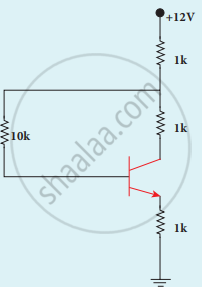
A transistor of α = 0.99 and VBE = 0.7 V is connected in the common-emitter configuration as shown in the figure. If the transistor is in the saturation region, find the value of collector current.
In a common emitter amplifier, the input resistance is 1000 Ω, the peak value of Input signal voltage is 5 mV, and β = 60. The peak value of output current is
A common emitter amplifier is designed with n-p-n transistor (α = 0.99). The input impedance is 1 kΩ and the load is 10 kΩ. The voltage gain will be ______
The condition to convert an amplified signal into an oscillating signal is ______
In the study of transistor as an amplifier, the ratio of collector current to emitter current is 0.98 then the ratio of collector current to base current will be ______.
In switching circuit, transistor is in ON state. Values of IC and IB are 5.2 mA and 10 µA respectively and value of RC is 1 k`Omega`. If Vcc is at 5.5 V, then VCE is ______.
If `alpha`-current gain of a transistor is 0.98. What is the value of `beta`- current gain of the transistor?
In switching circuit, transistor is in ON state, values of IE and lB are 10 mA and 0.8 mA respectively and RL is 2 k`Omega`. If VCE is 7.6 V, then VCC is ____________.
In an npn transistor circuit, the collector current is 10 mA. If 90% of the electrons emitted reach the collector, the emitter current (IE) and base current (IB) are given by ____________.
For a common emitter configuration, if 'α' and 'β' have their usual meanings, the correct relationship between 'α' and 'β' is ______.
A transistor when connected in common emitter mode has a ____________.
The current gain `alpha` of a transistor is 0.95. The change in collector current corresponding to a change of 0.4 mA in the base current in a common emitter arrangement is ______.
In a transistor, the thickness of the base region ____________.
In a transistor, doping level in base is increased slightly, the collector current and base current respectively ______.
In the case of transistor, the relation between current ratios αdc and βdc is ______.
In common emitter mode of transistor, the d.c. current gain is 20, the emitter current is 7 mA. The collector current is ______.
In a p-n-p transistor circuit, the collector current is 10 mA. If 90% of the holes emitted from the emitter reach the collector, ______.
The reverse bias in a junction diode is changed from 8V to 13V, then the value of the current changes from 40μA to 60μA. The resistance of junction diode will be ______.
The collector current in a common-emitter transistor amplifier is 4 mA. When the base current is increased by 20 µA, the collector current increases to 6 mA. The current gain is ______.
When an n-p-n junction transistor is used as an amplifier in common emitter mode, ______.
For a common emitter transistor configuration the ratio of `I_c/I_E` = 0.96, then the current gain in this configuration is ______.
