Advertisements
Advertisements
प्रश्न
In a BJT, the largest current flow occurs ______.
विकल्प
In the emitter
In the collector
In the base
Through CB junction
Advertisements
उत्तर
In a BJT, the largest current flow occurs in the emitter.
Explanation:
Emitter is a thick, heavily doped layer. This supplies a large number of majority carriers for the current flow through the transistor
APPEARS IN
संबंधित प्रश्न
The common-base DC current gain of a transistor is 0.967. If the emitter current is 10mA. What is the value of base current?
The principle based on which a solar cell operates is ____________.
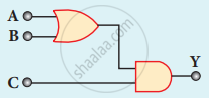
The output of the following circuit is 1 when the input ABC is
What is rectification?
Transistor functions as a switch. Explain.
Assuming VCEsat = 0.2 V and β = 50, find the minimum base current (IB) required to drive the transistor given in the figure to saturation.
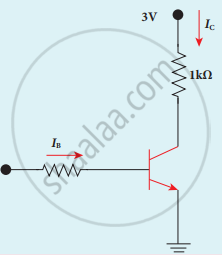
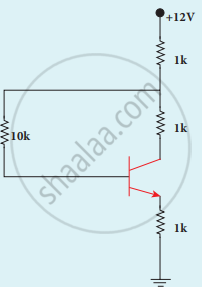
A transistor of α = 0.99 and VBE = 0.7 V is connected in the common-emitter configuration as shown in the figure. If the transistor is in the saturation region, find the value of collector current.
In a common emitter amplifier, the input resistance is 1000 Ω, the peak value of Input signal voltage is 5 mV, and β = 60. The peak value of output current is
The condition to convert an amplified signal into an oscillating signal is ______
In the symbol for a transistor, the arrow head points in the direction of the ____________.
In the study of transistor as an amplifier, the ratio of collector current to emitter current is 0.98 then the ratio of collector current to base current will be ______.
Ve, Vb, and Ve are emitter, base, and collector voltage respectively for npn transistor in CE mode. Amplifier works for the combination of biasing voltage equal to ______.
In an npn transistor, the base current is 100 µA and the collector current is 10 mA. The emitter current is ______.
Which of the following regions of a transistors are, respectively, heavily dopped and lightly dopped?
In a silicon transistor, a change of 7.89 mA in the emitter current if produces a change of 7.8 mA in the collector current, then the base current must change by ____________.
A pnp transistor is used in common-emitter mode. If a change of 40 µA in base current brings a change of 2 µA in collector current with 0.04 V in base-emitter voltage, then the input resistance is ____________.
In the case of transistor, the relation between current ratios αdc and βdc is ______.
In common emitter mode of transistor, the d.c. current gain is 20, the emitter current is 7 mA. The collector current is ______.
For an ideal diode, the current in the following arrangement is ______.

In common emitter amplifier, a change of 0.2 mA in the base current causes a change of 5 mA in the collector current. If input resistance is 2K `Omega` and voltage gain is 75, the load resistance used in the circuit is ______.
For a transistor, αdc and βdc are the current ratios, then the value of `(beta_"dc"-delta_"dc")/(alpha_"dc".beta_"dc")`
The reverse bias in a junction diode is changed from 8V to 13V, then the value of the current changes from 40μA to 60μA. The resistance of junction diode will be ______.
A common emitter amplifier circuit built using an n-p-n transistor is shown in the figure. Its DC current gain is 300, RC = 4 kΩ and VCC = 20 V. What is the minimum base current for VCE to reach saturation?

The base current in common emitter mode of the transistor changes by 10 µA. If the current gain of the transistor is 50, then change in collector current is ______.
The transfer ratio of a transistor is 50. The input resistance of the transistor when used in the CE configuration is 1K Ω. The peak value for an AC input voltage of 0.01 V of collector current is ______.
The current amplification factor for a transistor in its common emitter mode is 50. The current amplification factor in the common base mode of the transistor is ______.
How is a transistor biased for operating it as amplifier?
In the case of constants ‘α’ and ‘β’ of a transistor ______.
