Advertisements
Advertisements
Question
For a transistor IC = 15 mA, IB = 0.5 mA. What is the current amplification factor?
Advertisements
Solution
Current amplification factor, β = `("I"_"c")/("I"_"B") = 15/0.5 = 30`
RELATED QUESTIONS
With the help of a neat circuit diagram, explain the transistor as an amplifier?
The principle based on which a solar cell operates is ____________.
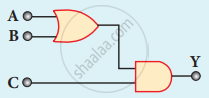
The output of the following circuit is 1 when the input ABC is
Explain the current flow in an NPN transistor.
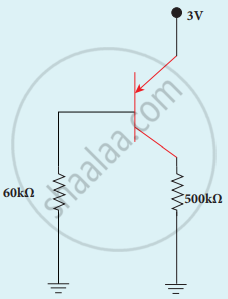
In the circuit shown in the figure, the BJT has a current gain (β) of 50. For an emitter-base voltage VEB = 600 mV, calculate the emitter-collector voltage VEC (in volts).
A transistor has a voltage gain A. If the amount βA of its output is applied to the input of the transistor, then the transistor becomes oscillator, when ______.
In the symbol for a transistor, the arrow head points in the direction of the ____________.
Least doped region in a transistor ____________.
Which of the following regions of a transistors are, respectively, heavily dopped and lightly dopped?
In a silicon transistor, a change of 7.89 mA in the emitter current if produces a change of 7.8 mA in the collector current, then the base current must change by ____________.
A transistor when connected in common emitter mode has a ____________.
The current gain `alpha` of a transistor is 0.95. The change in collector current corresponding to a change of 0.4 mA in the base current in a common emitter arrangement is ______.
In transistor amplifier, base-emitter junction is forward biased and collector emitter junction is reverse biased. The current gain is ______.
In common emitter mode of transistor, the d.c. current gain is 20, the emitter current is 7 mA. The collector current is ______.
A transistor having α = 0.8 is connected in a common emitter configuration. When the base current changes by 6 mA, the change in collector current is ______
A common emitter amplifier has a voltage gain of 50, an input impedance of 100Ω and an output impedance of 2000Ω. The power gain of the amplifier is ______.
A transistor is used as a common emitter amplifier with a load resistance 2 KΩ. The input resistance is 150 Ω. Base current is changed by 20 µA which results in a change in collector current by 1.5 mA. The voltage gain of the amplifier is ______.
A conducting wire has length 'L1' and diameter 'd1'. After stretching the same wire length becomes 'L2' and diameter 'd2' The ratio of resistances before and after stretching is ______.
A common emitter amplifier circuit built using an n-p-n transistor is shown in the figure. Its DC current gain is 300, RC = 4 kΩ and VCC = 20 V. What is the minimum base current for VCE to reach saturation?

The base current in common emitter mode of the transistor changes by 10 µA. If the current gain of the transistor is 50, then change in collector current is ______.
The current amplification factor for a transistor in its common emitter mode is 50. The current amplification factor in the common base mode of the transistor is ______.
The collector current in a common-emitter transistor amplifier is 4 mA. When the base current is increased by 20 µA, the collector current increases to 6 mA. The current gain is ______.
In a CE amplifier, the current gain is 80 and the emitter current is 9 mA. The base current is ______.
Explain the output characteristics of common emitter configuration of n-p-n transistor.
When an n-p-n junction transistor is used as an amplifier in common emitter mode, ______.
