Advertisements
Advertisements
Question
The size of an atom is indicated by its ______.
Options
atomic number
radius
number of shells
atomic mass
Advertisements
Solution
The size of an atom is indicated by its radius.
Explanation:
The size of an atom is defined by its atomic radius, which is the distance from the center of the nucleus to the outermost shell of electrons. While the number of shells influences the size, the physical dimension itself is specifically measured and referred to as the radius.
APPEARS IN
RELATED QUESTIONS
Answer the following in respect of element `31/15 P`
Give its electronic configuration
Give the trends in atomic size on moving across the period left to right.
Arrange the elements of second and third periods in increasing order of their atomic size (excluding noble gases).
Which is greater in size Fe2+ or Fe3+?
Write a scientific reason.
Atomic radius goes on increasing down a group.
Study the radius of the element given below and answer the following questions.
| elements | K | Na | Rb | Cs | Li |
| Atomic radius (pm) | 231 | 186 | 244 | 262 | 151 |
a) Which of the above elements have the smallest atom?
b) In which group of the modern periodic table the above element are belongs?
c) What is the periodic trend observed in the variation of atomic radii down a group?
Arrange the following in increasing order of property indicated
I, I+, I- (atomic size)
Supply the missing word from those in the brackets:
If an element has seven electrons in its outermost shell then it is likely to have the ______ (largest/ smallest) atomic size among all the elements in the same period.
Arrange the following as per the instruction given in the bracket
Na, K, Li (Increasing atomic size)
An element X has mass number 40 and contains 21 neutrons in its atom. To which group of the Periodic Table does it belong?
Which of the following gives the correct increasing order of the atomic radii of O, F and N?
Which of the following are the characteristics of isotopes of an element?
- Isotopes of an element have same atomic masses
- Isotopes of an element have same atomic number
- Isotopes of an element show same physical properties
- Isotopes of an element show same chemical properties
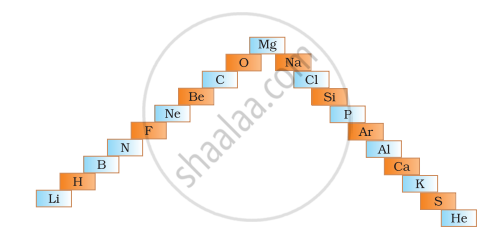
- In below ladder symbols of elements are jumbled up. Rearrange these symbols of elements in the increasing order of their atomic number in the Periodic Table.
- Arrange them in the order of their group also.
Arrange the following as per the instruction given in the bracket:
Carbon, Fluorine, Beryllium (decreasing order of atomic size).
Arrange the following as per instruction given in the bracket.
Mg, Cl, Na, S, Si (decreasing order of atomic size)
Arrange the following in order of increasing radii:
Cl−, Cl
Explain your choice.
Arrange the following in order of increasing radii:
N, O, P
Explain your choice.
