Advertisements
Advertisements
Question
Write the name and symbol of the element from the description.
The atom having the smallest atomic mass.
Advertisements
Solution
Name: Hydrogen
Symbol: H
RELATED QUESTIONS
Which is greater in size an atom or a cation?
Which is greater in size an atom or an anion?
Arrange the following in increasing order of property indicated
I, I+, I- (atomic size)
What happens to the atomic size of elements on moving from left to right in a period?
The metals of Group 2 from top to bottom are Be, Mg, Ca, Sr and Ba.
- Which one of these elements will form ions most readily and why?
- State the common feature in their electronic configuration.
The size of an atom is indicated by its ______.
Right or wrong sentence.
Nanometer unit is used to measure atomic radius.
Write scientific reason.
In same period, boron and oxygen elements have different atomic size.
Some elements and their atomic radii are given here. Arrange them in decreasing order of their atomic radii. Identify which of the above elements is the biggest atom and which is smallest?
| Element | K | Na | Rb | Cs | Li |
| Atomic radius (pm) | 231 | 186 | 244 | 262 | 151 |
Write information about the given atomic numbers in the table.
| Atomic Number | Electronic configuration | Group | Period | Element |
| 10 | ||||
| 20 | ||||
| 7 |
Carbon belongs to the second period and Group 14. Silicon belongs to the third period and Group 14. If the atomic number of carbon is 6, the atomic number of silicon is ______
An element X has mass number 40 and contains 21 neutrons in its atom. To which group of the Periodic Table does it belong?
Which of the following is the correct order of size?
When an atom of iodine becomes an iodine ion (I–) the radius will ______
Which of the following gives the correct increasing order of the atomic radii of O, F and N?
Which one of the following depict the correct representation of atomic radius(r) of an atom?
|
(i) |
(ii) |
|
(iii) |
(iv) |

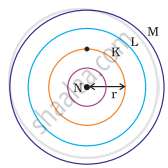
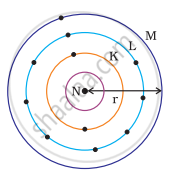
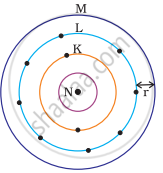
Arrange the following as per instruction given in the bracket.
Mg, Cl, Na, S, Si (decreasing order of atomic size)
Arrange the following in order of increasing radii:
Cl−, Cl
Explain your choice.
Which one has the largest size?
