Advertisements
Advertisements
प्रश्न
Write the name and symbol of the element from the description.
The atom having the smallest atomic mass.
Advertisements
उत्तर
Name: Hydrogen
Symbol: H
संबंधित प्रश्न
Arrange the elements of second and third periods in increasing order of their atomic size (excluding noble gases).
Why is the size of neon greater than fluorine?
Why is the size of sodium is greater than magnesium?
Which is greater in size an atom or a cation?
Size of atom progressively becomes smaller when we move from sodium (Na) to chlorine (CI) in the third period of the periodic table?
Fill in the blanks.
Size of the atoms ______ from left to right across a period and ______ on descending in a group of normal elements.
Arrange the following in increasing order of property indicated
I, I+, I- (atomic size)
The size of an atom is indicated by its ______.
While going from top to bottom in a group the atomic radius ______.
Write an explanation.
Atomic radius
The electronic configuration of metal A is 2, 8, 18, 1.
The metal A when exposed to air and moisture forms B a green layered compound. A with con. H2 SO4 forms C and D along with water. D is a gaseous compound. Find A, B, C, and D.
Which of the following is the correct order of size?
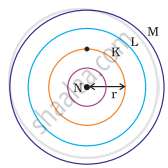
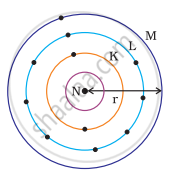
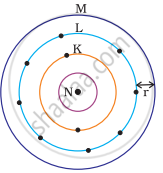
Which one of the following depict the correct representation of atomic radius(r) of an atom?
|
(i) |
(ii) |
|
(iii) |
(iv) |

Write the formula of the product formed when the element A (atomic number 19) combines with the element B (atomic number 17). Draw its electronic dot structure. What is the nature of the bond formed?
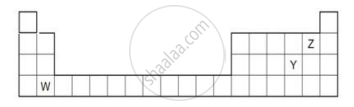
The diagram below shows part of the periodic table.
- Which elements would react together to form covalent compounds?
- Between the two elements W and Z, which will have a bigger atomic radius? Why?
Arrange the following as per the instruction given in the bracket:
Carbon, Fluorine, Beryllium (decreasing order of atomic size).
Arrange the following in order of increasing radii:
Cl−, Cl
Explain your choice.
Give reason for the following:
The size of a Cl− ion is greater than the size of a Cl atom.
