Advertisements
Advertisements
प्रश्न
Give reason for the following:
Argon atom is bigger than chlorine atom.
Advertisements
उत्तर
Since Argon has stable octet configuration, so due to the inter- electronic repulsions the effect of nuclear pull over the valence shell electrons cannot be seen which results in the bigger size.
APPEARS IN
संबंधित प्रश्न
Give the trends in atomic size on moving down the group.
Write the name and symbol of the element from the description.
The noble gas with the smallest atomic radius.
Give scientific reasons for the following:
Atomic radius goes on decreasing while going from left to right in a period.
The following questions refer to the Periodic Table.
What happens to the atomic size of elements moving from top to bottom of a group?
The changes in the properties of elements on moving from left to right across a period of the Periodic Table. For the property, choose the correct answer.
The atomic size:
Atomic radius is expressed in the unit ______.
Elements have been arranged in the following sequence on the basis of their increasing atomic masses.
| F, | Na, | Mg, | Al, | Si, | P, | S, | Cl, | Ar, | K |
- Pick two sets of elements which have similar properties.
- The given sequence represents which law of classification of elements?
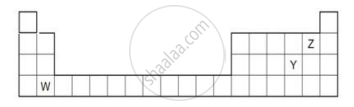
The diagram below shows part of the periodic table.
- Which elements would react together to form covalent compounds?
- Between the two elements W and Z, which will have a bigger atomic radius? Why?
Arrange the following in order of increasing radii:
Mg2+, Mg, Mg+
Explain your choice.
Which one of the following has the largest atomic radius?
