Advertisements
Advertisements
प्रश्न
Select the correct answer
Atomic radii of fluorine and neon in angstrom unit are
विकल्प
0.72, 13.6
1.60, 1.60
0.72, 0.72
none of these
Advertisements
उत्तर
0.72, 0.72
APPEARS IN
संबंधित प्रश्न
Arrange the following as per the instruction given in the brackets:
Na, K, Li (Increasing atomic size)
Answer the following in respect of element `31/15 P `
Is it a reducing agent or oxidizing agent?
Write the name and symbol of the element from the description.
The atom having the smallest atomic mass.
Among the elements of the second period, Li to Ne, pick out the element with the largest atomic size
Fill in the blanks.
Size of the atoms ______ from left to right across a period and ______ on descending in a group of normal elements.
On moving from left to right in a periodic table, the size of the atom ______.
Right or wrong sentence.
Nanometer unit is used to measure atomic radius.
Which of the following are the characteristics of isotopes of an element?
- Isotopes of an element have same atomic masses
- Isotopes of an element have same atomic number
- Isotopes of an element show same physical properties
- Isotopes of an element show same chemical properties
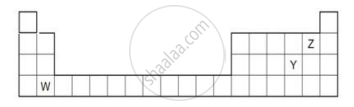
The diagram below shows part of the periodic table.
- Which elements would react together to form covalent compounds?
- Between the two elements W and Z, which will have a bigger atomic radius? Why?
Which one of the following has the largest atomic radius?
