Advertisements
Advertisements
प्रश्न
Write the name and symbol of the element from the description.
The noble gas with the smallest atomic radius.
Advertisements
उत्तर
Name: Helium
Symbol: He
संबंधित प्रश्न
What do you understand by atomic size? State its unit?
Which is greater in size an atom or an anion?
Size of atom progressively becomes smaller when we move from sodium (Na) to chlorine (CI) in the third period of the periodic table?
Give reason for the following:
Argon atom is bigger than chlorine atom.
Arrange the following in increasing order of property indicated
I, I+, I- (atomic size)
What happens to the atomic size of elements on moving from left to right in a period?
Atomic radius is expressed in the unit ______.
An element X has mass number 40 and contains 21 neutrons in its atom. To which group of the Periodic Table does it belong?
When an atom of iodine becomes an iodine ion (I–) the radius will ______
Which one of the following depict the correct representation of atomic radius(r) of an atom?
|
(i) |
(ii) |
|
(iii) |
(iv) |

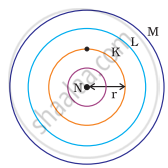
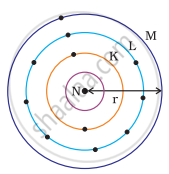
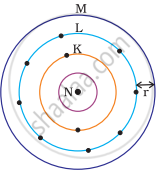
Elements have been arranged in the following sequence on the basis of their increasing atomic masses.
| F, | Na, | Mg, | Al, | Si, | P, | S, | Cl, | Ar, | K |
- Pick two sets of elements which have similar properties.
- The given sequence represents which law of classification of elements?
Write the formula of the product formed when the element A (atomic number 19) combines with the element B (atomic number 17). Draw its electronic dot structure. What is the nature of the bond formed?
Atomic number of a few elements are given below
10, 20, 7, 14
- Identify the elements
- Identify the Group number of these elements in the Periodic Table
- Identify the Periods of these elements in the Periodic Table
- What would be the electronic configuration for each of these elements?
- Determine the valency of these elements
- Electropositive nature of the element(s) increases down the group and decreases across the period
- Electronegativity of the element decreases down the group and increases across the period
- Atomic size increases down the group and decreases across a period (left to right)
- Metallic character increases down the group and decreases across a period.
On the basis of the above trends of the Periodic Table, answer the following about the elements with atomic numbers 3 to 9.
- Name the most electropositive element among them
- Name the most electronegative element
- Name the element with smallest atomic size
- Name the element which is a metalloid
- Name the element which shows maximum valency.
Arrange the following as per the instruction given in the bracket:
Carbon, Fluorine, Beryllium (decreasing order of atomic size).
Arrange the following in order of increasing radii:
Cl−, Cl
Explain your choice.
Arrange the following in order of increasing radii:
Mg2+, Mg, Mg+
Explain your choice.
Which one has the largest size?
Give reason for the following:
The size of a Cl− ion is greater than the size of a Cl atom.
This question refers to the elements of the Periodic Table with atomic numbers from 3 to 18. Some of the elements are shown by letters, but the letters are not the usual symbols of the elements.
| 3 | 4 | 5 | 6 | 7 | 8 | 9 | 10 |
| A | B | C | D | E | F | G | H |
| 11 | 12 | 13 | 14 | 15 | 16 | 17 | 18 |
| I | J | K | L | M | N | O | P |
Which of these have least atomic size in period 3?
