Advertisements
Advertisements
Question
The radius of the base of a cone is increasing at the rate of 3 cm/minute and the altitude is decreasing at the rate of 4 cm/minute. The rate of change of lateral surface when the radius = 7 cm and altitude 24 cm is
Options
54π cm2/min
7π cm2/min
27 cm2/min
none of these
Advertisements
Solution
\[\text { Let r be the radius, h be the height and S be the lateral surface area of the cone at any time t } .\]
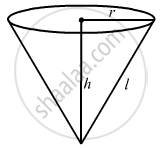
\[\text { Given }: \frac{dr}{dt} = 3 cm/\min\text { and } \frac{dh}{dt} = - 4 cm/\min\]
\[\text { Here }, \]
\[ l^2 = h^2 + r^2 \]
\[ \Rightarrow l = \sqrt{\left( 24 \right)^2 + \left( 7 \right)^2}\]
\[ \Rightarrow l = \sqrt{625}\]
\[ \Rightarrow l = 25\]
\[S=\pi rl\]
\[ \Rightarrow S^2 = \left( \pi rl \right)^2 \]
\[ \Rightarrow S^2 = \pi^2 r^2 \left( h^2 + r^2 \right)\]
\[ \Rightarrow S^2 = \pi^2 r^4 + \pi^2 h^2 r^2 \]
\[ \Rightarrow 2S\frac{dS}{dt} = 4 \pi^2 r^3 \frac{dr}{dt} + 2 \pi^2 r^2 h\frac{dh}{dt} + 2 \pi^2 h^2 r\frac{dr}{dt}\]
\[ \Rightarrow 2\pi rl\frac{dS}{dt} = 2 \pi^2 rh\left[ \frac{2 r^2}{h}\frac{dr}{dt} + r\frac{dh}{dt} + h\frac{dr}{dt} \right]\]
\[ \Rightarrow 25\frac{dS}{dt} = 24\pi\left[ \frac{2 \left( 7 \right)^2}{24} \times 3 - 7 \times 4 + 24 \times 3 \right] \left[ \text { Given }: r = 7, h = 24 \right]\]
\[ \Rightarrow 25\frac{dS}{dt} = 24\pi\left[ \frac{49}{4} - 28 + 72 \right]\]
\[ \Rightarrow 25\frac{dS}{dt} = 24\pi\left[ \frac{49 + 288 - 112}{4} \right]\]
\[ \Rightarrow \frac{dS}{dt} = 24\pi\left[ \frac{225}{100} \right]\]
\[ \Rightarrow \frac{dS}{dt} = 24\pi\left( 2 . 25 \right)\]
\[ \Rightarrow \frac{dS}{dt} = 54\pi \text{cm}^2 /\sec\]
APPEARS IN
RELATED QUESTIONS
The volume of a cube is increasing at the rate of 8 cm3/s. How fast is the surface area increasing when the length of an edge is 12 cm?
A stone is dropped into a quiet lake and waves move in circles at the speed of 5 cm/s. At the instant when the radius of the circular wave is 8 cm, how fast is the enclosed area increasing?
A balloon, which always remains spherical has a variable radius. Find the rate at which its volume is increasing with the radius when the later is 10 cm.
A particle moves along the curve 6y = x3 +2. Find the points on the curve at which the y-coordinate is changing 8 times as fast as the x-coordinate.
The total revenue in rupees received from the sale of x units of a product is given by R(x) = 13x2 + 26x + 15. Find the marginal revenue when x = 7.
The rate of change of the area of a circle with respect to its radius r at r = 6 cm is ______.
The volume of a sphere is increasing at the rate of 3 cubic centimeter per second. Find the rate of increase of its surface area, when the radius is 2 cm
Find the rate of change of the volume of a sphere with respect to its diameter ?
Find the rate of change of the area of a circle with respect to its radius r when r = 5 cm
A balloon in the form of a right circular cone surmounted by a hemisphere, having a diameter equal to the height of the cone, is being inflated. How fast is its volume changing with respect to its total height h, when h = 9 cm.
The volume of metal in a hollow sphere is constant. If the inner radius is increasing at the rate of 1 cm/sec, find the rate of increase of the outer radius when the radii are 4 cm and 8 cm respectively.
The volume of a cube is increasing at the rate of 9 cm3/sec. How fast is the surface area increasing when the length of an edge is 10 cm?
The volume of a spherical balloon is increasing at the rate of 25 cm3/sec. Find the rate of change of its surface area at the instant when radius is 5 cm ?
The side of a square is increasing at the rate of 0.1 cm/sec. Find the rate of increase of its perimeter ?
If the rate of change of volume of a sphere is equal to the rate of change of its radius, find the radius of the sphere ?
A cylindrical vessel of radius 0.5 m is filled with oil at the rate of 0.25 π m3/minute. The rate at which the surface of the oil is rising, is
The distance moved by the particle in time t is given by x = t3 − 12t2 + 6t + 8. At the instant when its acceleration is zero, the velocity is
The distance moved by a particle travelling in straight line in t seconds is given by s = 45t + 11t2 − t3. The time taken by the particle to come to rest is
Each side of an equilateral triangle is increasing at the rate of 8 cm/hr. The rate of increase of its area when side is 2 cm, is
The radius of a circular plate is increasing at the rate of 0.01 cm/sec. The rate of increase of its area when the radius is 12 cm, is
The diameter of a circle is increasing at the rate of 1 cm/sec. When its radius is π, the rate of increase of its area is
A man of height 6 ft walks at a uniform speed of 9 ft/sec from a lamp fixed at 15 ft height. The length of his shadow is increasing at the rate of
A cylindrical tank of radius 10 m is being filled with wheat at the rate of 314 cubic metre per hour. Then the depth of the wheat is increasing at the rate of
Find the rate of change of the area of a circle with respect to its radius r when r = 4 cm.
If the area of a circle increases at a uniform rate, then prove that perimeter varies inversely as the radius
Two men A and B start with velocities v at the same time from the junction of two roads inclined at 45° to each other. If they travel by different roads, find the rate at which they are being seperated.
The volume of a cube increases at a constant rate. Prove that the increase in its surface area varies inversely as the length of the side
Total revenue in rupees received from the sale of x units of a product is given by R(x)= 3x2+ 36x + 5. The marginal revenue, when x = 15 is ____________.
If the rate of change of volume of a sphere is equal to the rate of change of its radius then the surface area of a sphere is ____________.
A cylindrical tank of radius 10 feet is being filled with wheat at the rate of 3/4 cubic feet per minute. The then depth of the wheat is increasing at the rate of
A man 1.6 m tall walks at the rate of 0.3 m/sec away from a street light that is 4 m above the ground. At what rate is the tip of his shadow moving? At what rate is his shadow lengthening?
A spherical balloon is filled with 4500π cubic meters of helium gas. If a leak in the balloon causes the gas to escape at the rate of 72π cubic meters per minute, then the rate (in meters per minute) at which the radius of the balloon decreases 49 minutes after the leakage began is ______.
An edge of a variable cube is increasing at the rate of 10 cm/sec. How fast will the volume of the cube increase if the edge is 5 cm long?
What does a negative derivative mean for a quantity?
When should a given value be substituted while finding a rate of change?
