Advertisements
Advertisements
प्रश्न
The radius of the base of a cone is increasing at the rate of 3 cm/minute and the altitude is decreasing at the rate of 4 cm/minute. The rate of change of lateral surface when the radius = 7 cm and altitude 24 cm is
पर्याय
54π cm2/min
7π cm2/min
27 cm2/min
none of these
Advertisements
उत्तर
\[\text { Let r be the radius, h be the height and S be the lateral surface area of the cone at any time t } .\]
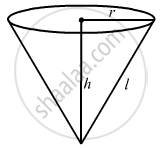
\[\text { Given }: \frac{dr}{dt} = 3 cm/\min\text { and } \frac{dh}{dt} = - 4 cm/\min\]
\[\text { Here }, \]
\[ l^2 = h^2 + r^2 \]
\[ \Rightarrow l = \sqrt{\left( 24 \right)^2 + \left( 7 \right)^2}\]
\[ \Rightarrow l = \sqrt{625}\]
\[ \Rightarrow l = 25\]
\[S=\pi rl\]
\[ \Rightarrow S^2 = \left( \pi rl \right)^2 \]
\[ \Rightarrow S^2 = \pi^2 r^2 \left( h^2 + r^2 \right)\]
\[ \Rightarrow S^2 = \pi^2 r^4 + \pi^2 h^2 r^2 \]
\[ \Rightarrow 2S\frac{dS}{dt} = 4 \pi^2 r^3 \frac{dr}{dt} + 2 \pi^2 r^2 h\frac{dh}{dt} + 2 \pi^2 h^2 r\frac{dr}{dt}\]
\[ \Rightarrow 2\pi rl\frac{dS}{dt} = 2 \pi^2 rh\left[ \frac{2 r^2}{h}\frac{dr}{dt} + r\frac{dh}{dt} + h\frac{dr}{dt} \right]\]
\[ \Rightarrow 25\frac{dS}{dt} = 24\pi\left[ \frac{2 \left( 7 \right)^2}{24} \times 3 - 7 \times 4 + 24 \times 3 \right] \left[ \text { Given }: r = 7, h = 24 \right]\]
\[ \Rightarrow 25\frac{dS}{dt} = 24\pi\left[ \frac{49}{4} - 28 + 72 \right]\]
\[ \Rightarrow 25\frac{dS}{dt} = 24\pi\left[ \frac{49 + 288 - 112}{4} \right]\]
\[ \Rightarrow \frac{dS}{dt} = 24\pi\left[ \frac{225}{100} \right]\]
\[ \Rightarrow \frac{dS}{dt} = 24\pi\left( 2 . 25 \right)\]
\[ \Rightarrow \frac{dS}{dt} = 54\pi \text{cm}^2 /\sec\]
APPEARS IN
संबंधित प्रश्न
If y = f (u) is a differential function of u and u = g(x) is a differential function of x, then prove that y = f [g(x)] is a differential function of x and `dy/dx=dy/(du) xx (du)/dx`
The volume of a cube is increasing at the rate of 8 cm3/s. How fast is the surface area increasing when the length of an edge is 12 cm?
The radius of a circle is increasing at the rate of 0.7 cm/s. What is the rate of increase of its circumference?
A balloon, which always remains spherical on inflation, is being inflated by pumping in 900 cubic centimetres of gas per second. Find the rate at which the radius of the balloon increases when the radius is 15 cm.
The volume of a sphere is increasing at the rate of 8 cm3/s. Find the rate at which its surface area is increasing when the radius of the sphere is 12 cm.
The volume of a sphere is increasing at the rate of 3 cubic centimeter per second. Find the rate of increase of its surface area, when the radius is 2 cm
Find the rate of change of the total surface area of a cylinder of radius r and height h, when the radius varies?
Find the rate of change of the area of a circle with respect to its radius r when r = 5 cm
The total revenue received from the sale of x units of a product is given by R (x) = 13x2 + 26x + 15. Find the marginal revenue when x = 7 ?
The radius of a spherical soap bubble is increasing at the rate of 0.2 cm/sec. Find the rate of increase of its surface area, when the radius is 7 cm.
A balloon which always remains spherical, is being inflated by pumping in 900 cubic centimetres of gas per second. Find the rate at which the radius of the balloon is increasing when the radius is 15 cm.
A man 2 metres high walks at a uniform speed of 5 km/hr away from a lamp-post 6 metres high. Find the rate at which the length of his shadow increases.
A man 180 cm tall walks at a rate of 2 m/sec. away, from a source of light that is 9 m above the ground. How fast is the length of his shadow increasing when he is 3 m away from the base of light?
A particle moves along the curve y = (2/3)x3 + 1. Find the points on the curve at which the y-coordinate is changing twice as fast as the x-coordinate ?
The side of a square is increasing at the rate of 0.1 cm/sec. Find the rate of increase of its perimeter ?
If the rate of change of volume of a sphere is equal to the rate of change of its radius, find the radius of the sphere ?
A ladder, 5 metre long, standing on a horizontal floor, leans against a vertical wall. If the top of the ladder slides down wards at the rate of 10 cm/sec, then find the rate at which the angle between the floor and ladder is decreasing when lower end of ladder is 2 metres from the wall ?
The coordinates of the point on the ellipse 16x2 + 9y2 = 400 where the ordinate decreases at the same rate at which the abscissa increases, are
The volume of a sphere is increasing at 3 cm3/sec. The rate at which the radius increases when radius is 2 cm, is
The distance moved by a particle travelling in straight line in t seconds is given by s = 45t + 11t2 − t3. The time taken by the particle to come to rest is
If the rate of change of area of a circle is equal to the rate of change of its diameter, then its radius is equal to
The diameter of a circle is increasing at the rate of 1 cm/sec. When its radius is π, the rate of increase of its area is
For the curve y = 5x – 2x3, if x increases at the rate of 2 units/sec, then how fast is the slope of curve changing when x = 3?
The rate of change of volume of a sphere with respect to its surface area, when the radius is 2 cm, is ______.
The radius of a cylinder is increasing at the rate of 3 m/s and its height is decreasing at the rate of 4 m/s. The rate of change of volume when the radius is 4 m and height is 6 m, is ____________.
If the rate of change of the area of the circle is equal to the rate of change of its diameter then its radius is equal to ____________.
Let y = f(x) be a function. If the change in one quantity 'y’ varies with another quantity x, then which of the following denote the rate of change of y with respect to x.
What is the rate of change of the area of a circle with respect to its radius when, r = 3 cm
A cylindrical tank of radius 10 feet is being filled with wheat at the rate of 3/4 cubic feet per minute. The then depth of the wheat is increasing at the rate of
A man 1.6 m tall walks at the rate of 0.3 m/sec away from a street light that is 4 m above the ground. At what rate is the tip of his shadow moving? At what rate is his shadow lengthening?
If the circumference of circle is increasing at the constant rate, prove that rate of change of area of circle is directly proportional to its radius.
An edge of a variable cube is increasing at the rate of 10 cm/sec. How fast will the volume of the cube increase if the edge is 5 cm long?
If a quantity \(y\) varies with another quantity \(x\) based on the rule \(y=f(x)\), which expression represents the rate of change of \(y\) with respect to \(x\)?
When \(x\) and \(y\) both vary with respect to \(t\), which formula gives the rate of change of \(y\) with respect to \(x\)?
For \[A=\pi r^2\], what is the rate of change of area with respect to radius when \[r=5\] cm?
Which procedure is used in related rates?
