Advertisements
Advertisements
Question
Discuss the following statement in groups of two pairs, each pair in a group taking opposite points of view.
The story is called ‘The Adventure’. Compare it with the adventure described in ‘We’re Not Afraid to Die...’
Advertisements
Solution
The story is called "The Adventure" Compare it to the adventure described in "We Are Not Afraid to Die." The underlying theme of both the stories, "The Adventure" and "We Are Not Afraid. to Die" is the same. However, the execution is very different. One deals with the adventure in a real life situation and the other one is about the adventure that was mentally experienced. In the story, "We Are Not Afraid to Die", the characters take a hazardous sea voyage, to overcome the odds and survive. Whatever the dangers were, they were very real. In the story, The Adventure", the protagonist does not embark upon an adventurous journey. His collision with the truck triggers his mind to travel to a world, which is different from the world that he lives in.
APPEARS IN
RELATED QUESTIONS
B1. What does the poet want us to do in the following situation?
(a) While struggling ………..
(b) While making money ………
(c) While dreaming ………………
(d) While losing …………..
It's doing your job the best you can,
And being just to your fellow man;
It's making money-but holding friends,
And being true to your aims and ends.
It's figuring how and learning why,
And looking forward and thinking high;
And dreaming a little and doing much,
It's keeping always in closest touch.
With what is finest in word and deed,
It's being through, yet making speed;
It's daring blithely the field of chance,
While making labour a brave romance.
It’s going onward despite defeat
And fighting staunchly, but keeping sweet;
It's struggling on with the will to win,
But taking loss with a cheerful grin.
B2. Achieving Success
Hints given by the poet to become successful are
(a) Doing your job the best
(b)
(c)
(d)
(e)
B3. Poetic Device
Select the appropriate rhyme scheme for the 3rd stanza.
(1) abab
(2) aabb
(3) aaba
Maggu’s achievements are particularly noteworthy because – as is well known – academic institutions in India are less than sold on the idea of inclusive education. In fact, when Maggu lost her sight in class IV, her school (which she declines to name) expelled her while suggesting she attend a “blind school”. Though shocked, Maggu rejected the advice. “Attending a special school would have tarred me with a handicap forever, which was not how I saw my future. Therefore I did the rounds of other public schools with my father, a small – time merchant, explaining that my case was different Since I had vision till the age of ten,” she recalls.
Impressed by her persistence and ambition, Delhi’s Bluebells School not only admitted her but pulled out all the stops to support her in academics sporting events and also notched up a respectable 73 percent average in the class XII exam with the help of Braille, interactive textbooks and extra coaching.
The respectable average in her CBSE exam paved the way for admission into LSR where again she proved her mettle by winning medals in a slew of inter – collage events (100 200 and 400 metre sprints) high jump, long jump, javelin and discuss throw: resulting in her being declared ‘Athlete of the year’ 2003’ at a sports meet for 100 physically challenged athletes. And the cherry on the cake was the selection to the IBSA Games last year. “It was a tough regimen,” recalls Maggu. “I had to attend sports camps manage my studies and officiates as sports president. But I managed.”
Questions:
(1) What qualities of Maggu are highlighted in this passage?
(2) Why did Maggu refuse to attend a ‘blind school’?
(3) Quote the lines that show that Jyoti Maggu was good in academics as well as in sports.
(4) Use any two phrases in sentences of your own :
(a) To win laurels
(b) To pave the way
(c) To prove one’s mettle
(d) A tough regimen
(5)
(a) I did the rounds of other public schools with my father [Change the voice]
(b) though shocked Maggu rejected the advice [Rewrite as a simple sentence]
(6) Should the physically challenged be sent to special schools? Express your views.
Attempt a character sketch of Mrs. Hall.
Answer the following question in 200-250 words:
"The best and most beautiful things in the world can't be seen or even touched. They must be felt with the heart." Justify the famous quote of Helen Keller.
Answer the following question in 150-200 words:
Why did Anne like her father more than she liked her mother?
Identify the phrases and lines that indicate distance between father and son.
Tick the item that is closest in meaning to the following phrase.
to meet one's match
This play, written in the 1950s, is a humorous and satirical depiction of the status of the mother in the family.
What are the issues it raises?
How does the insertion of dialogue in the story contribute to its interest?
We 'draw up a deed'. Complete the following phrase with an appropriate word.
________ends meet
Although Paul's mother liked to be rich she did not approve of betting on horses.
Identify some of the improbable images the author has used to effect greater humour.
How do the patterns of creativity displayed by scientists differ from those displayed by poets?
How does the poem capture the elusive nature of the peacock?
The peacock is the national bird of India. Why do you think the peacock has been chosen?
Give a brief account of the interaction between Grandpa and Jo.
Read the poem and fill in the table.
| Time of the day | Location | Poet’s Activity | Hawker’s Activities | Gardener’s Activities | Watchman’s Activities |
| Morning | __________ | __________ | __________ | __________ | __________ |
| Afternoon | __________ | __________ | __________ | __________ | __________ |
| Night | __________ | __________ | __________ | __________ | __________ |
Using a dictionary/internet note down the main difference between self-reliant and self-assured.
Imagine that you are the peasant. Compose a short prayer to God, after having received the plate of gold. Write it using stylish handwriting.
Read the story and choose the appropriate meaning.
Wielded the brush ____________.
Find out from a vet or from a website, what precaution a vet has to take when he/she is called to treat wild, dangerous animals?
Make point-wise notes of the same.
Do you have a pet?
Go through the poem and state whether the following statement is true or false.
Planners make tactful changes so that citizens do not recognize familiar landmarks.
Form pairs. Make a list of as many games as you can. (At least 25) Then classify the games using the following criteria:
- Indoor and outdoor games.
- Games played with and without any equipment.
- Games which have one-to-one matches and those in which teams play against each other (Single-player or team)
- Games played mostly by children and games played by adult players.
- Shape and size of the court or field.
Use the following figures to show your classification.
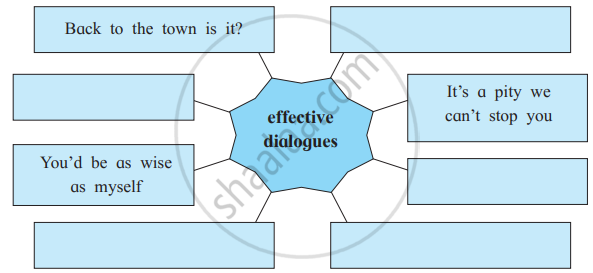
There are some dialogues that are short, but quite effective. They give us enjoyment and add beauty to the main story. Find some more from the text.
Comment on the versatility and the aptness of the stage settings, as per the requirement of the play “A Midsummer-Night’s Dream!”
Enact the advertisement:
Seven children wait in different places, striking a suitable pose as shown in the ad. The character ‘Krispy Krunchy’ comes in dancing. He goes near every child, singing the words shown in the ad. He offers a Krispy Krunchy piece to every child.
The child eats it and begins to smile and clap. At the end, the character faces the class, shows a big pack of Krispy Krunchy, and presents the last few lines.
Does the traveller really have a magic stone?
Find, in your science textbook, the topics of the stalls handled by students of VI A.
(Write the page number.)
Complete the following sentence with reference to the passage:
To this day, we venerate this tree as ____________.
Draw word webs for the following. Begin with the given word and go on writing as many other words associated with it, as you can. Use these words to write other related words to form a word web.

Read the following.
- I mean what I say. I say what I mean.
- I see what I eat. I eat what I see.
Use your imagination to write a funny sentence on this pattern.
Talk about your strengths.
Prepare similar word chains using the following ideas.
size - big _______________.
Answer the following question and write in short, why the parody sounds funny.
Why does the bee work hour after hour?
Write in your own words.
How does the poet describe his home in the second stanza?
What message does the poet wish to convey through this narrative poem, ‘Tansen’?
Form groups of 5-8 and list the following.
Bad habits
How did Miranda feel when her father raised the storm to destroy the ship?
Read the story again and write how these character reacted in these situation:
You are an absolute treasure…………. Dr.Krishnan………………..
Zigzag………………………..
What was Mrs. Krishnan busy with?
Answer the following question based on the reading of the story. Do not forget to go back to the passage whenever necessary to find and confirm the answer.
| Action | Effect |
| While you warm yourself | I will prepare the best tea. |
| I saved enough money | |
| Six hundred and two villages were destroyed. | |
| It was a terrible earthquake and it was felt | |
| I ran back to the village | |
| They lifted the door | |
| I went to thank the Army Officer |
How did Hamid’s friends enjoy the games in the fair?
Pick out the words which rhyme with the given words and write similar rhyming words on your own.
| 1. | far | ||
| 2. | fear | ||
| 3. | low | ||
| 4. | kind | ||
| 5. | remain | ||
| 6. | they |
Identify the character/speaker.
I must find out why he's in such a hurry!
Olive Ridleys are the only sea turtles seen on Indian shores.
Identify the speaker/character.
"Don't let us down now, Gulliver; we need your help."
Nilavan unknowingly started the space shuttle.
Read scene I of the play carefully and answer the question below.
Match the following.
| Sr.No. | CHARACTER | TRAIT |
| a. | Father Wolf | with a grey nose…feeds her four cubs |
| b. | Tabaqui | the big one from Waingunga River with a lame foot |
| c. | Mother Wolf | the chief of the Wolves |
| d. | Shere Khan | begs for meat and thanks for the meal/warns the wolves about the arrival of Shere Khan |
What did Anitha eat in the expo?
Identify the character/speaker.
"Grow the fish at home, Anbu."
Does the poet want diversity? why?
When do you feel proud?
What should we do for success?
Why is your nose important for you?
When should we not water the plants?
How did the animals know that the king was just a jackal?
On the basis of your understanding of the given passage, make notes in any appropriate format.
The Sherpas were nomadic people who first migrated from Tibet approximately 600 years ago, through the Nangpa La pass and settled in the Solukhumbu District, Nepal. These nomadic people then gradually moved westward along salt trade routes. During 14th century, Sherpa ancestors migrated from Kham. The group of people from the Kham region, east of Tibet, was called “Shyar Khamba”. The inhabitants of Shyar Khamba, were called Sherpa. Sherpa migrants travelled through Ü and Tsang, before crossing the Himalayas. According to Sherpa oral history, four groups migrated out of Solukhumbu at different times, giving rise to the four fundamental Sherpa clans: Minyagpa, Thimmi, Sertawa and Chawa. These four groups have since split into the more than 20 different clans that exist today
Sherpas had little contact with the world beyond the mountains and they spoke their own language. AngDawa, a 76-year-old former mountaineer recalled “My first expedition was to Makalu [the world’s fifth highest mountain] with Sir Edmund Hillary’’. We were not allowed to go to the top. We wore leather boots that got really heavy when wet, and we only got a little salary, but we danced the Sherpa dance, and we were able to buy firewood and make campfires, and we spent a lot of the time dancing and singing and drinking. Today Sherpas get good pay and good equipment, but they don’t have good entertainment. My one regret is that I never got to the top of Everest. I got to the South Summit, but I never got a chance to go for the top.
The transformation began when the Sherpa Tenzing Norgay and the New Zealander Edmund Hillary scaled Everest in 1953. Edmund Hillary took efforts to build schools and health clinics to raise the living standards of the Sherpas. Thus life in Khumbu improved due to the efforts taken by Edmund Hillary and hence he was known as ‘Sherpa King’.
Sherpas working on the Everest generally tend to perish one by one, casualties of crevasse falls, avalanches, and altitude sickness. Some have simply disappeared on the mountain, never to be seen again. Apart from the bad seasons in 1922, 1970 and 2014 they do not die en masse. Sherpas carry the heaviest loads and pay the highest prices on the world’s tallest mountain. In some ways, Sherpas have benefited from the commercialization of the Everest more than any group, earning income from thousands of climbers and trekkers drawn to the mountain. While interest in climbing Everest grew gradually over the decades after the first ascent, it wasn’t until the 1990s that the economic motives of commercial guiding on Everest began. This leads to eclipse the amateur impetus of traditional mountaineering. Climbers looked after each other for the love of adventure and “the brotherhood of the rope” now are tending to mountain businesses. Sherpas have taken up jobs as guides to look after clients for a salary. Commercial guiding agencies promised any reasonably fit person a shot at Everest.
Pick out word which mean the same as
stop doing something (para 1)
Enact any one anecdote in the classroom.
