Advertisements
Advertisements
Question
Right or wrong sentence.
The size of an atom depends on the number of valence electrons.
Options
Right
Wrong
Advertisements
Solution
The given sentence is wrong.
Explanation:
Atomic size is determined mainly by the principal quantum number (which shell the valence electrons occupy) and by effective nuclear charge and shielding, not simply the count of valence electrons. Atoms down a group get a new shell, so size increases, while across a period, added electrons stay in the same shell, but higher nuclear charge pulls them closer, so size decreases.
RELATED QUESTIONS
Answer the following in respect of element `31/15 P `
Is it a reducing agent or oxidizing agent?
Answer the following in respect of element `31/15 P `
Give its formula with chlorine?
What do you understand by atomic size? State its unit?
Give the trends in atomic size on moving across the period left to right.
Why is the size of sodium is greater than magnesium?
Arrange the following in order of increasing radii:
CI- , CI
Give scientific reasons for the following:
Atomic radius goes on decreasing while going from left to right in a period.
Select the correct answer
Atomic radii of fluorine and neon in angstrom unit are
The changes in the properties of elements on moving from left to right across a period of the Periodic Table. For the property, choose the correct answer.
The atomic size:
While going from top to bottom in a group the atomic radius ______.
Write scientific reason.
In same period, boron and oxygen elements have different atomic size.
Some elements and their atomic radii are given here. Arrange them in decreasing order of their atomic radii. Identify which of the above elements is the biggest atom and which is smallest?
| Element | K | Na | Rb | Cs | Li |
| Atomic radius (pm) | 231 | 186 | 244 | 262 | 151 |
Carbon belongs to the second period and Group 14. Silicon belongs to the third period and Group 14. If the atomic number of carbon is 6, the atomic number of silicon is ______
Which of the following is the correct order of atomic size?
Which of the following is the correct order of atomic size?
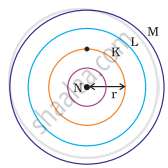
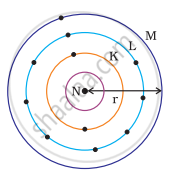
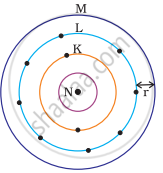
Which one of the following depict the correct representation of atomic radius(r) of an atom?
|
(i) |
(ii) |
|
(iii) |
(iv) |

Elements have been arranged in the following sequence on the basis of their increasing atomic masses.
| F, | Na, | Mg, | Al, | Si, | P, | S, | Cl, | Ar, | K |
- Pick two sets of elements which have similar properties.
- The given sequence represents which law of classification of elements?
Arrange the following as per instruction given in the bracket.
Mg, Cl, Na, S, Si (decreasing order of atomic size)
In Period 3 of the Periodic Table, element B is placed to the left of element A. On the basis of this information, choose the correct word from the option to complete the following statement:
The element A would have ______ atomic size than B.
Which one has the largest size?
