Advertisements
Advertisements
प्रश्न
Right or wrong sentence.
The size of an atom depends on the number of valence electrons.
पर्याय
Right
Wrong
Advertisements
उत्तर
The given sentence is wrong.
Explanation:
Atomic size is determined mainly by the principal quantum number (which shell the valence electrons occupy) and by effective nuclear charge and shielding, not simply the count of valence electrons. Atoms down a group get a new shell, so size increases, while across a period, added electrons stay in the same shell, but higher nuclear charge pulls them closer, so size decreases.
संबंधित प्रश्न
Answer the following in respect of element `31/15 P`
Give its electronic configuration
Give the trends in atomic size on moving down the group.
Write the name and symbol of the element from the description.
The atom having the smallest atomic mass.
Study the radius of the element given below and answer the following questions.
| elements | K | Na | Rb | Cs | Li |
| Atomic radius (pm) | 231 | 186 | 244 | 262 | 151 |
a) Which of the above elements have the smallest atom?
b) In which group of the modern periodic table the above element are belongs?
c) What is the periodic trend observed in the variation of atomic radii down a group?
Among the elements of the second period, Li to Ne, pick out the element with the largest atomic size
Arrange the following as per the instruction given in the bracket
Na, K, Li (Increasing atomic size)
Right or wrong sentence.
Nanometer unit is used to measure atomic radius.
Write an explanation.
Atomic radius
Which of the following is the correct order of atomic size?
Which one of the following depict the correct representation of atomic radius(r) of an atom?
|
(i) |
(ii) |
|
(iii) |
(iv) |

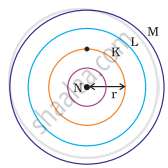
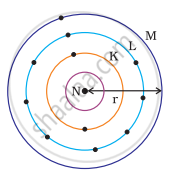
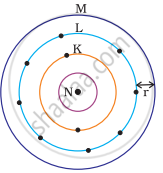
Arrange the following elements in increasing order of their atomic radii.
- Li, Be, F, N
- Cl, At, Br I
Write the formula of the product formed when the element A (atomic number 19) combines with the element B (atomic number 17). Draw its electronic dot structure. What is the nature of the bond formed?
An element X (atomic number 17) reacts with an element Y (atomic number 20) to form a divalent halide.
- Where in the periodic table are elements X and Y placed?
- Classify X and Y as metal (s), non-metal (s) or metalloid (s)
- What will be the nature of oxide of element Y? Identify the nature of bonding in the compound formed
- Draw the electron dot structure of the divalent halide
- In below ladder symbols of elements are jumbled up. Rearrange these symbols of elements in the increasing order of their atomic number in the Periodic Table.
- Arrange them in the order of their group also.
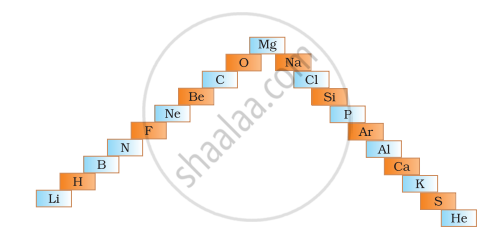
Arrange the following as per instruction given in the bracket.
Mg, Cl, Na, S, Si (decreasing order of atomic size)
Arrange the following in order of increasing radii:
N, O, P
Explain your choice.
Which one has the largest size?
