Advertisements
Advertisements
प्रश्न
Arrange the following in order of increasing radii:
N, O, P
Explain your choice.
Advertisements
उत्तर
O < N < P
Explanation:
N(7) = 2, 5; O(8) = 2, 6; P(15) = 2, 8, 5
Radius of oxygen < Radius of Nitrogen where as phosphorus has three shells.
APPEARS IN
संबंधित प्रश्न
Arrange the following as per the instruction given in the brackets:
Na, K, Li (Increasing atomic size)
Why is the size of neon greater than fluorine?
Write the name and symbol of the element from the description.
The atom having the smallest atomic mass.
What happens to the atomic size of elements on moving from left to right in a period?
The following questions refer to the Periodic Table.
What happens to the atomic size of elements moving from top to bottom of a group?
The changes in the properties of elements on moving from left to right across a period of the Periodic Table. For the property, choose the correct answer.
The atomic size:
- In below ladder symbols of elements are jumbled up. Rearrange these symbols of elements in the increasing order of their atomic number in the Periodic Table.
- Arrange them in the order of their group also.
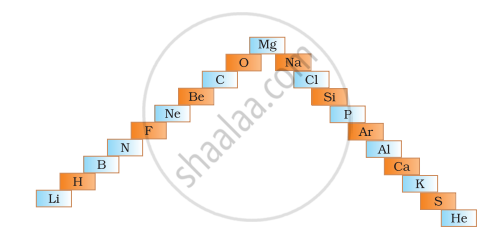
- Electropositive nature of the element(s) increases down the group and decreases across the period
- Electronegativity of the element decreases down the group and increases across the period
- Atomic size increases down the group and decreases across a period (left to right)
- Metallic character increases down the group and decreases across a period.
On the basis of the above trends of the Periodic Table, answer the following about the elements with atomic numbers 3 to 9.
- Name the most electropositive element among them
- Name the most electronegative element
- Name the element with smallest atomic size
- Name the element which is a metalloid
- Name the element which shows maximum valency.
In Period 3 of the Periodic Table, element B is placed to the left of element A. On the basis of this information, choose the correct word from the option to complete the following statement:
The element A would have ______ atomic size than B.
Which one of the following has the largest atomic radius?
