Advertisements
Advertisements
प्रश्न
Study the radius of the element given below and answer the following questions.
| elements | K | Na | Rb | Cs | Li |
| Atomic radius (pm) | 231 | 186 | 244 | 262 | 151 |
a) Which of the above elements have the smallest atom?
b) In which group of the modern periodic table the above element are belongs?
c) What is the periodic trend observed in the variation of atomic radii down a group?
Advertisements
उत्तर
a) Li
b) first group
c) while going down a group atomic radius goes on increasing. As a result, atomic size increases.
APPEARS IN
संबंधित प्रश्न
Arrange the following as per the instruction given in the bracket:
Mg, Cl, Na, S, Si (decreasing order of atomic size).
Answer the following in respect of element `31/15 P `
Is it a reducing agent or oxidizing agent?
Which is greater in size an atom or a cation?
Which is greater in size Fe2+ or Fe3+?
Give reasons for the following:
The size of the anion is greater than the size of the parent atom.
Write the name and symbol of the element from the description.
The atom having the smallest atomic mass.
Select the correct answer
Atomic radii of fluorine and neon in angstrom unit are
The following questions refer to the Periodic Table.
What happens to the atomic size of elements moving from top to bottom of a group?
_______ is the distance between the nucleus of the atom and its outermost shell.
Right or wrong sentence.
Nanometer unit is used to measure atomic radius.
Write an explanation.
Atomic radius
Some elements and their atomic radii are given here. Arrange them in decreasing order of their atomic radii. Identify which of the above elements is the biggest atom and which is smallest?
| Element | K | Na | Rb | Cs | Li |
| Atomic radius (pm) | 231 | 186 | 244 | 262 | 151 |
Which among the following elements has the largest atomic radii?
Elements have been arranged in the following sequence on the basis of their increasing atomic masses.
| F, | Na, | Mg, | Al, | Si, | P, | S, | Cl, | Ar, | K |
- Pick two sets of elements which have similar properties.
- The given sequence represents which law of classification of elements?
Arrange the following elements in increasing order of their atomic radii.
- Li, Be, F, N
- Cl, At, Br I
Write the formula of the product formed when the element A (atomic number 19) combines with the element B (atomic number 17). Draw its electronic dot structure. What is the nature of the bond formed?
Atomic number of a few elements are given below
10, 20, 7, 14
- Identify the elements
- Identify the Group number of these elements in the Periodic Table
- Identify the Periods of these elements in the Periodic Table
- What would be the electronic configuration for each of these elements?
- Determine the valency of these elements
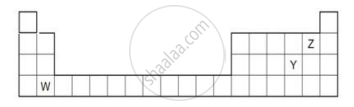
The diagram below shows part of the periodic table.
- Which elements would react together to form covalent compounds?
- Between the two elements W and Z, which will have a bigger atomic radius? Why?
Arrange the following in order of increasing radii:
N, O, P
Explain your choice.
