Advertisements
Advertisements
प्रश्न
Study the radius of the element given below and answer the following questions.
| elements | K | Na | Rb | Cs | Li |
| Atomic radius (pm) | 231 | 186 | 244 | 262 | 151 |
a) Which of the above elements have the smallest atom?
b) In which group of the modern periodic table the above element are belongs?
c) What is the periodic trend observed in the variation of atomic radii down a group?
Advertisements
उत्तर
a) Li
b) first group
c) while going down a group atomic radius goes on increasing. As a result, atomic size increases.
APPEARS IN
संबंधित प्रश्न
Arrange the following as per the instruction given in the bracket:
Mg, Cl, Na, S, Si (decreasing order of atomic size).
What do you understand by atomic size? State its unit?
Size of atom progressively becomes smaller when we move from sodium (Na) to chlorine (CI) in the third period of the periodic table?
Give reasons for the following:
The size of the anion is greater than the size of the parent atom.
Write the name and symbol of the element from the description.
The noble gas with the smallest atomic radius.
The following questions refer to the Periodic Table.
What happens to the atomic size of elements moving from top to bottom of a group?
_______ is the distance between the nucleus of the atom and its outermost shell.
While going from top to bottom in a group the atomic radius ______.
Right or wrong sentence.
Nanometer unit is used to measure atomic radius.
Right or wrong sentence.
The size of an atom depends on the number of valence electrons.
Write an explanation.
Atomic radius
Write scientific reason.
In same period, boron and oxygen elements have different atomic size.
An element X has mass number 40 and contains 21 neutrons in its atom. To which group of the Periodic Table does it belong?
Arrange the following elements in increasing order of their atomic radii.
- Li, Be, F, N
- Cl, At, Br I
Write the formula of the product formed when the element A (atomic number 19) combines with the element B (atomic number 17). Draw its electronic dot structure. What is the nature of the bond formed?
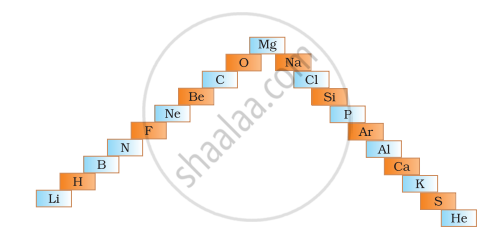
- In below ladder symbols of elements are jumbled up. Rearrange these symbols of elements in the increasing order of their atomic number in the Periodic Table.
- Arrange them in the order of their group also.
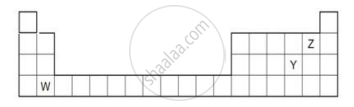
The diagram below shows part of the periodic table.
- Which elements would react together to form covalent compounds?
- Between the two elements W and Z, which will have a bigger atomic radius? Why?
Arrange the following in order of increasing radii:
N, O, P
Explain your choice.
This question refers to the elements of the Periodic Table with atomic numbers from 3 to 18. Some of the elements are shown by letters, but the letters are not the usual symbols of the elements.
| 3 | 4 | 5 | 6 | 7 | 8 | 9 | 10 |
| A | B | C | D | E | F | G | H |
| 11 | 12 | 13 | 14 | 15 | 16 | 17 | 18 |
| I | J | K | L | M | N | O | P |
Which of these have least atomic size in period 3?
