Advertisements
Advertisements
प्रश्न
Arrange the following in order of increasing radii:
Cl−, Cl
Explain your choice.
Advertisements
उत्तर
Cl < Cl−
Explanation:
The radius of an anion is more than the parent atom.
APPEARS IN
संबंधित प्रश्न
Which is greater in size an atom or a cation?
Give reasons for the following:
The size of the anion is greater than the size of the parent atom.
Arrange the following in order of increasing radii:
CI- , CI
Fill in the blank by selecting the correct word from the bracket.
If an element has seven electrons in its outermost shell then it is likely to have the _____ atomic size among all the elements in the same period.
Right or wrong sentence.
Nanometer unit is used to measure atomic radius.
An element X has mass number 40 and contains 21 neutrons in its atom. To which group of the Periodic Table does it belong?
Which of the following is the correct order of size?
An element X (atomic number 17) reacts with an element Y (atomic number 20) to form a divalent halide.
- Where in the periodic table are elements X and Y placed?
- Classify X and Y as metal (s), non-metal (s) or metalloid (s)
- What will be the nature of oxide of element Y? Identify the nature of bonding in the compound formed
- Draw the electron dot structure of the divalent halide
Atomic number of a few elements are given below
10, 20, 7, 14
- Identify the elements
- Identify the Group number of these elements in the Periodic Table
- Identify the Periods of these elements in the Periodic Table
- What would be the electronic configuration for each of these elements?
- Determine the valency of these elements
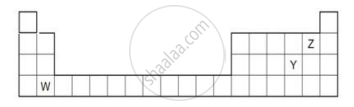
The diagram below shows part of the periodic table.
- Which elements would react together to form covalent compounds?
- Between the two elements W and Z, which will have a bigger atomic radius? Why?