Advertisements
Advertisements
प्रश्न
Write a scientific reason.
Atomic radius goes on increasing down a group.
Give scientific reasons:
Atomic radius goes on increasing down the ‘group’.
Advertisements
उत्तर
- Atomic radius increases as we move from top to bottom in a group because a new shell of electrons is added to the atoms at every step.
- The number of electron shells increases gradually, due to which the size of the atoms increases.
- As the size of the atoms increases, it leads to an increase in the atomic radius.
- The distance between the nucleus and the outermost electrons increases, so the attractive force of the nucleus decreases.
APPEARS IN
संबंधित प्रश्न
Give the trends in atomic size on moving across the period left to right.
Arrange the elements of second and third periods in increasing order of their atomic size (excluding noble gases).
Which is greater in size Fe2+ or Fe3+?
Give scientific reasons for the following:
Atomic radius goes on decreasing while going from left to right in a period.
Study the radius of the element given below and answer the following questions.
| elements | K | Na | Rb | Cs | Li |
| Atomic radius (pm) | 231 | 186 | 244 | 262 | 151 |
a) Which of the above elements have the smallest atom?
b) In which group of the modern periodic table the above element are belongs?
c) What is the periodic trend observed in the variation of atomic radii down a group?
Select the correct answer
Atomic radii of fluorine and neon in angstrom unit are
The size of an atom is indicated by its ______.
Write an explanation.
Atomic radius
Some elements and their atomic radii are given here. Arrange them in decreasing order of their atomic radii. Identify which of the above elements is the biggest atom and which is smallest?
| Element | K | Na | Rb | Cs | Li |
| Atomic radius (pm) | 231 | 186 | 244 | 262 | 151 |
Write information about the given atomic numbers in the table.
| Atomic Number | Electronic configuration | Group | Period | Element |
| 10 | ||||
| 20 | ||||
| 7 |
Which of the following gives the correct increasing order of the atomic radii of O, F, and N?
When an atom of iodine becomes an iodine ion (I–) the radius will ______
Which of the following gives the correct increasing order of the atomic radii of O, F and N?
Which of the following are the characteristics of isotopes of an element?
- Isotopes of an element have same atomic masses
- Isotopes of an element have same atomic number
- Isotopes of an element show same physical properties
- Isotopes of an element show same chemical properties
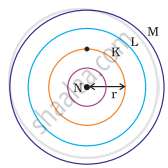
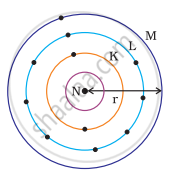
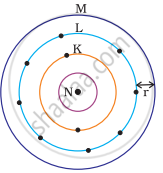
Which one of the following depict the correct representation of atomic radius(r) of an atom?
|
(i) |
(ii) |
|
(iii) |
(iv) |

Elements have been arranged in the following sequence on the basis of their increasing atomic masses.
| F, | Na, | Mg, | Al, | Si, | P, | S, | Cl, | Ar, | K |
- Pick two sets of elements which have similar properties.
- The given sequence represents which law of classification of elements?
In Period 3 of the Periodic Table, element B is placed to the left of element A. On the basis of this information, choose the correct word from the option to complete the following statement:
The element A would have ______ atomic size than B.
Give reason for the following:
The size of a Cl− ion is greater than the size of a Cl atom.
This question refers to the elements of the Periodic Table with atomic numbers from 3 to 18. Some of the elements are shown by letters, but the letters are not the usual symbols of the elements.
| 3 | 4 | 5 | 6 | 7 | 8 | 9 | 10 |
| A | B | C | D | E | F | G | H |
| 11 | 12 | 13 | 14 | 15 | 16 | 17 | 18 |
| I | J | K | L | M | N | O | P |
Which of these have least atomic size in period 3?
