Advertisements
Advertisements
Question
Read the following Intros of news items. Choose any ONE of them and write the headline, the dateline and a short continuing paragraph for it.
(i) A shortage of onions in Maharashtra has surged prices by 30 percent. It forced the authorities to import onions from abroad.
(ii) The birth anniversary of the late President Dr. S. Radhakrishnan was celebrated yesterday in Saraswati Kanya Pathshala as Teacher's Day.
Advertisements
Solution
APPEARS IN
RELATED QUESTIONS
A1. Information Transfer (Non-verbal to verbal)
'Transfer the following information into a paragraph form.
Manuscripts collected from both students and teachers.
↓
Throughly screened, necessary additions, alterations. omissions are made.
↓
Preparing a rough draft
↓
Manuscripts along with a dummy sent to the printer
↓
Proof correction
↓
Sent for final printing
OR
A2. Here are some tips about keeping healthy as given in a Science magazine. Read and
write in the form of Do's and Don'ts (table):
You must include vegetables and fruits in your diet and drink a lot of water. You should avoid junk food and aerated water. You shouldn't sit for long period of time. Rather you should exercise regularly. You shouldn't ignore the importance of good breathing habits. Try breathing deeply whenever you think of it. See to it that you leep for at least 7 hour a day. In fact, you should avoid irregular timings.
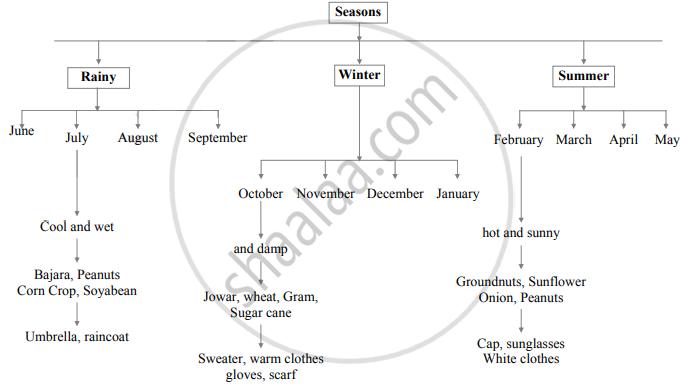
Read the following tree diagram about 'Morphemes' and write a short paragraph on it.

Read the following extract and extend it by adding an imaginary paragraph of your own in about 120 words :
Rosalind and Orlando were married at once in the forest
and on the same day Oliver who was 110 longer selfish and married Celia. Just as they were going to be married, a mess,enger came to ask Duke senior to go back to his dukedom. Celia s fathcr; Duke Frederick, had mended his wicked ways and asked his brother to return.
Frederick had set out with a11 anny to fight the old Duke, but on his way he had met a wise and holy man, who had persuaded him that it was wrong and wicked to drive his elder brother from the court. So Frederick had given up the dukedom and the good.
Duke could go home again. There was great rejoicing in the forest of Arden, under the greenwood tree. Frederick was forgiven and Duke senior and his followers returned from the forest to live happily in their Own homes.
Read the following extract and complete the table given below :
Computer Assisted Language Leaming (CALL) materials come in two main formats: CD/DVD RO Ms and Web-based. Some are tailored to the content to be used in the classrooms whereas others can be used independently. CALL materials allow you to work at your own pace.
Multimedia materials offer you the opportunity to take part in other computer-assisted activities, such as text-based gap-filling, multiple-choice and text reconstruction activities. Language teachers often develop such text-based CALL activities to accompany a particular course. CALL materials can be regularly updated.
Because CALL learning activity types are usually designed from a template, they can sometimes be repetitive.
A major advantage of CALL materials is that they offer instant feedback on your spoken or written performance. However, such feedback can be limited. If you are more interested in creating your own responses or elaborating on your ideas, you may find this type of Facebook frustrating. Web-based CALL materials can offer more variety through the use of hyperlinks, but feedback is still limited.
Just as representations of the cultures of the target language offered by courses using books; audio and videotapes can perpetuate stereotypes.
| Computer Assisted Language Learning Material | ||
| Formats | Advantages | Disadvantages |
| ------------and Web-based | (a) content tailored for classroom use |
(i) ------- |
| (b) ----------- | (ii) limited feedback | |
| (c) ----------- | (iii) --------- | |
| (d) offer opportunity to take part in other computer-assisted activities | (iv)-------- | |
| (e) ----------- | ||
| (f) ----------- | ||
| (g) offer variety | ||
|
Courses
|
Intake capacity
|
Vacant seats
|
|
Engineering:
|
||
|
Degree
|
1, 55, 102
|
42, 497
|
|
Diploma
|
1, 65, 413
|
55, 107
|
|
Post - graduation
|
13, 651
|
1, 810
|
|
Pharmacy:
|
||
|
Degree
|
9, 712
|
924
|
|
Diploma
|
12, 959
|
1, 771
|
|
Post - graduation
|
5, 296
|
3, 506
|

Question:
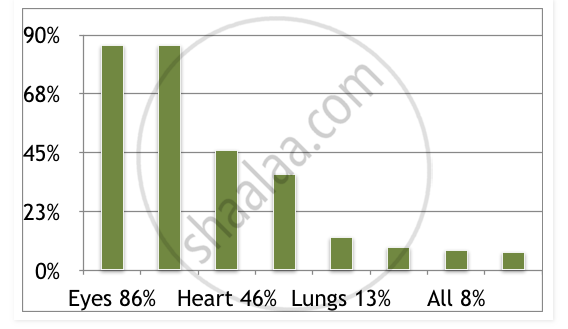
Read the following graph regarding ‘High Awareness but Little Action’ about organ donation. Write a paragraph based on it in about 120 words:
Read the following extract and extend it by adding an imaginary paragraph of your own in about 120 words :
Someone was standing in the doorway. An elderly woman,
very fluffy, very pink. Her cheeks were pink, her dress was pink,
her hair was bunched up and white. She was straight out of Agatha Christie.
"Miss Marple!" I exclaimed.
''May I come in?" asked the pink lady.
"Please come in " said my mother. ''Do sit down. Do you
require a room?" '
''Not today, thank you. l'm staying with Padre Dutt. He insisted on putting me up. But I may want a room for a day or two - just for old times' sake."
"You've stayed here before."
"A long time ago. I'm Mrs Green, you know. The missing
Mrs Green. The one for whom you put up that handSome tombstone in the cemetery. I was very touched by it. And I'm glad you didn't add ' Beloved "wife of Henry Green ', because I didn't love him any more than he loved me."
Information Transfer Non-Verbal to Verbal :
Observe the following web-chart carefully and write two short paragraphs of ‘Advantages of watching Television’ with the help of the points given.
Information Transfer :Non-verbal to Verbal
Read the information on the life history of Kalpana Chawla. On the basis of given points write two short paragraphs on her life history. Suggest a suitable title.
Kalpana Chawla : The first Indian woman in space.
Born : 1961, Karnal, a small town of Haryana.
Schooling : Tagore Bal Niketan, Karnal (1976). B.E from Punjab Engineering College, Chandigarh.
1984 : Master’s degree in Aerospace Engineering – University of Texas
1986 : Ph.D in Aerospace Engineering – University of Colorado
1995 : Picked up for the space programme by NASA.
1997 : Became the first Indian American in space
January 2003 : Went abroad her second space shuttle Columbia to study the outer atmosphere of the sun.
1st February 2003 : Space shuttle lost contact and crashed claiming Kalpana’s life with six fellow astronauts.Read the information on the life history of Kalpana Chawla. On the basis of given points write two short paragraphs on her life history. Suggest a suitable title.
Kalpana Chawla : The first Indian woman in space.
Born : 1961, Karnal, a small town of Haryana.
Schooling : Tagore Bal Niketan, Karnal (1976). B.E from Punjab Engineering College, Chandigarh.
1984 : Master’s degree in Aerospace Engineering – University of Texas
1986 : Ph.D in Aerospace Engineering – University of Colorado
1995 : Picked up for the space programme by NASA.
1997 : Became the first Indian American in space
January 2003 : Went abroad her second space shuttle Columbia to study the outer atmosphere of the sun.
1st February 2003 : Space shuttle lost contact and crashed claiming Kalpana’s life with six fellow astronauts.Read the information on the life history of Kalpana Chawla. On the basis of given points write two short paragraphs on her life history. Suggest a suitable title.
Kalpana Chawla : The first Indian woman in space.
Born : 1961, Karnal, a small town of Haryana.
Schooling : Tagore Bal Niketan, Karnal (1976). B.E from Punjab Engineering College, Chandigarh.
1984 : Master’s degree in Aerospace Engineering – University of Texas
1986 : Ph.D in Aerospace Engineering – University of Colorado
1995 : Picked up for the space programme by NASA.
1997 : Became the first Indian American in space
January 2003 : Went abroad her second space shuttle Columbia to study the outer atmosphere of the sun.
1st February 2003 : Space shuttle lost contact and crashed claiming Kalpana’s life with six fellow astronauts.
The following graph shows the number of visitors (in millions) visiting the famous Salarjung Museum in Hyderabad between 2000 and 2010 as well as the number of visitors expected to visit it in the next ten years.

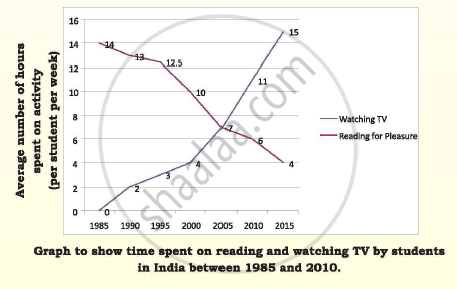
The graph below describes the average number of hours spent by students aged 11-15 years on two activities (per student per week) in India between 1985 and 2010 and gives projections for 2015. Study the information carefully and then write a paragraph interpreting the data. Include the following:
• A comparison of the trends in the two activities
• A comparison of the situation in 1985
• A comparison of the situation between 1985 and 2010
• Predictions for the future
A survey was conducted among the teachers of New Hope High School to find out whether Class X students should be allowed to use mobile phones in the campus. The results of the survey are shown in the pie-chart below.
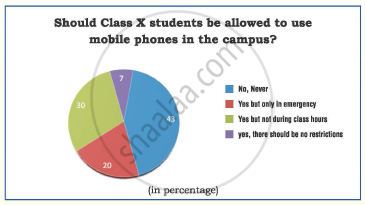
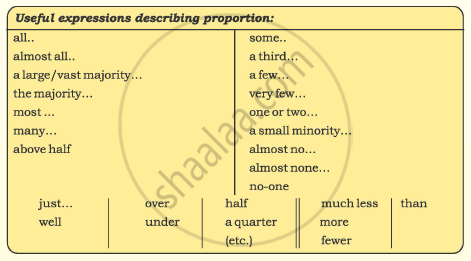
Look at the pie chart and the useful expressions above. Fill in the gaps in the following summary of results.
As can be seen from the above pie-chart, nearly a__________ of the teachers felt that Class X students must not be allowed to use mobile phones in the school campus. However, nearly one____________ believed
the phones should be permitted but not during class hours. About __________were of the opinion that the students may be allowed to use these phones only in times of emergency while a very__________ did not favour any restrictions on their use in the campus.
A school carried out two surveys in Class X. Look at the pie charts below and write short summaries of the results as in the model above.
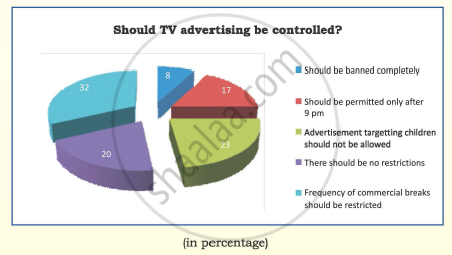
____________________________________________________________________
____________________________________________________________________
____________________________________________________________________
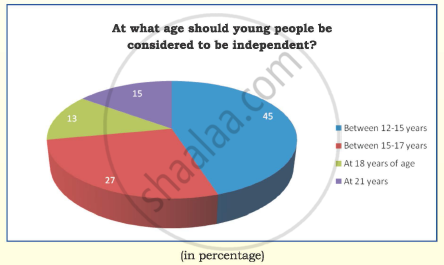
____________________________________________________________________
____________________________________________________________________
____________________________________________________________________
Read the following information and prepare a pie diagram for the same.
Annual Water Usage in Maharashtra
Water is life. It is a universal solvent and an important resource. The annual usage of water differs in various sectors of Maharashtra. The major occupation of Maharashtra being agriculture, the maximum amount of available water is used for irrigation that is 86%. The distant following place 7% is contributed by domestic sector including drinking, washing, cooking, etc. There is a close competition of other sectors which is not far away with 6% usage of water. One of the key factors which plays an important role in the development of a nation is industrial sector. The consumption of water by industrial sector is very negligible which is 1%. We know energy sector plays a vital role in the development of a nation.
In this sector, the use of water is almost nil. If we try to observe its place in the chart we do realise that it holds 0% usage and is yet to open its account.
Observe the following table and transfer the information into a paragraph:
Statewise Distribution of Urban and Rural Population in India:
| States | Population in Millions | |
| Rural | Urban | |
| Maharashtra | 560 | 410 |
| Gujarat | 320 | 190 |
| Madhya Pradesh | 440 | 160 |
| Chhattisgarh | 170 | 40 |
| Andhra Pradesh | 550 | 210 |
| Karnataka | 350 | 180 |
Read the following extract and complete the table given below about 'Types of Diseases':
Health is defined as not simply the absence of disease. It involves a state of feeling well, both in body and in mind.
The diseases may be classified into the following types, Some diseases are present at birth. They are called congenital diseases. They may develop during pregnancy or are inherited, Some of them may be caused by environmental factors. Examples of congenital diseases are Down's syndrome, sickle cell anaemia, cystic fibrosis, haemophilia, etc.
Some diseases are acquired by humans themselves and hence are called Self-Inflicted or Acquired diseases. Examples of acquired diseases are coronary heart diseases, hypertension.
Some diseases are transmitted from one person to another. They are called as Communicable or Infectious diseases. They are caused by biological agents, Examples of communicable diseases are Cholera, Typhoid, Measles, Malaria, etc.
Non- communicable diseases are caused by exogenous factors like physical, chemical, nutritional deficiencies. The examples are Kwashiorkor, Pellagra, Scurvy, and Rickets, etc.
Title
| Sr.No. | Types | Causes |
Examples |
| 1. | Congenital |
o develop during pregnancy o environmental factors |
|
| 2. | Self-Inflicted Acquired | Coronary heart disease. hypertension | |
| 3. | By biological agents | Cholera, typhoid, measles, malaria | |
| 4. | Non-communicable diseases | Kwashiorkor, Pellagra, Scurvy, and Rickets |
Do anyone of the following activities.
Transfer the given information into a paragraph.
Read the following passage and complete the table
Dialect is a form of a language spoken in one area which may be different from other forms of the same language. Each language has dialects which change every few kilometers. India is a multi-lingual country. Each state follows its own language as official language. For example, Marathi is the official language of Maharashtra, while Ahirani, Wharadi, Konkani and Malwani are its dialects. Several languages in India are spoken but do not have any script. In Karnataka, Kannada is the official language. Tulu is spoken in Karnataka but has no script. In England, English is the official language while Scottish, spoken in Scotland and Welsh spoken in Wales are dialects of English.
| State | Official language | Dialects | Spoken/ Without script |
| Maharashtra | Marathi | ||
| Karnataka | |||
| England |
Look at the table given below and write a short paragraph based on it in about 120 words :
The following table shows irregular rainfall causing low groundwater level in Nashik district, and Talukawise its worst hit villages.
| Drop in water level | Talukas | |||
| 0 to 1 meter | Nashik, Igatpuri, Niphad, Chandwad, Kalwan, Deola, Tryambakeshwar | |||
| 1 to 2 meters | Sinnar, Yeola, Nandgaon, Satana, Malegaon | |||
| Worst Hit Areas | ||||
| Talukas | Situation over coming months | |||
| Oct.-Dec. | Jan-Mar. | Apr.-June | Total | |
| Igatpuri | 01 | 06 | 49 | 56 |
| Malegaon | 31 | 54 | 37 | 122 |
| Nandgaon | 08 | 17 | 37 | 62 |
| Niphad | 01 | 04 | 47 | 52 |
| Source: Times of India, Nashik Times, City Edn. Date: Oct. 18, 2018 |
||||
Transfer the information into a paragraph:
Read the following web diagram to transform into a paragraph:

Read the following paragraph and transfer the information in the form of a tree diagram:
The United Nations was established at the end of the second world war to maintain international peace and security.
In the central system of the UN, there are 15 members of the Security Council. The Economic and Social Council has 54 members. The Secretariat of the United Nations is headed by Secretary-General.
The UN has several specialized agencies such as the World Health Organisation (WHO), the Food and Agricultural Organisation (FAO), the International Labour Organization (ILO), the United Nations Educational, Scientific and Cultural Organisation (UNESCO).
Observe the following web diagram carefully and convert it into a paragraph.

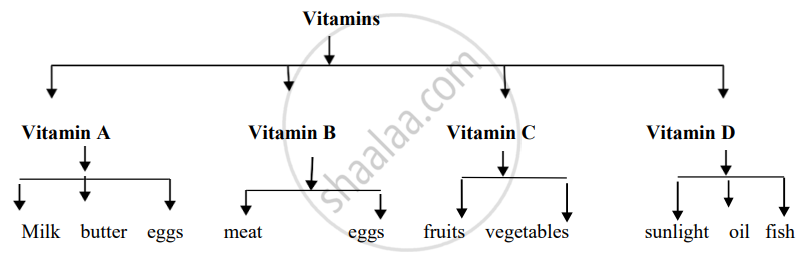
Read the information given in the following tree diagram regarding “Types of vitamins” Write a paragraph with the given points and give a suitable title to it.
Write two short paragraphs on ‘Village life’ by using the points given in the following web diagram:

Non-verbal to verbal:
Transfer the information into a paragraph.
Observe the web diagram and write a paragraph on it. Suggest a suitable title.

Verbal to Non-verbal:
Prepare a fact file using the following points:
Location, Modes of transport, Best time to visit, Accommodation, Places to visit Uniqueness
Ooty or Udhagamandalam’ is a hill station in Tamil Nadu. The queen of the blue mountains sits in the central region of the Nilgiri Range at 7,400 feet, 292 km south west of Bengaluru. The botanical garden, The Ooty Lake, Holy Trinity Church are the places which add to the beauty of Ooty. Wenlock downs is one of the most popular picnic spots in Ooty. Ooty’s hotels range from swanky to budget places. Hotel Surya, Nilgiri Hotel, Khims are some renowned hotels. It is best to visit the place during off season, i.e. March to May to avoid large crowd. Coimbatore is the nearest airport and from there cabs are available to Ooty. From Coimbatore to Udhagamandalam station you may travel by rail or meter gauge. For those taking the road NH 17 Bandipur via Maddur and Mysore will be convenient. From Bandlpur take the route to Mudumalai reserve to Ooty via Gudalur. Ooty is well known for its handmade chocolates, aromatic oils, spices and of course tea.
Non-verbal to Verbal
Study the table given below and prepare a paragraph on it.
| Alligators | Crocodiles | |
| 1. | U shaped round snout | V shaped round snout |
| 2. | Live in fresh water | Live in fresh water and saline water |
| 3. | Have wide jaws; upper jaw is wider than the lower jaw | Have narrow jaws; both the jaws are of the same size |
| 4. | Only upper teeth are visible when the mouth is closed | Both the teeth are visible when the mouth is closed. |
| 5. | No functioning salt glands | Very functional salt glands |
| 6. | Sensory pits on scales near the jaw | Sensory pits in every scale of the body |
Read the following information and complete the table given below. Give a suitable title:
|
Turtles and tortoises are closely related. They are both reptiles from the same family (Testudines or Chelonian). The main difference between the two is that turtle is the name given to water-dwellers and tortoise is the name given to land-dwellers. They are easily identified by the presence of a shell, from which their head and limbs protrude. Turtles are found in Africa and America. Its shell is lighter and more streamlined than that of a tortoise. To enable swimming, it has webbed feet with long claws. Turtles are omnivores, eating both vegetation and meat. Their lifespan is shorter than that of the tortoise with an average of 20-40 years and a maximum of 86 years. Tortoises are found mainly in Asia and Africa, but also in America. It has a rounder, bumpier, heavier shell than a turtle. Its bent legs are short and sturdy. Tortoises are usually herbivores, but some eat meat, their lifespan is longer than that of the turtle with an average of 80-150 years and a maximum of 188 years. |
| FEATURES | TURTLES | TORTOISE |
| (i) Habitat | ||
| (ii) Places found in | ||
| (iii) Shell | ||
| (iv) Lifespan |
Transfer the information into a paragraph:
Observe the chart and write a paragraph on it. Suggest a suitable title:

Verbal to Non-Verbal
Read the following information and complete the table given below:
| Basically industries are broadly classified on the basis of raw material, the scale of production and the volume of investment made. Further they are classified as per the source of raw material, example, agro-based industries such as sugar, cotton, etc. Forest based such as paper, lac, and mineral based such as iron, steel and chemicals, etc. The scale of the production determines whether they are small scales, such as food processing, leather goods, etc., or large scale, automobile, shipbuilding, etc. Similarly, there are industries which are set up by the government, called Public Sector. Those industries which are set up by the Private entrepreneur are called Private Sector and those which are run collectively by a group of people are called Co-operative Sector. |
| Table | Information |
| (1) Examples of forest-based industries. | |
| (2) Examples of small scale industries. | |
| (3) Examples of large scale industries. | |
| (4) Industries setup by private entrepreneur. | |
| (5) Industries run by a group of people. |
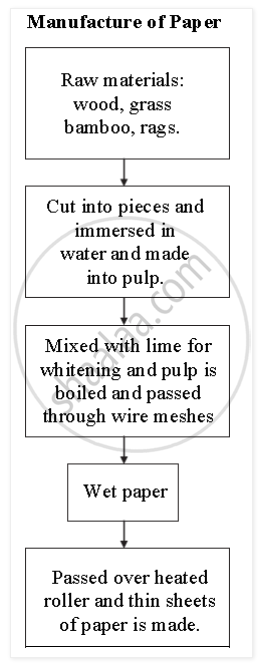
Transfer the given information in the form of a paragraph.
THE WATER CYCLE PROCESS

Verbal to Non-verbal
Read the information from the given paragraph and write it into a tree diagram.
| There are different kinds of musical instruments. They are divided into three main classes according to the way that they are played. Some instruments are played by blowing air into them. These are called wind instruments. Some of these are said to be of the wood wind family. Examples of woodwind instruments are the flute, the clarinet and the horn. There are also various other wind instruments such as the mouth organ and the bagpipes. Some instruments are played by banging or striking them. Instruments like this are called percussion instruments. The last big group of musical instruments have strings. There are two kinds of stringed instruments. Examples are the harp and the guitar, the violin and the cello. |
Non-Verbal to Verbal
Transfer the given information in the form of a paragraph.
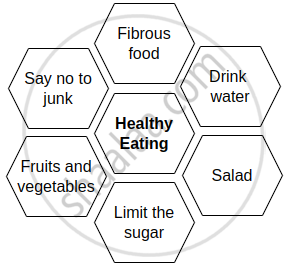
Verbal to Non-verbal:
Read the following statements and prepare a chart of ‘Dos’ and ‘Don'ts’. Suggest a suitable title for it.
Nature is abode for all of us. It provides us with all our basic needs. However, we must take care of the following things so that our mother nature is not harmed.
- We must plant more trees.
- We should not cut trees.
- We must keep our area neat and clean.
- We should never discharge garbage without proper management.
- We should not pollute air and water.
- We should not use plastic bags.
- We should not hunt birds or animals.
- We should use more of public transport.
- We should spread awareness about the importance of maintaining balance in nature.
A survey was conducted in the National Capital in over twenty schools about 40 different activities that interest the children in the age group of 13 years to 15 years. Write a paragraph in not more than 120 words, analyzing the following information.

Non-Verbal to Verbal
Write a paragraph of 100 words based on the information given in the following table and give a suitable title for it:
| Types of Forests | Plants | Animals | |
| (1) |
Equatorial Evergreen |
Mahogany, Rosewood, Ironwood, Oil palm |
Different types of monkeys, snakes, lizards, bats, tse-tse flies |
| (2) | Marshes |
Mangraove, Creepers, Numerous tall trees like Mahogany |
Different types of insects, snakes, crocodiles, tse-tse and other flies |
Draw a table of comparison (tabular form) between Amir and Anita that includes the information given below. Give a suitable title:
|
Amir and Anita are good neighbours. They are cooperative and have happy families. Amir, an 18-year young chap is in std. 12 and goes to a famous college in the city. Anita, a 16-year charming girl will appear for her 10th class Board Exam this year. Amir’s father a big businessman in the city and Anita’s father is a government officer. Amir’s mother, a housewife, helps his father in their family business also. Anita’s mother is a doctor and has her own clinic. Amir is a good sportsman who likes to play outdoor games on the contrary Anita likes to remain indoors and enjoys indoor games. Amir is strong and dynamic. Though strong Anita is sensitive also. Photography and bird-watching are my interests of Amir. Anita spends her time in her hobbies of singing and painting. Amir after his 12th exam wants to pursue his career in wild-life photography. Anita would like to join Arts stream after her Board Exams. |
| Amir | Anita | |
| (1) Age | ||
| (2) Class | ||
| (3) Father’s occupation | ||
| (4) Mother's occupation | ||
| (5) His/Her qualities | ||
| (6) His/Her hobbies/interest | ||
| (7) His/Her ambitions/future plans |
(A1) Verbal to Non-Verbal:
Read the following information and complete the flowchart for the same, and give a suitable title.
|
Sugar beet grows through the summer and is harvested in autumn and winter. When it arrives on site, the sugar beet is washed. The sugar beet is sliced into thin strips called cossettes.‘These thin strips are mixed with hot water to extract the sugar and a lime solution is added to the raw juice to remove any impurities. |
Non-verbal to Verbal:
Transfer the given information into a paragraph. Suggest a suitable title:
| Caused by Man | Caused by Nature | Solutions | |
| i. | Too many people | Droughts | Stricter laws to control population. |
| ii. | More agricultural land required to meet the needs of the ever growing populations | Floods | Stricter laws and proper execution of laws |
| iii. | Cutting of forests for wood etc. | Forest fires | Use alternative products. |
| iv. | Poaching by hunters. | - | Reduce demand for illegal wildlife parts and products by not purchasing products made from these items. |
Non-verbal to verbal:
Read the information given in the following tree-diagram and write two short paragraphs based on it. Give a suitable title to your write up: