Advertisements
Advertisements
Question
Verbal to Non-verbal:
Prepare a fact file using the following points:
Location, Modes of transport, Best time to visit, Accommodation, Places to visit Uniqueness
Ooty or Udhagamandalam’ is a hill station in Tamil Nadu. The queen of the blue mountains sits in the central region of the Nilgiri Range at 7,400 feet, 292 km south west of Bengaluru. The botanical garden, The Ooty Lake, Holy Trinity Church are the places which add to the beauty of Ooty. Wenlock downs is one of the most popular picnic spots in Ooty. Ooty’s hotels range from swanky to budget places. Hotel Surya, Nilgiri Hotel, Khims are some renowned hotels. It is best to visit the place during off season, i.e. March to May to avoid large crowd. Coimbatore is the nearest airport and from there cabs are available to Ooty. From Coimbatore to Udhagamandalam station you may travel by rail or meter gauge. For those taking the road NH 17 Bandipur via Maddur and Mysore will be convenient. From Bandlpur take the route to Mudumalai reserve to Ooty via Gudalur. Ooty is well known for its handmade chocolates, aromatic oils, spices and of course tea.
Advertisements
Solution
Fact File of Ooty
| Location | Ooty or Udhagamandalam Hill station in Tamil Nadu |
| How to Reach | Flight to Coimbatore and Cabs from there. Narrow gauge rail from Coimbatore to Udhagamandalam station. From Bandipur on NH 17 via Maddur and Mysore to Mudumalai reserve via Gudalur. |
| Best time to visit | March to May; off season. |
| Where to stay/Accommodation | Hotels range from swanky to budget places like Hotel Surya, Nilgiri Hotel, Khims. |
| What to See | The botanical garden, The Ooty Lake, Holy Trinity Church, Wenlock downs. |
| Specialities | Tea, handmade chocolates, aromatic oils and spices. |
APPEARS IN
RELATED QUESTIONS
A1.Books have the power to inspire and do many more things. Observe the web diagram and convert the information into a paragraph. Add a few more points to the given information:

A2. Read the given information and fill the table provided:
Acclaimed in Indian classics as the Kalpavriksha, the all giving tree the coconut palm grows in several states in India. The coconut palm is member of the plant family Arecaceae popularly known as palm family. It flourishes on sandy soils requiring high humidity abundant sunlight and high rainfall for optimal growth. All parts of the palm are used in some way or another in the daily life of the people. Coconut water provides a refreshing and nutritious drink. The firm kernel that line the inside is high in calories and the white milk extracted from it is used in many different ways. Oil extracted from dried mature coconuts is used as cooking oil. The leaves are braided to make thatched roof and mats. The mid ribs of the leaves are dried and tied together to make brooms. The coconut shell and husk are good sources of efficient fuel. During religious ceremonies married women are often presented with a coconut along with a few grains of rice as a symbol of fertility and prosperity.
| Name : | |
| Scientific name : | |
| Place where grown : | |
| Climate required : | |
| Uses : | |
| (a) Liquid | |
| (b) Kernel | |
| (c) Leaves | |
| (d) Shell | |
| Symbolises : |
Information Transfer: Non-verbal to Verbal
A survey was conducted among the teachers of New Hope High School to find out whether Class X students should be allowed to use mobile phones in the campus. The results of the survey are shown in the pie-chart below.
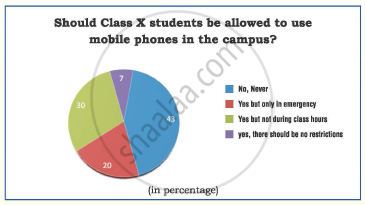
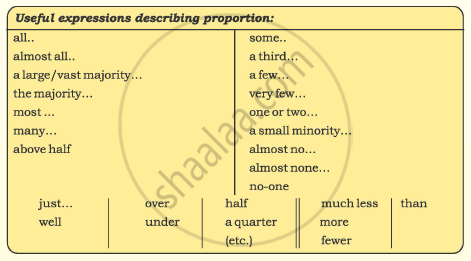
Look at the pie chart and the useful expressions above. Fill in the gaps in the following summary of results.
As can be seen from the above pie-chart, nearly a__________ of the teachers felt that Class X students must not be allowed to use mobile phones in the school campus. However, nearly one____________ believed
the phones should be permitted but not during class hours. About __________were of the opinion that the students may be allowed to use these phones only in times of emergency while a very__________ did not favour any restrictions on their use in the campus.
Extend the given extract by adding an imaginary paragraph of your own (about 120 words)
A couple of days later, I was walking around the camp, around the barracks, near the barbed-wire fence where the guards could not easily see. I was alone.
On the other side of the fence, I spotted someone: a little girl with light, almost luminous curls. She was half-hidden behind a birch tree.
I glanced around to make sure no one saw me. I called to her softly in German. 'Do you have something to eat?'
She didn't understand.
I inched closer to the fence and repeated the question in polish. She stepped forward. I was thin and gaunt, with rags wrapped around my feet, but the girl looked unafraid. In her eyes, I saw life.
She pulled an apple from her woollen jacket and threw it over the fence.
I grabbed the fruit and, as I started to run away, I heard her say faintly, 'I'II see you tomorrow."
Read the following passage and complete the table
Dialect is a form of a language spoken in one area which may be different from other forms of the same language. Each language has dialects which change every few kilometers. India is a multi-lingual country. Each state follows its own language as official language. For example, Marathi is the official language of Maharashtra, while Ahirani, Wharadi, Konkani and Malwani are its dialects. Several languages in India are spoken but do not have any script. In Karnataka, Kannada is the official language. Tulu is spoken in Karnataka but has no script. In England, English is the official language while Scottish, spoken in Scotland and Welsh spoken in Wales are dialects of English.
| State | Official language | Dialects | Spoken/ Without script |
| Maharashtra | Marathi | ||
| Karnataka | |||
| England |
Look at the table given below and write a short paragraph based on it in about 120 words :
The following table shows irregular rainfall causing low groundwater level in Nashik district, and Talukawise its worst hit villages.
| Drop in water level | Talukas | |||
| 0 to 1 meter | Nashik, Igatpuri, Niphad, Chandwad, Kalwan, Deola, Tryambakeshwar | |||
| 1 to 2 meters | Sinnar, Yeola, Nandgaon, Satana, Malegaon | |||
| Worst Hit Areas | ||||
| Talukas | Situation over coming months | |||
| Oct.-Dec. | Jan-Mar. | Apr.-June | Total | |
| Igatpuri | 01 | 06 | 49 | 56 |
| Malegaon | 31 | 54 | 37 | 122 |
| Nandgaon | 08 | 17 | 37 | 62 |
| Niphad | 01 | 04 | 47 | 52 |
| Source: Times of India, Nashik Times, City Edn. Date: Oct. 18, 2018 |
||||
Observe the following web diagram carefully and convert it into a paragraph.

Non-verbal to verbal
Read the information from the given bar graph and write it in paragraph form.
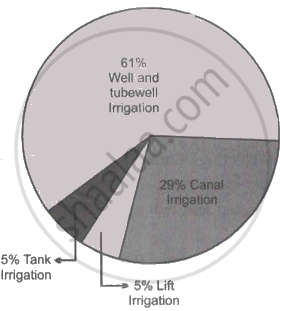
Non-Verbal to Verbal
Transfer the given information in the form of a paragraph.
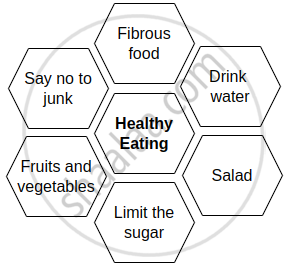
A survey was conducted in the National Capital in over twenty schools about 40 different activities that interest the children in the age group of 13 years to 15 years. Write a paragraph in not more than 120 words, analyzing the following information.

