Advertisements
Advertisements
Question
Read the following information and prepare a pie diagram for the same.
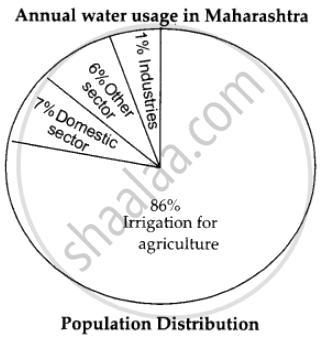
Annual Water Usage in Maharashtra
Water is life. It is a universal solvent and an important resource. The annual usage of water differs in various sectors of Maharashtra. The major occupation of Maharashtra being agriculture, the maximum amount of available water is used for irrigation that is 86%. The distant following place 7% is contributed by domestic sector including drinking, washing, cooking, etc. There is a close competition of other sectors which is not far away with 6% usage of water. One of the key factors which plays an important role in the development of a nation is industrial sector. The consumption of water by industrial sector is very negligible which is 1%. We know energy sector plays a vital role in the development of a nation.
In this sector, the use of water is almost nil. If we try to observe its place in the chart we do realise that it holds 0% usage and is yet to open its account.
Advertisements
Solution
APPEARS IN
RELATED QUESTIONS
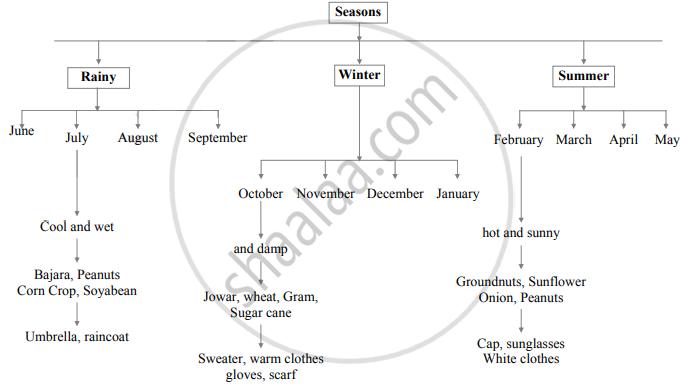
Read the following tree diagram about 'Morphemes' and write a short paragraph on it.

Read the following extract and complete the tree – diagram given below:

Read the following extract and extend it by adding an imaginary paragraph of your own in about 120 words :
Someone was standing in the doorway. An elderly woman,
very fluffy, very pink. Her cheeks were pink, her dress was pink,
her hair was bunched up and white. She was straight out of Agatha Christie.
"Miss Marple!" I exclaimed.
''May I come in?" asked the pink lady.
"Please come in " said my mother. ''Do sit down. Do you
require a room?" '
''Not today, thank you. l'm staying with Padre Dutt. He insisted on putting me up. But I may want a room for a day or two - just for old times' sake."
"You've stayed here before."
"A long time ago. I'm Mrs Green, you know. The missing
Mrs Green. The one for whom you put up that handSome tombstone in the cemetery. I was very touched by it. And I'm glad you didn't add ' Beloved "wife of Henry Green ', because I didn't love him any more than he loved me."
Look at the following web chart and write a short paragraph based on it in about 120 words. Suggest a suitable title:

Look at the graph and the paragraph below which provides an interpretation of the data given in the graph.
Graph to show number of whales caught in Antarctic (1985-2010)

As whalers reduced catching of the large/r whales, they switched to smaller species. This is evident when we compare figures for the Antarctic catch of the larger sei whale with those for small minke whale. In 1985, fifteen times as many sei whales as minke whales were caught. By 1995, catches of both the species were virtually the same (9000). By the 2000, the situation had reversed and the number of minke whales killed more than doubled as compared to sei whales (6000). The graph shows that while the sei catch was reduced by 95% between 1985 and 2010, over the same period the minke whale catch was eight times greater. If these trends continue, the situation for the smaller species will be as bad as it used to be for the larger ones.
Discuss with a partner:
1. What expressions have been used for comparing the data? Underline them.
2. Does the analysis identify the main trends? Has any projection or guess been made based on the available data?
3. Can you spot a sentence that summarizes the data or draws a conclusion based on it?
4. Has the analysis been supported with figures from the given data?
5. Is there any unnecessary repetition?
6. How many times has the verb 'be' in its different forms been used? Some useful expressions :
|
{much ,many, far ,slightly, a little} |
more, greater,higher, less, lower, further, farther |
|
{half, twice, ten times, (etc.)} |
as { adj. adv.} as |
|
10 percent 150 percent |
{more less } than |
| almost the same ____ as | |
| as {adj adv.} as |
A survey was conducted among the teachers of New Hope High School to find out whether Class X students should be allowed to use mobile phones in the campus. The results of the survey are shown in the pie-chart below.
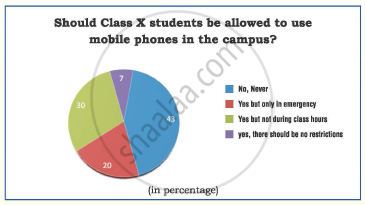
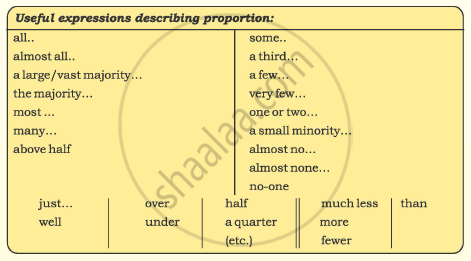
Look at the pie chart and the useful expressions above. Fill in the gaps in the following summary of results.
As can be seen from the above pie-chart, nearly a__________ of the teachers felt that Class X students must not be allowed to use mobile phones in the school campus. However, nearly one____________ believed
the phones should be permitted but not during class hours. About __________were of the opinion that the students may be allowed to use these phones only in times of emergency while a very__________ did not favour any restrictions on their use in the campus.
Read the given extract carefully and transfer the following into a flow chart:
Garbage disposal has become a great problem in urban areas. A lot of garbage is being collected from every household. Some cities have come up with innovative ideas to tackle this problem. First of all, the garbage in trucks is segregated into organic waste from recyclable waste. Then it is put in separate containers.
Earthworm culture is added to this organic waste. After a few weeks the conversion process is complete and what we can get is vermicompost which is a very good quality compost that can be mixed with soil and used for better yields.
(i) Read the following tree diagram and find out more information about opportunities in ‘on and off the shore’ the Indian Navy.

(ii) Required qualifications and various fields/opportunities for women to join in the Navy.

(iii) Colleges that provide education in oceanography -
- National Institute of Oceanography, Goa
- National Institute of Oceanography, Mumbai
- MBA (Logistic Shipping Management), IIKM Business School, Calicut, Kerala
- Indira Gandhi College of Distance Education IGCDE Tamil Nadu.
Gurmeet Kaur is an aspiring candidate for a public- funded engineering college in the suburbs. She belongs to a nearby village, has minimal technological skills and exposure, has the required cut-off percentage and is looking for a complete or partial scholarship.
Write a paragraph in about 100-120 words analysing her SWOT notes to support your stand on whether she should /not join the college.
|
STRENGTH
|
WEAKNESS
|
|
OPPORTUNITIES
|
THREAT
|
Non-verbal to verbal:
Read the information given in the following tree-diagram and write two short paragraphs based on it. Give a suitable title to your write up: