Advertisements
Advertisements
Question
Read the given extract carefully and transfer the following into a flow chart:
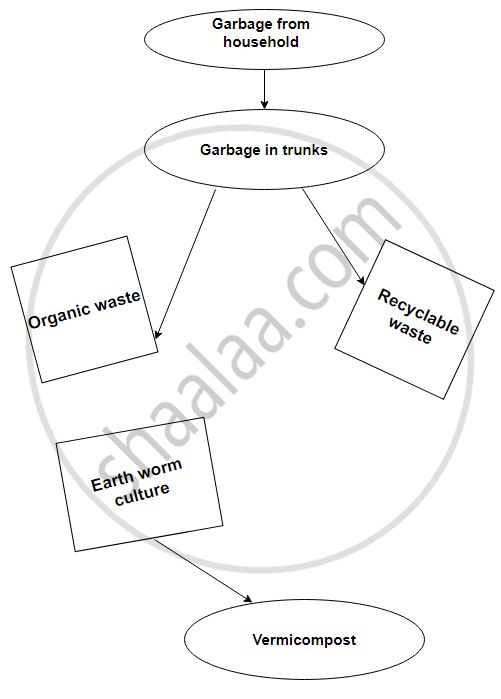
Garbage disposal has become a great problem in urban areas. A lot of garbage is being collected from every household. Some cities have come up with innovative ideas to tackle this problem. First of all, the garbage in trucks is segregated into organic waste from recyclable waste. Then it is put in separate containers.
Earthworm culture is added to this organic waste. After a few weeks the conversion process is complete and what we can get is vermicompost which is a very good quality compost that can be mixed with soil and used for better yields.
Advertisements
Solution
Preparing a flow chart
APPEARS IN
RELATED QUESTIONS
Read the following extract and extend it by adding an imaginary paragraph of your own in about 120 words:
[You may begin with: Mrs. Green: May I come in.......]
"May I come in?" asked the pink lady.
"Please come in," said my mother. "Do sit down. Do you require a room'?"
"Not today, thank you. I'm staying with Padre Dutt.
He insisted on putting me up. But I may want room for a day or two -- lust for old time's sake."
"You've stayed here before."
''A long time ago. I'm Mrs. Green, you know. The missing
Mrs. Green. The one for whom you put up that handsome tombstone in the cemetery. I was very touched by it. And I'm glad you didn't add 'Beloved wife of Henry Green' because I didn't' love him any more than he loved me.''
''Then - then - you aren't the skeleton?'' stammered my
mother.
''Do I look like a skeleton?''
''No!'' we said together.
· ''But we heard you disappeared,'' I said, ''and when we found that skeleton -''
''You put two and two together.''
''Well, it was Miss Kellner who convinced us,'' said my
mother. ''And you did disappear mysteriously. You were missing for years. And everyone knew Mr. Green was a philanderer!''
''Couldn't wait to get away from him," said the pink lady.
'Couldn't stand him anymore. He was a lady-killer, but not a real killer.''
''But your father ca1ne looking for you. Didn't you get in touch with him?''
|
Courses
|
Intake capacity
|
Vacant seats
|
|
Engineering:
|
||
|
Degree
|
1, 55, 102
|
42, 497
|
|
Diploma
|
1, 65, 413
|
55, 107
|
|
Post - graduation
|
13, 651
|
1, 810
|
|
Pharmacy:
|
||
|
Degree
|
9, 712
|
924
|
|
Diploma
|
12, 959
|
1, 771
|
|
Post - graduation
|
5, 296
|
3, 506
|
Question:
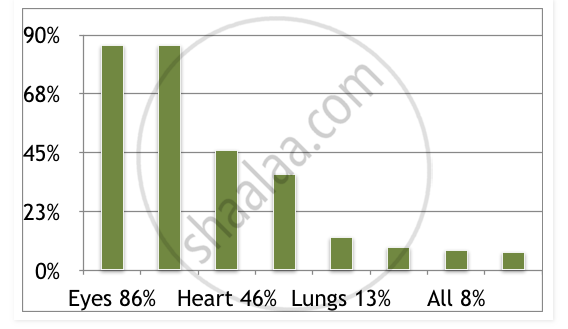
Read the following graph regarding ‘High Awareness but Little Action’ about organ donation. Write a paragraph based on it in about 120 words:
Read the following extract and extend it by adding an imaginary paragraph of your own in about 120 words :
Someone was standing in the doorway. An elderly woman,
very fluffy, very pink. Her cheeks were pink, her dress was pink,
her hair was bunched up and white. She was straight out of Agatha Christie.
"Miss Marple!" I exclaimed.
''May I come in?" asked the pink lady.
"Please come in " said my mother. ''Do sit down. Do you
require a room?" '
''Not today, thank you. l'm staying with Padre Dutt. He insisted on putting me up. But I may want a room for a day or two - just for old times' sake."
"You've stayed here before."
"A long time ago. I'm Mrs Green, you know. The missing
Mrs Green. The one for whom you put up that handSome tombstone in the cemetery. I was very touched by it. And I'm glad you didn't add ' Beloved "wife of Henry Green ', because I didn't love him any more than he loved me."
Read the following paragraph and transfer the information in the form of a tree diagram:
|
The United Nations was established at the end of the second world war to maintain international peace and security. The UN has several specialized agencies such as the World Health Organisation (WHO), the Food and Agricultural Organisation (FAO), the International Labour Organization (ILO), the United Nations Educational, Scientific and Cultural Organisation (UNESCO). |
Verbal to Non-verbal:
Write Do’s and Don’ts for ‘In the Examination Hall’. Suggest a suitable title.
You should carry all necessary materials for exam such as pens, pencils, erasers, scale, geometrical box etc. You should not forget your identity card and hall tickets. After you enter the examination hall, keep all required things on your desk. You should follow the instructions given by the invigilator. You must read the question paper carefully. You should avoid observing other students because their tension might disturb you. You need not feel upset even if you notice other students writing very speedily. You stay calm. In any case do not talk to any of the students during the exam. It’s advisable to drink sufficient water before you enter the exam hall. Last but not the least, don’t forget to check all answers in last 10 minutes, before submitting your answer sheet to the invigilator.
Non-verbal to Verbal
Study the table given below and prepare a paragraph on it.
| Alligators | Crocodiles | |
| 1. | U shaped round snout | V shaped round snout |
| 2. | Live in fresh water | Live in fresh water and saline water |
| 3. | Have wide jaws; upper jaw is wider than the lower jaw | Have narrow jaws; both the jaws are of the same size |
| 4. | Only upper teeth are visible when the mouth is closed | Both the teeth are visible when the mouth is closed. |
| 5. | No functioning salt glands | Very functional salt glands |
| 6. | Sensory pits on scales near the jaw | Sensory pits in every scale of the body |
Transfer the information into a paragraph:
Observe the chart and write a paragraph on it. Suggest a suitable title:

Transfer the given information in the form of a paragraph.
THE WATER CYCLE PROCESS

Verbal to Non - Verbal
Read the following information and write it into Do's and Don'ts. Give a suitable title for it:
Outside "The Central Library" there is a board displaying some rules and regulations for the members.
They are as follows:
- You should enter your name and registered number in the register, before entering in the library.
- You should pay your monthly/annual membership on time.
- You are not allowed to write anything in the book/magazine you have taken.
- You should not take any book or magazine out of the library without prior permission and registration.
- You should maintain pin-drop silence in the library.
- You are not allowed to eat, drink, chat or smoke inside the library.
- You should return the books or magazines you have taken on time.
- You should not disturb other members and the librarian when you are in the library.
