Advertisements
Advertisements
Question
(i) A ray of white light breaks up into its components while passing through a glass prism. Draw a ray diagram to show the path of rays.
(ii) Mark the least deviated colour in your diagram

(iii) Why do different coloured rays deviate differently in a prism?
Advertisements
Solution
The splitting of white light into its component colours on passing through a glass prism is shown in the following diagram.

(ii) The least deviated colour is red, which is marked in the diagram.
(iii) Different colours have different wavelengths; therefore, they deviate differently when passing through a glass prism. The amount of deviation depends on the wavelength of the coloured light.
APPEARS IN
RELATED QUESTIONS
A student is observing a diagram showing the path of a ray of light passing through a glass prism. He would find that for all angles of incidence the ray of light bends:
Why do the component colours of incident white light split into a spectrum while passing through a glass prism, explain
In the following diagram the correctly marked angles are :

(a) ∠A and ∠e
(b) ∠i, ∠A and ∠D
(c) ∠A ∠r and ∠e
(b) ∠A ∠r and ∠D
The colour of white light which suffers the maximum bending (or maximum refraction) on passing through a glass prism is:
(a) yellow
(b) orange
(c) red
(d) violet
Which of the following colour of white light has the least wavelength?
(a) red
(b) orange
(c) violet
(d) blue
The splitting of white light into its constituent colours is called .............
You are given a disc divided into seven sectors with colours violet, indigo, blue, green, yellow, orange and red in them. What would be its colour when it is rotated rapidly?
The diagram below shows the path taken by a narrow beam of yellow monochromatic light passing through an equiangular glass prism. If the yellow light is replaced by a narrow beam of white light incident at the same angle, draw another diagram to show the passage of white light through the prism and label it to show the effect of prism on the white light.

While performing the experiment to trace the path of a ray of light passing through a glass prism, four students marked the incident ray and the emergent ray in their diagrams in the manner shown below. 
(A) I
(B) II
(C) III
(D) IV
If white light is used in same way what change is expected in the emergent beam?
Draw a labelled diagram: Dispersion of light through a prism.
Answer the following:
What do you mean by dispersion? Name the different colours of light in the proper sequence in the spectrum of light.
Differentiate between a glass slab and a glass prism.
Which characteristic property of light is responsible for the blue colour of the sky?
Rainbow is a beautiful natural phenomenon. It is the combined effect of a natural three processes together produced by light. Write it into the circle.
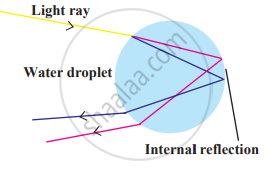
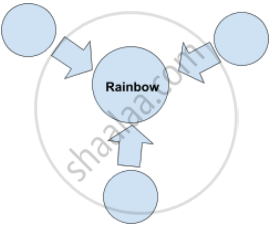
Observe the given figure and write appropriate phenomenon of light in the box.
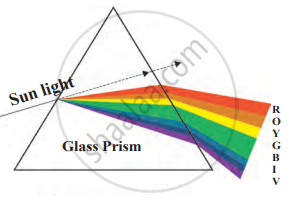
The phenomena of light involved in the formation of rainbow are ______.
Why do we see a rainbow in the sky only after rainfall?
The dispersive powers of flint glass and crown glass are 0.053 and 0.034, respectively and their mean refractive indices are 1.68 and 1.53 for white light. Calculate the angle of the flint glass prism required to form an achromatic combination with a crown glass prism of refracting angle 4°:
