Advertisements
Advertisements
Question
Find the area under the given curve and given line:
y = x4, x = 1, x = 5 and x-axis
Advertisements
Solution
The curve y = x4 passes through the point (0, 0). The line OY is symmetric.
Now, y = x4
`dy/dx = 4x^3`
The sign of `dy/dx` changes from -ve to +ve when x moves through x = 0.
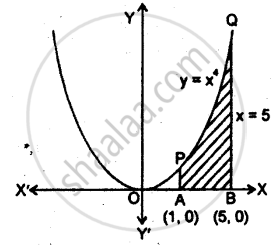
∴ x = 0 is the lowest point.
∴ Area of the region bounded by y = x4, x = 1, x = 5 and x-axis
= Area of the region PABQ
`= int_1^5 y dx = int_1^5 x^4 dx`
`= [x^5/5]_1^5 = [5^5/5 - 1/5]`
`= [5^4 - 1/5]`
`= 625 - 1/5`
`= (3125 - 1)/5`
`= 3124/5`
= 624.8 square unit
APPEARS IN
RELATED QUESTIONS
Find the area of the region bounded by y2 = 9x, x = 2, x = 4 and the x-axis in the first quadrant.
Find the area of the smaller part of the circle x2 + y2 = a2 cut off by the line `x = a/sqrt2`
Area of the region bounded by the curve y2 = 4x, y-axis and the line y = 3 is ______.
Find the area between the curves y = x and y = x2
Find the area enclosed between the parabola y2 = 4ax and the line y = mx
Find the area enclosed between the parabola 4y = 3x2 and the straight line 3x - 2y + 12 = 0.
Find the area of the smaller region bounded by the ellipse \[\frac{x^2}{9} + \frac{y^2}{4} = 1\] and the line \[\frac{x}{3} + \frac{y}{2} = 1 .\]
Find the area of the region bounded by the parabola y2 = 16x and the line x = 4.
Draw a rough sketch and find the area bounded by the curve x2 = y and x + y = 2.
Using integration find the area of the triangle formed by negative x-axis and tangent and normal to the circle `"x"^2 + "y"^2 = 9 "at" (-1,2sqrt2)`.
Find the area of the region bounded by the following curves, the X-axis and the given lines: 2y = 5x + 7, x = 2, x = 8
Choose the correct alternative :
Area of the region bounded by the curve x2 = y, the X-axis and the lines x = 1 and x = 3 is _______.
The area of the region bounded by y2 = 4x, the X-axis and the lines x = 1 and x = 4 is _______.
If the curve, under consideration, is below the X-axis, then the area bounded by curve, X-axis and lines x = a, x = b is positive.
State whether the following statement is True or False:
The area bounded by the curve y = f(x) lies on the both sides of the X-axis is `|int_"a"^"b" "f"(x) "d"x| + |int_"b"^"c" "f"(x) "d"x|`
State whether the following statement is True or False:
The equation of the area of the circle is `x^2/"a"^2 + y^2/"b"^2` = 1
The area of the region x2 = 4y, y = 1 and y = 2 and the Y axis lying in the first quadrant is ______
Find the area of the region bounded by the curve y = `sqrt(9 - x^2)`, X-axis and lines x = 0 and x = 3
Find the area of the region bounded by the curve 4y = 7x + 9, the X-axis and the lines x = 2 and x = 8
Find the area of the region bounded by the curve y = (x2 + 2)2, the X-axis and the lines x = 1 and x = 3
The area of the region bounded by the curve y = 4x3 − 6x2 + 4x + 1 and the lines x = 1, x = 5 and X-axis is ____________.
`int_0^log5 (e^xsqrt(e^x - 1))/(e^x + 3)` dx = ______
`int "e"^x ((sqrt(1 - x^2) * sin^-1 x + 1)/sqrt(1 - x^2))`dx = ________.
Area enclosed between the curve y2(4 - x) = x3 and line x = 4 above X-axis is ______.
The area enclosed by the parabolas x = y2 - 1 and x = 1 - y2 is ______.
Which equation below represents a parabola that opens upward with a vertex at (0, – 5)?
If a2 + b2 + c2 = – 2 and f(x) = `|(1 + a^2x, (1 + b^2)x, (1 + c^2)x),((1 + a^2)x, 1 + b^2x, (1 + c^2)x),((1 + a^2)x, (1 + b^2)x, 1 + c^2x)|` then f(x) is a polynomial of degree
Find the area between the two curves (parabolas)
y2 = 7x and x2 = 7y.
Area in first quadrant bounded by y = 4x2, x = 0, y = 1 and y = 4 is ______.
Area bounded by y = sec2x, x = `π/6`, x = `π/3` and x-axis is ______.
The area (in sq. units) of the region {(x, y) : y2 ≥ 2x and x2 + y2 ≤ 4x, x ≥ 0, y ≥ 0} is ______.
If the area enclosed by y = f(x), X-axis, x = a, x = b and y = g(x), X-axis, x = a, x = b are equal, then f(x) = g(x).
Find the area of the regions bounded by the line y = −2x, the X-axis and the lines x = −1 and x = 2.
What is the total area bounded by \[y=f(x)\], the \[x\]-axis, and the ordinates \[x=a\] and \[x=b\], when the region is above the \[x\]-axis?
A curve crosses the \[x\]-axis, forming area \[A_1\] below the axis and area \[A_2\] above the axis. What is its total area?
For the ellipse \[\frac{x^2}{a^2}+\frac{y^2}{b^2}=1\], which expression for \[y\] is obtained before selecting the first-quadrant branch?
