Advertisements
Advertisements
प्रश्न
Find the area under the given curve and given line:
y = x4, x = 1, x = 5 and x-axis
Advertisements
उत्तर
The curve y = x4 passes through the point (0, 0). The line OY is symmetric.
Now, y = x4
`dy/dx = 4x^3`
The sign of `dy/dx` changes from -ve to +ve when x moves through x = 0.
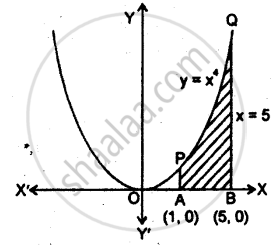
∴ x = 0 is the lowest point.
∴ Area of the region bounded by y = x4, x = 1, x = 5 and x-axis
= Area of the region PABQ
`= int_1^5 y dx = int_1^5 x^4 dx`
`= [x^5/5]_1^5 = [5^5/5 - 1/5]`
`= [5^4 - 1/5]`
`= 625 - 1/5`
`= (3125 - 1)/5`
`= 3124/5`
= 624.8 square unit
APPEARS IN
संबंधित प्रश्न
Find the area of the region in the first quadrant enclosed by the x-axis, the line y = x and the circle x2 + y2 = 32.
Find the area of the region bounded by y2 = 9x, x = 2, x = 4 and the x-axis in the first quadrant.
Find the area of the region in the first quadrant enclosed by x-axis, line x = `sqrt3` y and the circle x2 + y2 = 4.
The area between x = y2 and x = 4 is divided into two equal parts by the line x = a, find the value of a.
Find the area between the curves y = x and y = x2
Find the area of the region {(x, y) : y2 ≤ 4x, 4x2 + 4y2 ≤ 9}
Find the equation of an ellipse whose latus rectum is 8 and eccentricity is `1/3`
Using integration, find the area of the region {(x, y) : x2 + y2 ≤ 1 ≤ x + y}.
Find the area of the region bounded by the following curves, the X-axis and the given lines:
y = x2 + 1, x = 0, x = 3
Area of the region bounded by x2 = 16y, y = 1 and y = 4 and the Y-axis, lying in the first quadrant is _______.
Fill in the blank :
Area of the region bounded by x2 = 16y, y = 1, y = 4 and the Y-axis, lying in the first quadrant is _______.
State whether the following is True or False :
The area bounded by the two cures y = f(x), y = g (x) and X-axis is `|int_"a"^"b" f(x)*dx - int_"b"^"a" "g"(x)*dx|`.
Solve the following :
Find the area of the region bounded by the curve xy = c2, the X-axis, and the lines x = c, x = 2c.
Choose the correct alternative:
Using the definite integration area of the circle x2 + y2 = 16 is ______
Choose the correct alternative:
Area of the region bounded by the parabola y2 = 25x and the lines x = 5 is ______
The area of the region bounded by the curve y2 = x and the Y axis in the first quadrant and lines y = 3 and y = 9 is ______
Find the area of the region bounded by the curve y = (x2 + 2)2, the X-axis and the lines x = 1 and x = 3
Find area of the region bounded by the parabola x2 = 36y, y = 1 and y = 4, and the positive Y-axis
Find the area of the region bounded by the curve y = `sqrt(36 - x^2)`, the X-axis lying in the first quadrant and the lines x = 0 and x = 6
Find the area of the circle x2 + y2 = 62
Find the area of the circle x2 + y2 = 16
The area of the region bounded by the curve y = 4x3 − 6x2 + 4x + 1 and the lines x = 1, x = 5 and X-axis is ____________.
Area bounded by the curve xy = 4, X-axis between x = 1, x = 5 is ______.
The area of the region bounded by the X-axis and the curves defined by y = cot x, `(pi/6 ≤ x ≤ pi/4)` is ______.
The area bounded by the X-axis, the curve y = f(x) and the lines x = 1, x = b is equal to `sqrt("b"^2 + 1) - sqrt(2)` for all b > 1, then f(x) is ______.
Which equation below represents a parabola that opens upward with a vertex at (0, – 5)?
The area of the circle `x^2 + y^2 = 16`, exterior to the parabola `y = 6x`
The slope of a tangent to the curve y = 3x2 – x + 1 at (1, 3) is ______.
Area of the region bounded by y= x4, x = 1, x = 5 and the X-axis is ______.
Area bounded by the curves y = `"e"^(x^2)`, the x-axis and the lines x = 1, x = 2 is given to be α square units. If the area bounded by the curve y = `sqrt(ℓ "n"x)`, the x-axis and the lines x = e and x = e4 is expressed as (pe4 – qe – α), (where p and q are positive integers), then (p + q) is ______.
The area (in sq. units) of the region {(x, y) : y2 ≥ 2x and x2 + y2 ≤ 4x, x ≥ 0, y ≥ 0} is ______.
The area bounded by the curve, y = –x, X-axis, x = 1 and x = 4 is ______.
If the area enclosed by y = f(x), X-axis, x = a, x = b and y = g(x), X-axis, x = a, x = b are equal, then f(x) = g(x).
Find the area of the region lying in the first quadrant and bounded by y = 4x2, x = 0,y = 2 and y = 4.
Find the area of the regions bounded by the line y = −2x, the X-axis and the lines x = −1 and x = 2.
Which standard form corresponds to a region bounded by the \[y\]-axis?
What is the area enclosed by the ellipse \[\frac{x^2}{a^2}+\frac{y^2}{b^2}=1\]?
