Advertisements
Advertisements
Question
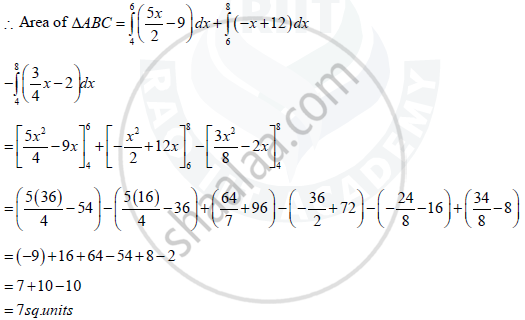
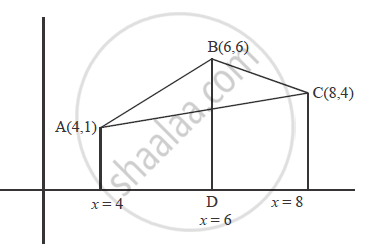
Using the method of integration, find the area of the triangle ABC, coordinates of whose vertices are A (4 , 1), B (6, 6) and C (8, 4).
Advertisements
Solution
Equation of AB
`y - y_1 = (y_2 -y_1)/(x_2-x_1) (x - x_1)`
`y - 1 = (6-1)/(6-4) (x - 4)`
`y - 1 = 5/2 (x - 4)`
2y - 2 = 5x - 20
`y = (5x)/2 - 9`
Equation of BC
`y - 6 = (4 - 6)/(8 - 6) (x - 6)`
`y - 6 = (-2)/(+2) (x - 6)`
y - 6 = -x + 6
y = -x + 12
Equation of AC
`y - 1 = (4 -1)/(8 - 4) (x - 4)`
`y -1 = 3/4 (x - 4)`
`4y - 4 = 3x - 12`
`y = (3x)/4 - 2`
RELATED QUESTIONS
The area between x = y2 and x = 4 is divided into two equal parts by the line x = a, find the value of a.
Area of the region bounded by the curve y2 = 4x, y-axis and the line y = 3 is ______.
Find the area of the region lying in the first quadrant and bounded by y = 4x2, x = 0, y = 1 and y = 4
Find the area of the region {(x, y) : y2 ≤ 4x, 4x2 + 4y2 ≤ 9}
Find the area of the region bounded by the parabola y2 = 16x and the line x = 4.
Using integration find the area of the triangle formed by negative x-axis and tangent and normal to the circle `"x"^2 + "y"^2 = 9 "at" (-1,2sqrt2)`.
Find the area of the region bounded by the following curves, the X-axis and the given lines: y = x4, x = 1, x = 5
Find the area of the region bounded by the following curves, the X-axis and the given lines:
y = x2 + 1, x = 0, x = 3
Fill in the blank :
The area of the region bounded by the curve x2 = y, the X-axis and the lines x = 3 and x = 9 is _______.
State whether the following is True or False :
The area of the portion lying above the X-axis is positive.
Solve the following :
Find the area of the region bounded by the curve y = x2 and the line y = 10.
Area of the region bounded by the curve x = y2, the positive Y axis and the lines y = 1 and y = 3 is ______
Choose the correct alternative:
Area of the region bounded by y2 = 16x, x = 1 and x = 4 and the X axis, lying in the first quadrant is ______
Choose the correct alternative:
Area of the region bounded by x = y4, y = 1 and y = 5 and the Y-axis lying in the first quadrant is ______
The area of the shaded region bounded by two curves y = f(x), and y = g(x) and X-axis is `int_"a"^"b" "f"(x) "d"x + int_"a"^"b" "g"(x) "d"x`
The area of the region bounded by the curve y2 = x and the Y axis in the first quadrant and lines y = 3 and y = 9 is ______
Find the area of the region bounded by the curve 4y = 7x + 9, the X-axis and the lines x = 2 and x = 8
Find the area of the region bounded by the curve y = `sqrt(36 - x^2)`, the X-axis lying in the first quadrant and the lines x = 0 and x = 6
Find the area of the circle x2 + y2 = 16
Area bounded by the curve xy = 4, X-axis between x = 1, x = 5 is ______.
The equation of curve through the point (1, 0), if the slope of the tangent to t e curve at any point (x, y) is `(y - 1)/(x^2 + x)`, is
Equation of a common tangent to the circle, x2 + y2 – 6x = 0 and the parabola, y2 = 4x, is:
Find the area between the two curves (parabolas)
y2 = 7x and x2 = 7y.
Area bounded by y = sec2x, x = `π/6`, x = `π/3` and x-axis is ______.
The area bounded by the curve, y = –x, X-axis, x = 1 and x = 4 is ______.
Which expression gives physical area when the curve \[y=f(x)\] lies below the \[x\]-axis from \[x=a\] to \[x=b\]?
