Advertisements
Advertisements
Question
Find the area of the smaller region bounded by the ellipse `x^2/a^2 + y^2/b^2 = 1` and the line `x/a + y/b = 1`
Advertisements
Solution
The area of the smaller region bounded by the ellipse, `x^2/a^2 + y^2/b^2 = 1`, and the line, `x/a + y/b = 1`, is represented by the shaded region BCAB as
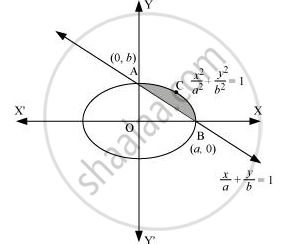
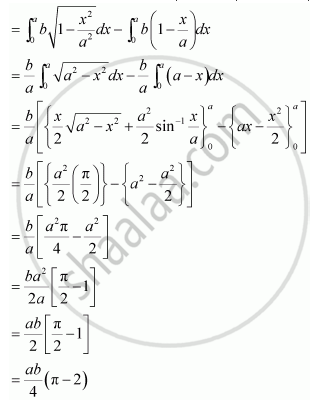
∴ Area BCAB = Area (OBCAO) – Area (OBAO)
APPEARS IN
RELATED QUESTIONS
Find the area of the region bounded by x2 = 4y, y = 2, y = 4 and the y-axis in the first quadrant.
Find the area of the region in the first quadrant enclosed by x-axis, line x = `sqrt3` y and the circle x2 + y2 = 4.
Find the area bounded by the curve x2 = 4y and the line x = 4y – 2
Area of the region bounded by the curve y2 = 4x, y-axis and the line y = 3 is ______.
Find the area of the region lying in the first quadrant and bounded by y = 4x2, x = 0, y = 1 and y = 4
Sketch the graph of y = |x + 3| and evaluate `int_(-6)^0 |x + 3|dx`
Find the area enclosed between the parabola 4y = 3x2 and the straight line 3x - 2y + 12 = 0.
Find the area bounded by the circle x2 + y2 = 16 and the line `sqrt3 y = x` in the first quadrant, using integration.
Area of the region bounded by x2 = 16y, y = 1 and y = 4 and the Y-axis, lying in the first quadrant is _______.
Area of the region bounded by y = x4, x = 1, x = 5 and the X-axis is _______.
State whether the following is True or False :
The area bounded by the curve y = f(x), X-axis and lines x = a and x = b is `|int_"a"^"b" f(x)*dx|`.
If the curve, under consideration, is below the X-axis, then the area bounded by curve, X-axis and lines x = a, x = b is positive.
State whether the following is True or False :
The area of the portion lying above the X-axis is positive.
Solve the following:
Find the area of the region bounded by the curve x2 = 25y, y = 1, y = 4 and the Y-axis.
Choose the correct alternative:
Area of the region bounded by the curve y = x3, x = 1, x = 4 and the X-axis is ______
Find the area of the region bounded by the parabola y2 = 25x and the line x = 5
Find the area of the region bounded by the curve 4y = 7x + 9, the X-axis and the lines x = 2 and x = 8
Find area of the region bounded by the parabola x2 = 36y, y = 1 and y = 4, and the positive Y-axis
The area of the region bounded by the curve y = 4x3 − 6x2 + 4x + 1 and the lines x = 1, x = 5 and X-axis is ____________.
`int_0^log5 (e^xsqrt(e^x - 1))/(e^x + 3)` dx = ______
`int "e"^x ((sqrt(1 - x^2) * sin^-1 x + 1)/sqrt(1 - x^2))`dx = ________.
Area under the curve `y=sqrt(4x+1)` between x = 0 and x = 2 is ______.
The area enclosed by the parabolas x = y2 - 1 and x = 1 - y2 is ______.
The area bounded by the X-axis, the curve y = f(x) and the lines x = 1, x = b is equal to `sqrt("b"^2 + 1) - sqrt(2)` for all b > 1, then f(x) is ______.
If a2 + b2 + c2 = – 2 and f(x) = `|(1 + a^2x, (1 + b^2)x, (1 + c^2)x),((1 + a^2)x, 1 + b^2x, (1 + c^2)x),((1 + a^2)x, (1 + b^2)x, 1 + c^2x)|` then f(x) is a polynomial of degree
The area included between the parabolas y2 = 4a(x +a) and y2 = 4b(x – a), b > a > 0, is
The area of the circle `x^2 + y^2 = 16`, exterior to the parabola `y = 6x`
The slope of a tangent to the curve y = 3x2 – x + 1 at (1, 3) is ______.
The area (in sq.units) of the part of the circle x2 + y2 = 36, which is outside the parabola y2 = 9x, is ______.
The area (in sq. units) of the region {(x, y) : y2 ≥ 2x and x2 + y2 ≤ 4x, x ≥ 0, y ≥ 0} is ______.
For an area bounded by \[x=g(y)\], the \[y\]-axis, and the horizontal lines \[y=c\] and \[y=d\], which strips are used?
Which integral gives the area bounded by \[x=g(y)\], the \[y\]-axis, and the horizontal lines \[y=c\] and \[y=d\]?
Which expression gives physical area when the curve \[y=f(x)\] lies below the \[x\]-axis from \[x=a\] to \[x=b\]?
Which standard form corresponds to a region bounded by the \[y\]-axis?
Why is \[y\] taken as positive for the region AOBA of the ellipse \[\frac{x^2}{a^2}+\frac{y^2}{b^2}=1\]?
Which antiderivative is used in evaluating \[\int \sqrt{a^2-x^2}\,dx\] for the ellipse area?
