Advertisements
Advertisements
Question
Find the area of the region enclosed by the parabola x2 = y, the line y = x + 2 and x-axis
Advertisements
Solution
The area of the region enclosed by the parabola, x2 = y, the line, y = x + 2, and x-axis is represented by the shaded region OACO as
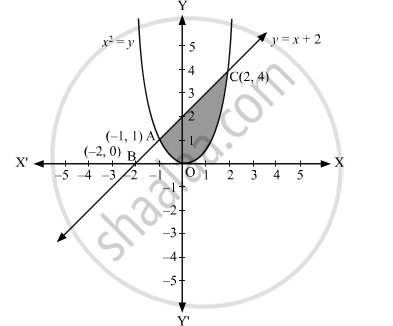
The point of intersection of the parabola, x2 = y, and the line, y = x + 2, is A (–1, 1) and C(2, 4).
Area of OACO = ∫-12x + 2 dx - ∫-12 x2 dx⇒Area of OACO = x22 + 2x-12 - 13x3-12⇒Area of OACO = 222+22 - -122+2-1 - 1323 - -13⇒Area of OACO = 2 + 4 - 12-2 - 138 + 1⇒Area of OACO = 6 + 32 - 3⇒Area of OACO = 3 + 32 = 92 square units
APPEARS IN
RELATED QUESTIONS
Find the area of the region bounded by x2 = 4y, y = 2, y = 4 and the y-axis in the first quadrant.
Find the area of the region in the first quadrant enclosed by x-axis, line x = `sqrt3` y and the circle x2 + y2 = 4.
Find the area of the region bounded by the curve y2 = 4x and the line x = 3
Find the area between the curves y = x and y = x2
Find the area of the smaller region bounded by the ellipse `x^2/a^2 + y^2/b^2 = 1` and the line `x/a + y/b = 1`
Find the area enclosed between the parabola 4y = 3x2 and the straight line 3x - 2y + 12 = 0.
Find the area of the region bounded by the following curve, the X-axis and the given line:
y = 2 – x2, x = –1, x = 1
Find the area of the region bounded by the parabola y2 = 4x and the line x = 3.
Choose the correct alternative :
Area of the region bounded by the curve x2 = y, the X-axis and the lines x = 1 and x = 3 is _______.
Fill in the blank :
Area of the region bounded by x2 = 16y, y = 1, y = 4 and the Y-axis, lying in the first quadrant is _______.
If the curve, under consideration, is below the X-axis, then the area bounded by curve, X-axis and lines x = a, x = b is positive.
Choose the correct alternative:
Using the definite integration area of the circle x2 + y2 = 16 is ______
Area of the region bounded by the curve x = y2, the positive Y axis and the lines y = 1 and y = 3 is ______
Choose the correct alternative:
Area of the region bounded by the curve x2 = 8y, the positive Y-axis lying in the first quadrant and the lines y = 4 and y = 9 is ______
State whether the following statement is True or False:
The equation of the area of the circle is `x^2/"a"^2 + y^2/"b"^2` = 1
The area of the region x2 = 4y, y = 1 and y = 2 and the Y axis lying in the first quadrant is ______
Find the area of the region bounded by the curve 4y = 7x + 9, the X-axis and the lines x = 2 and x = 8
Find area of the region bounded by 2x + 4y = 10, y = 2 and y = 4 and the Y-axis lying in the first quadrant
Find area of the region bounded by the parabola x2 = 4y, the Y-axis lying in the first quadrant and the lines y = 3
Find the area of the region bounded by the curve y = `sqrt(36 - x^2)`, the X-axis lying in the first quadrant and the lines x = 0 and x = 6
Find the area of the circle x2 + y2 = 62
The area bounded by y = `27/x^3`, X-axis and the ordinates x = 1, x = 3 is ______
Area under the curve `y=sqrt(4x+1)` between x = 0 and x = 2 is ______.
The equation of curve through the point (1, 0), if the slope of the tangent to t e curve at any point (x, y) is `(y - 1)/(x^2 + x)`, is
Equation of a common tangent to the circle, x2 + y2 – 6x = 0 and the parabola, y2 = 4x, is:
The area of the region bounded by the curve y = sin x and the x-axis in [–π, π] is ______.
The figure shows as triangle AOB and the parabola y = x2. The ratio of the area of the triangle AOB to the area of the region AOB of the parabola y = x2 is equal to ______.

The area enclosed by the parabola x2 = 4y and its latus rectum is `8/(6m)` sq units. Then the value of m is ______.
The area bounded by the curve `y = 3/2sqrtx`, the line x = 1 and x-axis is ______ sq. units.
What is the area of an elementary horizontal strip of length \[x\] and infinitesimally small width \[dy\]?
Which integral gives the area bounded by \[x=g(y)\], the \[y\]-axis, and the horizontal lines \[y=c\] and \[y=d\]?
Why cannot a curve crossing the \[x\]-axis within \[a,b\] be integrated directly from \[a\] to \[b\] to obtain total area?
Which standard form corresponds to a region bounded by the \[y\]-axis?
For the ellipse \[\frac{x^2}{a^2}+\frac{y^2}{b^2}=1\], which expression for \[y\] is obtained before selecting the first-quadrant branch?
Why is the area enclosed by \[\frac{x^2}{a^2}+\frac{y^2}{b^2}=1\] written as \[4\int_0^a y\,dx\]?
