Advertisements
Advertisements
Question
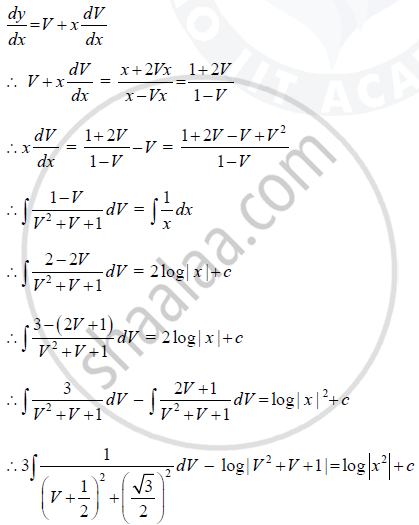
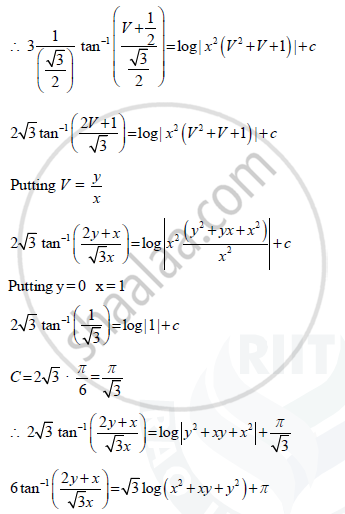
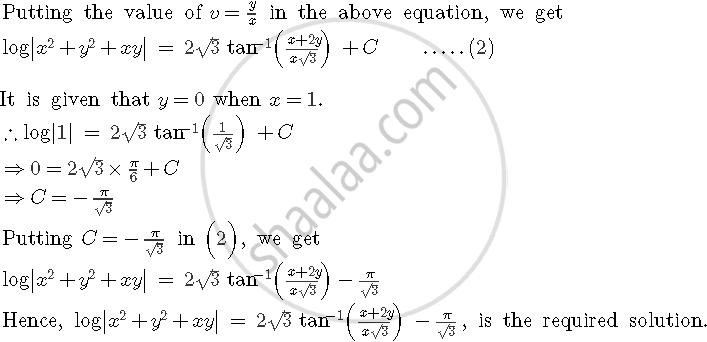
Find the particular solution of the differential equation `(x - y) dy/dx = (x + 2y)` given that y = 0 when x = 1.
Advertisements
Solution 1
`dy/dx = (x + 2y)/(x - y)`
Putting y = Vx
Solution 2
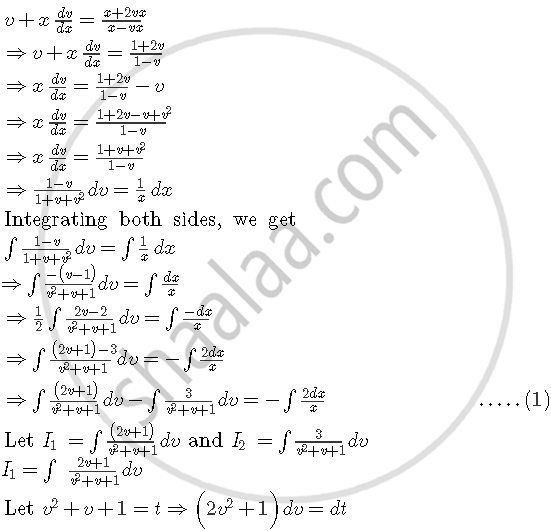
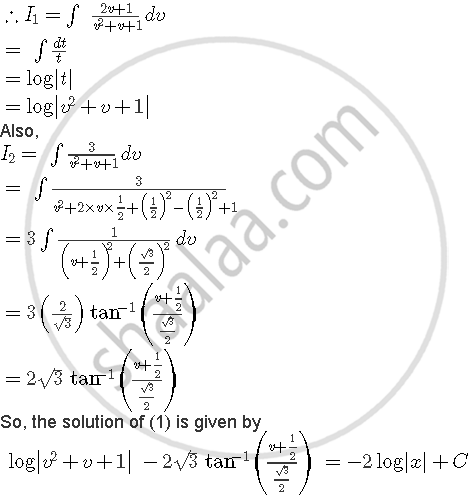
The given differential equation is
`(x - y) dy/dx = x + 2y`
`=> dy/dx = (x + 2y)/(x - y)`
This is a homogeneous differential equation.
Putting y=vx and `dy/dx = v + x dy/dx`, we get
RELATED QUESTIONS
Show that the given differential equation is homogeneous and solve them.
(x2 – y2) dx + 2xy dy = 0
Show that the given differential equation is homogeneous and solve them.
`x^2 dy/dx = x^2 - 2y^2 + xy`
Show that the given differential equation is homogeneous and solve them.
`x dy/dx - y + x sin (y/x) = 0`
Show that the given differential equation is homogeneous and solve them.
`y dx + x log(y/x)dy - 2x dy = 0`
Which of the following is a homogeneous differential equation?
(x2 + 3xy + y2) dx − x2 dy = 0
Solve the following initial value problem:
\[x e^{y/x} - y + x\frac{dy}{dx} = 0, y\left( e \right) = 0\]
Solve the following initial value problem:
\[\left\{ x \sin^2 \left( \frac{y}{x} \right) - y \right\}dx + x dy = 0, y\left( 1 \right) = \frac{\pi}{4}\]
Find the particular solution of the differential equation x cos\[\left( \frac{y}{x} \right)\frac{dy}{dx} = y \cos\left( \frac{y}{x} \right) + x\], given that when x = 1, \[y = \frac{\pi}{4}\]
A homogeneous differential equation of the form \[\frac{dx}{dy} = h\left( \frac{x}{y} \right)\] can be solved by making the substitution
Solve the differential equation: x dy - y dx = `sqrt(x^2 + y^2)dx,` given that y = 0 when x = 1.
Solve the following differential equation:
y2 dx + (xy + x2)dy = 0
F(x, y) = `(sqrt(x^2 + y^2) + y)/x` is a homogeneous function of degree ______.
F(x, y) = `(x^2 + y^2)/(x - y)` is a homogeneous function of degree 1.
Solve : `x^2 "dy"/"dx"` = x2 + xy + y2.
Let the solution curve of the differential equation `x (dy)/(dx) - y = sqrt(y^2 + 16x^2)`, y(1) = 3 be y = y(x). Then y(2) is equal to ______.
Find the general solution of the differential equation:
(xy – x2) dy = y2 dx
Which differential equation is called a homogeneous differential equation?
For the substitution \[y=vx\], which differentiated form is correct?
After using \[y=vx\] and writing the right-hand side as \[g(v)\], which separable form is obtained?
Which substitutions are chosen for a homogeneous differential equation?
For \[F(x,y)=\frac{y\cos\left(\frac{y}{x}\right)+x}{x\cos\left(\frac{y}{x}\right)}\], what is \[F(\lambda x,\lambda y)\]?
From \[v+x\frac{dv}{dx}=\frac{v\cos v+1}{\cos v}\], what is \[x\frac{dv}{dx}\]?
Which final answer results after replacing \[v=\frac{y}{x}\] in \[\sin v=\ln|Cx|\]?
