Advertisements
Advertisements
प्रश्न
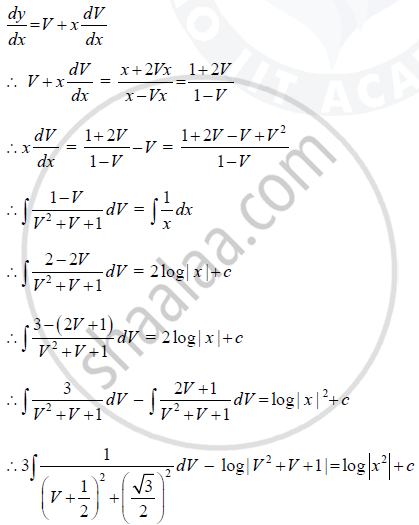
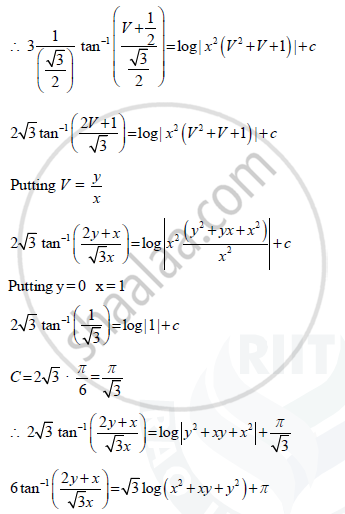
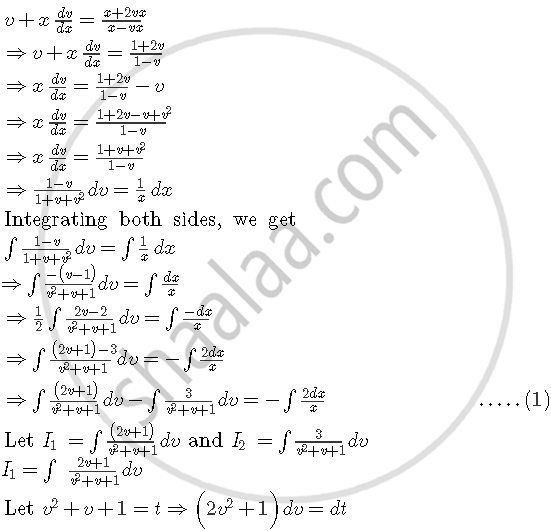
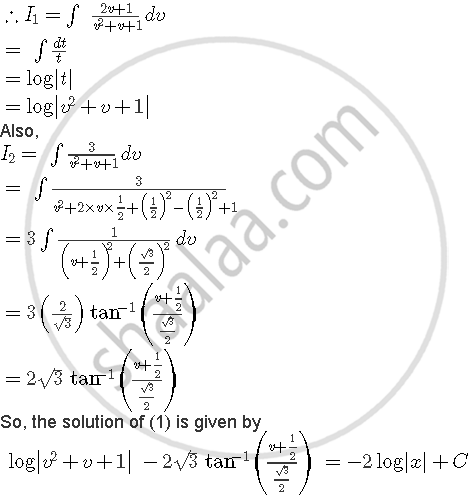
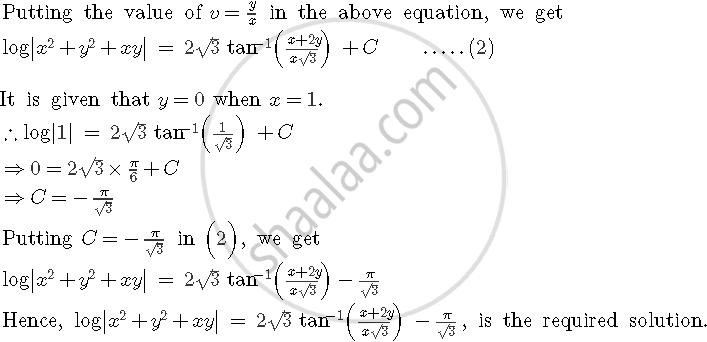
Find the particular solution of the differential equation `(x - y) dy/dx = (x + 2y)` given that y = 0 when x = 1.
Advertisements
उत्तर १
`dy/dx = (x + 2y)/(x - y)`
Putting y = Vx
उत्तर २
The given differential equation is
`(x - y) dy/dx = x + 2y`
`=> dy/dx = (x + 2y)/(x - y)`
This is a homogeneous differential equation.
Putting y=vx and `dy/dx = v + x dy/dx`, we get
संबंधित प्रश्न
Show that the given differential equation is homogeneous and solve them.
(x2 + xy) dy = (x2 + y2) dx
Show that the given differential equation is homogeneous and solve them.
`y' = (x + y)/x`
Show that the given differential equation is homogeneous and solve them.
`x^2 dy/dx = x^2 - 2y^2 + xy`
Show that the given differential equation is homogeneous and solve them.
`{xcos(y/x) + ysin(y/x)}ydx = {ysin (y/x) - xcos(y/x)}xdy`
Show that the given differential equation is homogeneous and solve them.
`(1+e^(x/y))dx + e^(x/y) (1 - x/y)dy = 0`
For the differential equation find a particular solution satisfying the given condition:
(x + y) dy + (x – y) dx = 0; y = 1 when x = 1
Prove that x2 – y2 = c (x2 + y2)2 is the general solution of differential equation (x3 – 3x y2) dx = (y3 – 3x2y) dy, where c is a parameter.
Solve the following initial value problem:
(x2 + y2) dx = 2xy dy, y (1) = 0
Solve the following initial value problem:
(y4 − 2x3 y) dx + (x4 − 2xy3) dy = 0, y (1) = 1
Solve the following initial value problem:
\[\left\{ x \sin^2 \left( \frac{y}{x} \right) - y \right\}dx + x dy = 0, y\left( 1 \right) = \frac{\pi}{4}\]
Show that the family of curves for which \[\frac{dy}{dx} = \frac{x^2 + y^2}{2xy}\], is given by \[x^2 - y^2 = Cx\]
Solve the differential equation: x dy - y dx = `sqrt(x^2 + y^2)dx,` given that y = 0 when x = 1.
Solve the following differential equation:
`(1 + 2"e"^("x"/"y")) + 2"e"^("x"/"y")(1 - "x"/"y") "dy"/"dx" = 0`
Solve the following differential equation:
`"dy"/"dx" + ("x" - "2y")/("2x" - "y") = 0`
Solve the following differential equation:
`x * dy/dx - y + x * sin(y/x) = 0`
Solve the following differential equation:
(x2 + 3xy + y2)dx - x2 dy = 0
State whether the following statement is True or False:
A homogeneous differential equation is solved by substituting y = vx and integrating it
F(x, y) = `(sqrt(x^2 + y^2) + y)/x` is a homogeneous function of degree ______.
F(x, y) = `(x^2 + y^2)/(x - y)` is a homogeneous function of degree 1.
Let the solution curve of the differential equation `x (dy)/(dx) - y = sqrt(y^2 + 16x^2)`, y(1) = 3 be y = y(x). Then y(2) is equal to ______.
If a curve y = f(x), passing through the point (1, 2), is the solution of the differential equation, 2x2dy = (2xy + y2)dx, then `f(1/2)` is equal to ______.
Find the general solution of the differential equation:
(xy – x2) dy = y2 dx
Read the following passage:
|
An equation involving derivatives of the dependent variable with respect to the independent variables is called a differential equation. A differential equation of the form `dy/dx` = F(x, y) is said to be homogeneous if F(x, y) is a homogeneous function of degree zero, whereas a function F(x, y) is a homogeneous function of degree n if F(λx, λy) = λn F(x, y). To solve a homogeneous differential equation of the type `dy/dx` = F(x, y) = `g(y/x)`, we make the substitution y = vx and then separate the variables. |
Based on the above, answer the following questions:
- Show that (x2 – y2) dx + 2xy dy = 0 is a differential equation of the type `dy/dx = g(y/x)`. (2)
- Solve the above equation to find its general solution. (2)
A function \[F(x,y)\] is homogeneous of degree \[n\] when which condition holds?
Writing \[x\cos\left(\frac{y}{x}\right)\frac{dy}{dx}=y\cos\left(\frac{y}{x}\right)+x\] in standard form gives which expression?
After putting \[y=vx\] in \[\frac{dy}{dx}=\frac{y\cos\left(\frac{y}{x}\right)+x}{x\cos\left(\frac{y}{x}\right)}\], which equation results?
