Advertisements
Advertisements
Question
Solve the following :
Find the area of the region bounded by the curve y = x2 and the line y = 10.
Advertisements
Solution
Given equation of the curve is
y = x2
∴ x = `sqrt(y)` ...[∵ In first quadrant, x> 0]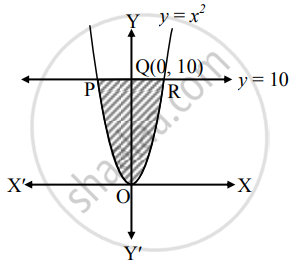
Required area = area of the region ORQPO
= 2 (area of the region ORQO)
= `2 int_0^10x*dy`
= `2int_0^10 y^(1/2)*dy`
= `2[y^(3/2)/(3/2)]_0^10`
= `(4)/(3)[(10)^(3/2) - 0]`
= `(4)/(3)(10sqrt(10))`
= `(40sqrt(10))/(3)"sq.units"`.
APPEARS IN
RELATED QUESTIONS
Using integration find the area of the triangle formed by positive x-axis and tangent and normal of the circle
`x^2+y^2=4 at (1, sqrt3)`
Find the area of the region bounded by the curve y2 = x and the lines x = 1, x = 4 and the x-axis.
Find the area of the region bounded by x2 = 4y, y = 2, y = 4 and the y-axis in the first quadrant.
Find the area under the given curve and given line:
y = x4, x = 1, x = 5 and x-axis
Find the area of the region lying in the first quadrant and bounded by y = 4x2, x = 0, y = 1 and y = 4
Find the area enclosed between the parabola 4y = 3x2 and the straight line 3x - 2y + 12 = 0.
Choose the correct alternative :
Area of the region bounded by the curve x2 = y, the X-axis and the lines x = 1 and x = 3 is _______.
Area of the region bounded by y = x4, x = 1, x = 5 and the X-axis is _______.
Solve the following:
Find the area of the region bounded by the curve x2 = 25y, y = 1, y = 4 and the Y-axis.
Choose the correct alternative:
Area of the region bounded by x = y4, y = 1 and y = 5 and the Y-axis lying in the first quadrant is ______
State whether the following statement is True or False:
The equation of the area of the circle is `x^2/"a"^2 + y^2/"b"^2` = 1
The area of the shaded region bounded by two curves y = f(x), and y = g(x) and X-axis is `int_"a"^"b" "f"(x) "d"x + int_"a"^"b" "g"(x) "d"x`
The area of the region x2 = 4y, y = 1 and y = 2 and the Y axis lying in the first quadrant is ______
Find the area of the region bounded by the curve y = `sqrt(2x + 3)`, the X axis and the lines x = 0 and x = 2
Find the area of the region bounded by the curve 4y = 7x + 9, the X-axis and the lines x = 2 and x = 8
Find area of the region bounded by the curve y = – 4x, the X-axis and the lines x = – 1 and x = 2
Find the area of the region bounded by the curve y = `sqrt(36 - x^2)`, the X-axis lying in the first quadrant and the lines x = 0 and x = 6
Find the area of the circle x2 + y2 = 16
The area of the region bounded by the curve y = 4x3 − 6x2 + 4x + 1 and the lines x = 1, x = 5 and X-axis is ____________.
The area enclosed by the parabolas x = y2 - 1 and x = 1 - y2 is ______.
The area bounded by the X-axis, the curve y = f(x) and the lines x = 1, x = b is equal to `sqrt("b"^2 + 1) - sqrt(2)` for all b > 1, then f(x) is ______.
Equation of a common tangent to the circle, x2 + y2 – 6x = 0 and the parabola, y2 = 4x, is:
The area included between the parabolas y2 = 4a(x +a) and y2 = 4b(x – a), b > a > 0, is
The area of the region bounded by the curve y = x2, x = 0, x = 3, and the X-axis is ______.
The figure shows as triangle AOB and the parabola y = x2. The ratio of the area of the triangle AOB to the area of the region AOB of the parabola y = x2 is equal to ______.

The area bounded by the curve | x | + y = 1 and X-axis is ______.
Why is \[y\] taken as positive for the region AOBA of the ellipse \[\frac{x^2}{a^2}+\frac{y^2}{b^2}=1\]?
What is the area enclosed by the ellipse \[\frac{x^2}{a^2}+\frac{y^2}{b^2}=1\]?
