Advertisements
Advertisements
Question
Explain the application of heating effect of electric current in an electric bulb with a diagram.
Advertisements
Solution
- Electric bulb works on the principle of heating effect electric of current.
- The solenoid type coil of bulb has high resistivity and very high melting point.
- When current is passed through the bulb, solenoid type coil of bulb gets heated to high temperature (upto 3400 °C) and starts glowing.

RELATED QUESTIONS
Why does the cord of an electric heater not glow while the heating element does?
An electric heater of resistance 8 Ω draws 15 A from the service mains 2 hours. Calculate the rate at which heat is developed in the heater.
How does the resistance of a wire vary with its area of cross-section?
An electric heater is connected to the 230 V mains supply. A current of 8 A flows through the heater.
(b) How much energy is transferred to the heater each second?
Write down the formula for the heat produced when a current I is passed through a resistor R for time t.
Explain why, the current that makes the heater element very hot, only slightly warms the connecting wires leading to the heater.
Derive the expression for the heat produced due to a current 'I' flowing for a time interval 't' through a resistor 'R' having a potential difference 'V' across its ends. With which name is this relation known?
How much heat will an instrument of 12 W produce in one minute if it is connected to the heat produced by it?
The current passing through an electric kettle has been doubled. The heat produced will become:
(a) half
(b) double
(c) four time
(d) one-fourth
An electric fuse works on the:
(a) chemical effect of current
(b) magnetic effect of current
(c) lighting effect of current
(d) heating effect of current
The heat produced in a wire of resistance 'x' when a current 'y' flows through it in time 'z' is given by:
(a) x2 × y × z
(b) x × z × y2
(c) y × z2 × x
(d) y × z × x
Which of the following characteristic is not suitable for a fuse wire?
(a) thin and short
(b) thick and short
(c) low melting point
(d) higher resistance than rest of wiring
Which electric heating device in your home do you think have resistors which control the flow of electricity?
Give Scientific reason.
In practice, the unit kWh is used for the measurement of electrical energy, rather than joule.
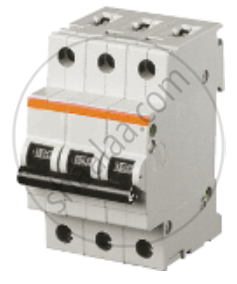
Identify the figure and give its use.
Heat energy is being produced in a resistance in a circuit at the rate of 100 W. The current of 3 A is flowing in the circuit. What must be the value of the resistance?
An electric iron of 1100 W is operated for 2 hrs daily. What will be the electrical consumption expenses for that in the month of April? (The electric company charges Rs 5 per unit of energy).
Give scientific reason :
In the electric equipment producing heat e.g. iron, electric heater, boiler, toaster, etc., an alloy such as Nichrome is used, not pure metals.
Rewrite the following statement by selecting the correct option:
1 A = ____________ mA.
Compute the heat generated while transferring 96000 coulombs of charge in two hours through a potential difference of 40 V.
The electricity bill specifies the usage in _______.
What is a short circuit?
Explain the importance/uses of fuse wire.
What does overloading cause?
Mark the correct choice
- Assertion: Electric appliances with a metallic body have three wire connections.
- Reason: Three-pin connections reduce the heating of the connecting wires.
Why is parallel arrangement used in domestic wiring?
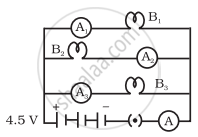
B1, B2 and B3 are three identical bulbs connected as shown in Figure. When all the three bulbs glow, a current of 3A is recorded by the ammeter A.
- What happens to the glow of the other two bulbs when the bulb B1 gets fused?
- What happens to the reading of A1, A2, A3 and A when the bulb B2 gets fused?
- How much power is dissipated in the circuit when all the three bulbs glow together?
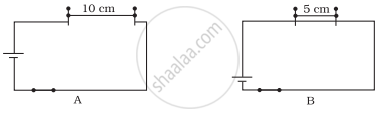
Paheli took a wire of length 10 cm. Boojho took a wire of 5 cm of the same material and thickness. Both of them connected the wires as shown in the circuit given in the following figure. The current flowing in both the circuits is the same.
- Will the heat produced in both cases be equal? Explain.
- Will the heat produced be the same if the wires taken by them are of equal lengths but of different thickness? Explain.
An MCB can be used instead of a fuse in an electrical circuit.
An electric fuse has a body made of ceramic and two points for connecting the fuse wire.
It would cost a man Rs. 3.50 to buy 1.0 kW h of electrical energy from the Main Electricity Board. His generator has a maximum power of 2.0 kW. The generator produces energy at this maximum power for 3 hours. Calculate how much it would cost to buy the same amount of energy from the Main Electricity Board.
Match the following
| 1. | Bulb | a. | Conductor |
| 2. | Electroplating | b. |
Insulator |
| 3. | Pure water | c. | Heating effect of current |
| 4. | Salt solution | d. | Chemical effect of current |
Assertion: A current-carrying wire should be charged.
Reason: The current in a wire is due to the flow of free electrons in a definite direction.
Name a few appliances which work on the basis of the heating effect of current.
A student boils water in an electric kettle for 20 minutes. Using the same mains supply he wants to reduce the boiling time of water. To do so should he increase or decrease the length of the heating element? Justify your answer.
What is a trip switch?
The following is not a safety device.
An electrochemical cell converts ______ energy into ______ energy.
