Advertisements
Advertisements
Questions
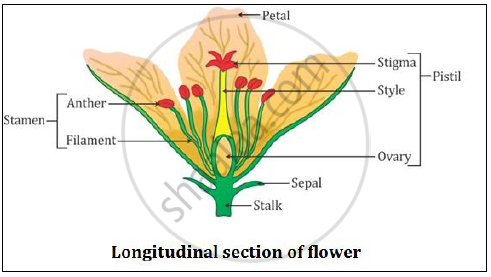
Draw a diagram of the longitudinal section of a flower and label the following parts.
Draw a labelled diagram of the longitudinal section of a flower.
Draw a well-labelled diagram of the longitudinal section of a flower.
Advertisements
Solution 1
Longitudinal section of a flower:
Solution 2

Longitudinal section of flower
RELATED QUESTIONS
Name the parts labelled as A, B, C and D in the diagram given below:-

State significance of pollination.
You are asked by your teacher to study the different parts of an embryo of a gram seed. Given below are the steps to be followed for the experiment:
I. Soak the gram seeds in plain water and keep them overnight.
II. Cut open a soaked seed and observe its different parts.
III. Take some dry gram seeds in a petri dish.
IV. Drain the excess water.
V. Cover the soaked seeds with a wet cotton cloth and leave them for a day.
The correct sequence of these steps is :
(A) III, I, V, IV, II
(B) III, I, II, IV, V
(C) III, IV, V, I, II
(D) III, I, IV, V, II
Write the names of those parts of a flower which serve the same function as the following do in the animals :
(i) testis,
(ii) sperm,
(iii) ovary,
(iv) egg
Explain what you understand by sexual reproduction.
Sketch the reproductive parts of a flower.
The process of fusion of the male and female gametes is called ______.
State the name of the functional unit concerned with sexual reproduction.
What is the function of a flower?
Fill in the following blank with suitable word :
The female organ of reproduction in the flower is the...........
Fill in the following blank with suitable word :
The male organ of reproduction in the flower is the.......... .
Fill in the following blank with suitable word :
The name of the structure in the flower in which the male gamete is formed is...........
Fill in the following blank with suitable word :
The.......... at the base of the carpel contains egg cells.
Draw a neat sketch of the carpel of a flower. Mark in it stigma, style and ovary.
Explain the term 'fertilisation'.
Name the part of a seed which grows into root.
Name the part of a seed which grows into shoot.
In tobacco plant, the male gametes have 24 chromosomes.
What is the number of chromosomes in the female gamete?
What changes take place in the flower after fertilisation which lead to the formation of seeds and fruit?
(a) Draw a neat diagram of a flower showing its various parts. In this diagram mark stem, receptacle, sepals, petals, stamen and carpel.
(b) What name is given to (i) all the petals of a flower, and (ii) all the sepals of a flower?
(c) What are (i) stamen, and (ii) carpel, in a flower?
(d) What is the other name of carpel of a flower?
(e) What is the name of yellow powdery substance present in the anther of a flower?
The length of pollen tube depends on the distance between :
(a) pollen grain and upper surface of stigma
(b) pollen grain on upper surface of stigma and ovule
(c) pollen grain in anther and upper surface of stigma
(d) upper surface of stigma and lower part of style
Which of the following statements are true for sexual reproduction in flowering plants?
(i) it requires two types of gametes
(ii) fertilisation is a compulsory event
(iii) it always results in the formation of zygote
(iv) offsprings formed are clones
(a) (i) and (iv)
(b) (i), (ii) and (iv)
(c) (i), (ii) and (iii)
(d) (ii), (iii) and (iv)
The part of a seed which grows and develops into root on germination is :
(a) cotyledon
(b) plumule
(c) follicle
(d) radicle
When an insect sits on the flower of a plant then some particles A present in the top of little stalks in the flower attach to its body hair. When this insect now sits on the flower of another similar plant, then particles A attached to the hair of insect are put on the top of a flask-shaped organ at the centre of flower. The particle A grows a long tube b from the top of flask-shaped organ through which C moves down and reaches the bottom part of flask-shaped organ. Here C fuses with the nucleus of d contained in structure E. the fusion of C and D forms a new cell f which grows and develops into a seed of the plant.
(a) What are particles A? What is the process of transferring A from one flower to another flower of similar plant by the insect known as?
(b) What is the name of tube B?
(c) What is C which moves down through the tube B?
(d) Name D and E.
(e) What is F?
What is a flower ? Draw a neat labelled diagram showing the L.S. of a typical flower.
State whether the following statement is true (T) or false (F):
Flowers which possess stamens and carpel are called unisexual.
Find the odd-one out, giving reason:
Anther, pollen grain, ovule male gamete
Write one main difference between asexual and sexual mode of reproduction. Which species is likely to have comparatively better chances of survival – the one reproducing asexually or the one reproducing sexually? Give reason to justify your answer.
A student is asked to study the different parts of an embryo of pea seeds. Given below are the essential steps for the experiment :
(I) Soak the pea seeds in plain water and keep them overnight.
(II) Cut open the soaked seed and observe its different parts.
(III) Take some pea seeds in a petri dish.
(IV) Drain the excess water. Cover the seeds with a wet cotton cloth and leave them as it is for a day.
The correct sequence of these steps is
(A) III, I, IV, II
(B) III, IV, I, II
(C) III, I, II, IV
(D) III, II, I, IV
Sketch the labelled diagram.
Flower with its sexual reproductive organs.
Fill in the blank by selecting suitable word:
Transfer of pollen grains from the anther to the stigma is known as______________.
Find an odd one out.
Pollen tube reaches the embryo sac via style.
Write the functions of sepals
Give scientific reason.
Flower is a structural unit of sexual reproduction in plants.
Give scientific reason.
Fertilization in plants is called double fertilization.
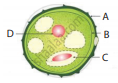
Identify the parts A, B, C, and D?
In which of the following manner the arrangement of megaspores in a tetrad is observed in angiosperms?
Generally, in a pollen tube, which of the following moves to the tip of the tube?
Identify the female gametophyte in angiosperms.
What would be the number of chromosomes of the aleurone cells of a plant with 42 chromosomes in its roots tip cells?
Flowers showing ornithophily show few characteristic like ______.
Conidia are formed endogenously while zoospores are formed endogenously.
The seed that contains the future plant is called the ______
In human beings, fertilization occurs in the ______
Variations occur as a result of ______
Complete the table
| Carly x | ______ | ______ |
| ______ | petal | attract insects |
| Androecium | ______ | Male reproductive part |
| ______ | ______ | Female reproductive part. |
Which among the following statements are true for unisexual flowers?
- They possess both stamen and pistil
- They possess either stamen or pistil
- They exhibit cross pollination
- Unisexual flowers possessing only stamens cannot produce fruits
Give reason for the following:
Fertilization cannot take place in flowers if pollination does not occur.
Draw the diagram of a flower and label the four whorls. Write the names of gamete producing organs in the flower.
Sketch and label the essential and accessory whorls of flower.
Triple fusion involves ______.
