Advertisements
Advertisements
Question
Advertisements
Solution
We have,
\[\frac{dy}{dx} = x^5 \tan^{- 1} \left( x^3 \right)\]
\[ \Rightarrow dy = \left\{ x^5 \tan^{- 1} \left( x^3 \right) \right\}dx\]
Integrating both sides, we get
\[\int dy = \int x^5 \tan^{- 1} \left( x^3 \right)dx\]
\[ \Rightarrow y = \int x^5 \tan^{- 1} \left( x^3 \right)dx\]
\[\text{Putting }t = x^3 ,\text{ we get }\]
\[dt = 3 x^2 dx\]
\[ \therefore y = \frac{1}{3}\int t \tan^{- 1} t dt\]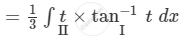
\[ = \frac{1}{3}\left[ \tan^{- 1} t\int t dt - \int\left\{ \frac{d}{dt}\left( \tan^{- 1} t \right)\int t dx \right\}dt \right]\]
\[ = \frac{1}{3} \times \frac{t^2 \tan^{- 1} t}{2} - \frac{1}{6}\int\frac{t^2}{\left( 1 + t^2 \right)}dt\]
\[ = \frac{t^2 \tan^{- 1} t}{6} - \frac{1}{6}\int\frac{t^2 + 1 - 1}{\left( 1 + t^2 \right)}dt\]
\[ = \frac{t^2 \tan^{- 1} t}{6} - \frac{1}{6}\int dt + \frac{1}{6}\int\frac{1}{1 + t^2}dt\]
\[ = \frac{t^2 \tan^{- 1} t}{6} - \frac{1}{6}t + \frac{\tan^{- 1} t}{6} + C\]
\[ = \frac{x^6 \tan^{- 1} x^3}{6} - \frac{1}{6} x^3 + \frac{\tan^{- 1} x^3}{6} + C\]
\[ = \frac{1}{6}\left( x^6 \tan^{- 1} x^3 - x^3 + \tan^{- 1} x^3 \right) + C\]
\[\text{Hence, }y = \frac{1}{6}\left( x^6 \tan^{- 1} x^3 - x^3 + \tan^{- 1} x^3 \right) +\text{C is the solution to the given differential equation.}\]
APPEARS IN
RELATED QUESTIONS
Differential equation \[\frac{d^2 y}{d x^2} - \frac{dy}{dx} = 0, y \left( 0 \right) = 2, y'\left( 0 \right) = 1\]
Function y = ex + 1
Differential equation \[\frac{d^2 y}{d x^2} + y = 0, y \left( 0 \right) = 1, y' \left( 0 \right) = 1\] Function y = sin x + cos x
Solve the following differential equation:
\[\left( 1 + y^2 \right) \tan^{- 1} xdx + 2y\left( 1 + x^2 \right)dy = 0\]
The volume of a spherical balloon being inflated changes at a constant rate. If initially its radius is 3 units and after 3 seconds it is 6 units. Find the radius of the balloon after `t` seconds.
Find the particular solution of the differential equation \[\frac{dy}{dx} = \frac{xy}{x^2 + y^2}\] given that y = 1 when x = 0.
Solve the following initial value problem:-
\[x\frac{dy}{dx} - y = \left( x + 1 \right) e^{- x} , y\left( 1 \right) = 0\]
Solve the following initial value problem:-
\[\frac{dy}{dx} + y \tan x = 2x + x^2 \tan x, y\left( 0 \right) = 1\]
A bank pays interest by continuous compounding, that is, by treating the interest rate as the instantaneous rate of change of principal. Suppose in an account interest accrues at 8% per year, compounded continuously. Calculate the percentage increase in such an account over one year.
Experiments show that radium disintegrates at a rate proportional to the amount of radium present at the moment. Its half-life is 1590 years. What percentage will disappear in one year?
Find the equation of the curve which passes through the origin and has the slope x + 3y− 1 at any point (x, y) on it.
A curve is such that the length of the perpendicular from the origin on the tangent at any point P of the curve is equal to the abscissa of P. Prove that the differential equation of the curve is \[y^2 - 2xy\frac{dy}{dx} - x^2 = 0\], and hence find the curve.
Find the equation of the curve which passes through the point (1, 2) and the distance between the foot of the ordinate of the point of contact and the point of intersection of the tangent with x-axis is twice the abscissa of the point of contact.
Write the differential equation obtained by eliminating the arbitrary constant C in the equation x2 − y2 = C2.
The solution of the differential equation y1 y3 = y22 is
The differential equation satisfied by ax2 + by2 = 1 is
Find the equation of the plane passing through the point (1, -2, 1) and perpendicular to the line joining the points A(3, 2, 1) and B(1, 4, 2).
Determine the order and degree of the following differential equations.
| Solution | D.E |
| y = aex + be−x | `(d^2y)/dx^2= 1` |
For each of the following differential equations find the particular solution.
`y (1 + logx)dx/dy - x log x = 0`,
when x=e, y = e2.
Solve the following differential equation.
xdx + 2y dx = 0
Solve:
(x + y) dy = a2 dx
Solve the differential equation sec2y tan x dy + sec2x tan y dx = 0
Solve `("d"y)/("d"x) = (x + y + 1)/(x + y - 1)` when x = `2/3`, y = `1/3`
Solve the differential equation (x2 – yx2)dy + (y2 + xy2)dx = 0
Choose the correct alternative:
General solution of `y - x ("d"y)/("d"x)` = 0 is
The solution of differential equation `x^2 ("d"^2y)/("d"x^2)` = 1 is ______
Solve the following differential equation `("d"y)/("d"x)` = cos(x + y)
Solution: `("d"y)/("d"x)` = cos(x + y) ......(1)
Put `square`
∴ `1 + ("d"y)/("d"x) = "dv"/("d"x)`
∴ `("d"y)/("d"x) = "dv"/("d"x) - 1`
∴ (1) becomes `"dv"/("d"x) - 1` = cos v
∴ `"dv"/("d"x)` = 1 + cos v
∴ `square` dv = dx
Integrating, we get
`int 1/(1 + cos "v") "d"v = int "d"x`
∴ `int 1/(2cos^2 ("v"/2)) "dv" = int "d"x`
∴ `1/2 int square "dv" = int "d"x`
∴ `1/2* (tan("v"/2))/(1/2)` = x + c
∴ `square` = x + c
An appropriate substitution to solve the differential equation `"dx"/"dy" = (x^2 log(x/y) - x^2)/(xy log(x/y))` is ______.
If `y = log_2 log_2(x)` then `(dy)/(dx)` =
Which of the following defines a differential equation?
Why is the equation \[x\frac{dy}{dx} + y = 0\] classified as a differential equation?
