Advertisements
Advertisements
प्रश्न
Advertisements
उत्तर
We have,
\[\frac{dy}{dx} = x^5 \tan^{- 1} \left( x^3 \right)\]
\[ \Rightarrow dy = \left\{ x^5 \tan^{- 1} \left( x^3 \right) \right\}dx\]
Integrating both sides, we get
\[\int dy = \int x^5 \tan^{- 1} \left( x^3 \right)dx\]
\[ \Rightarrow y = \int x^5 \tan^{- 1} \left( x^3 \right)dx\]
\[\text{Putting }t = x^3 ,\text{ we get }\]
\[dt = 3 x^2 dx\]
\[ \therefore y = \frac{1}{3}\int t \tan^{- 1} t dt\]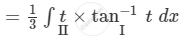
\[ = \frac{1}{3}\left[ \tan^{- 1} t\int t dt - \int\left\{ \frac{d}{dt}\left( \tan^{- 1} t \right)\int t dx \right\}dt \right]\]
\[ = \frac{1}{3} \times \frac{t^2 \tan^{- 1} t}{2} - \frac{1}{6}\int\frac{t^2}{\left( 1 + t^2 \right)}dt\]
\[ = \frac{t^2 \tan^{- 1} t}{6} - \frac{1}{6}\int\frac{t^2 + 1 - 1}{\left( 1 + t^2 \right)}dt\]
\[ = \frac{t^2 \tan^{- 1} t}{6} - \frac{1}{6}\int dt + \frac{1}{6}\int\frac{1}{1 + t^2}dt\]
\[ = \frac{t^2 \tan^{- 1} t}{6} - \frac{1}{6}t + \frac{\tan^{- 1} t}{6} + C\]
\[ = \frac{x^6 \tan^{- 1} x^3}{6} - \frac{1}{6} x^3 + \frac{\tan^{- 1} x^3}{6} + C\]
\[ = \frac{1}{6}\left( x^6 \tan^{- 1} x^3 - x^3 + \tan^{- 1} x^3 \right) + C\]
\[\text{Hence, }y = \frac{1}{6}\left( x^6 \tan^{- 1} x^3 - x^3 + \tan^{- 1} x^3 \right) +\text{C is the solution to the given differential equation.}\]
APPEARS IN
संबंधित प्रश्न
Solve the equation for x: `sin^(-1) 5/x + sin^(-1) 12/x = π/2, x ≠ 0`
Form the differential equation representing the family of ellipses having centre at the origin and foci on x-axis.
Show that the function y = A cos x + B sin x is a solution of the differential equation \[\frac{d^2 y}{d x^2} + y = 0\]
Hence, the given function is the solution to the given differential equation. \[\frac{c - x}{1 + cx}\] is a solution of the differential equation \[(1+x^2)\frac{dy}{dx}+(1+y^2)=0\].
Show that y = ex (A cos x + B sin x) is the solution of the differential equation \[\frac{d^2 y}{d x^2} - 2\frac{dy}{dx} + 2y = 0\]
Differential equation \[\frac{d^2 y}{d x^2} + y = 0, y \left( 0 \right) = 0, y' \left( 0 \right) = 1\] Function y = sin x
C' (x) = 2 + 0.15 x ; C(0) = 100
Solve the following differential equation:
(xy2 + 2x) dx + (x2 y + 2y) dy = 0
Solve the differential equation \[x\frac{dy}{dx} + \cot y = 0\] given that \[y = \frac{\pi}{4}\], when \[x=\sqrt{2}\]
3x2 dy = (3xy + y2) dx
Solve the following initial value problem:-
\[\frac{dy}{dx} + 2y \tan x = \sin x; y = 0\text{ when }x = \frac{\pi}{3}\]
Solve the following initial value problem:-
\[\frac{dy}{dx} + y\cot x = 2\cos x, y\left( \frac{\pi}{2} \right) = 0\]
The normal to a given curve at each point (x, y) on the curve passes through the point (3, 0). If the curve contains the point (3, 4), find its equation.
Find the equation of the curve passing through the point (0, 1) if the slope of the tangent to the curve at each of its point is equal to the sum of the abscissa and the product of the abscissa and the ordinate of the point.
The integrating factor of the differential equation (x log x)
\[\frac{dy}{dx} + y = 2 \log x\], is given by
Integrating factor of the differential equation cos \[x\frac{dy}{dx} + y\] sin x = 1, is
What is integrating factor of \[\frac{dy}{dx}\] + y sec x = tan x?
Verify that the function y = e−3x is a solution of the differential equation \[\frac{d^2 y}{d x^2} + \frac{dy}{dx} - 6y = 0.\]
Form the differential equation of the family of circles having centre on y-axis and radius 3 unit.
Solve the following differential equation.
`dy/dx = x^2 y + y`
Solve the following differential equation.
`x^2 dy/dx = x^2 +xy - y^2`
The differential equation of `y = k_1e^x+ k_2 e^-x` is ______.
The solution of `dy/dx + x^2/y^2 = 0` is ______
The integrating factor of the differential equation `dy/dx - y = x` is e−x.
For the differential equation, find the particular solution
`("d"y)/("d"x)` = (4x +y + 1), when y = 1, x = 0
Choose the correct alternative:
Solution of the equation `x("d"y)/("d"x)` = y log y is
Solve the following differential equation `("d"y)/("d"x)` = x2y + y
Solve the following differential equation
sec2 x tan y dx + sec2 y tan x dy = 0
Solution: sec2 x tan y dx + sec2 y tan x dy = 0
∴ `(sec^2x)/tanx "d"x + square` = 0
Integrating, we get
`square + int (sec^2y)/tany "d"y` = log c
Each of these integral is of the type
`int ("f'"(x))/("f"(x)) "d"x` = log |f(x)| + log c
∴ the general solution is
`square + log |tan y|` = log c
∴ log |tan x . tan y| = log c
`square`
This is the general solution.
Integrating factor of the differential equation `x "dy"/"dx" - y` = sinx is ______.
