Advertisements
Advertisements
प्रश्न
Advertisements
उत्तर
We have,
\[\frac{dy}{dx} = x^5 \tan^{- 1} \left( x^3 \right)\]
\[ \Rightarrow dy = \left\{ x^5 \tan^{- 1} \left( x^3 \right) \right\}dx\]
Integrating both sides, we get
\[\int dy = \int x^5 \tan^{- 1} \left( x^3 \right)dx\]
\[ \Rightarrow y = \int x^5 \tan^{- 1} \left( x^3 \right)dx\]
\[\text{Putting }t = x^3 ,\text{ we get }\]
\[dt = 3 x^2 dx\]
\[ \therefore y = \frac{1}{3}\int t \tan^{- 1} t dt\]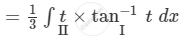
\[ = \frac{1}{3}\left[ \tan^{- 1} t\int t dt - \int\left\{ \frac{d}{dt}\left( \tan^{- 1} t \right)\int t dx \right\}dt \right]\]
\[ = \frac{1}{3} \times \frac{t^2 \tan^{- 1} t}{2} - \frac{1}{6}\int\frac{t^2}{\left( 1 + t^2 \right)}dt\]
\[ = \frac{t^2 \tan^{- 1} t}{6} - \frac{1}{6}\int\frac{t^2 + 1 - 1}{\left( 1 + t^2 \right)}dt\]
\[ = \frac{t^2 \tan^{- 1} t}{6} - \frac{1}{6}\int dt + \frac{1}{6}\int\frac{1}{1 + t^2}dt\]
\[ = \frac{t^2 \tan^{- 1} t}{6} - \frac{1}{6}t + \frac{\tan^{- 1} t}{6} + C\]
\[ = \frac{x^6 \tan^{- 1} x^3}{6} - \frac{1}{6} x^3 + \frac{\tan^{- 1} x^3}{6} + C\]
\[ = \frac{1}{6}\left( x^6 \tan^{- 1} x^3 - x^3 + \tan^{- 1} x^3 \right) + C\]
\[\text{Hence, }y = \frac{1}{6}\left( x^6 \tan^{- 1} x^3 - x^3 + \tan^{- 1} x^3 \right) +\text{C is the solution to the given differential equation.}\]
APPEARS IN
संबंधित प्रश्न
Show that the differential equation of which y = 2(x2 − 1) + \[c e^{- x^2}\] is a solution, is \[\frac{dy}{dx} + 2xy = 4 x^3\]
(y2 + 1) dx − (x2 + 1) dy = 0
Solve the differential equation \[\left( 1 + x^2 \right)\frac{dy}{dx} + \left( 1 + y^2 \right) = 0\], given that y = 1, when x = 0.
Solve the differential equation \[\frac{dy}{dx} = \frac{2x\left( \log x + 1 \right)}{\sin y + y \cos y}\], given that y = 0, when x = 1.
Find the solution of the differential equation cos y dy + cos x sin y dx = 0 given that y = \[\frac{\pi}{2}\], when x = \[\frac{\pi}{2}\]
In a bank principal increases at the rate of r% per year. Find the value of r if ₹100 double itself in 10 years (loge 2 = 0.6931).
Solve the following initial value problem:-
\[\frac{dy}{dx} + y \tan x = 2x + x^2 \tan x, y\left( 0 \right) = 1\]
Solve the following initial value problem:
\[\frac{dy}{dx} + y \cot x = 4x\text{ cosec }x, y\left( \frac{\pi}{2} \right) = 0\]
Solve the following initial value problem:-
\[dy = \cos x\left( 2 - y\text{ cosec }x \right)dx\]
A bank pays interest by continuous compounding, that is, by treating the interest rate as the instantaneous rate of change of principal. Suppose in an account interest accrues at 8% per year, compounded continuously. Calculate the percentage increase in such an account over one year.
In a simple circuit of resistance R, self inductance L and voltage E, the current `i` at any time `t` is given by L \[\frac{di}{dt}\]+ R i = E. If E is constant and initially no current passes through the circuit, prove that \[i = \frac{E}{R}\left\{ 1 - e^{- \left( R/L \right)t} \right\}.\]
Find the equation of the curve passing through the point \[\left( 1, \frac{\pi}{4} \right)\] and tangent at any point of which makes an angle tan−1 \[\left( \frac{y}{x} - \cos^2 \frac{y}{x} \right)\] with x-axis.
Show that the equation of the curve whose slope at any point is equal to y + 2x and which passes through the origin is y + 2 (x + 1) = 2e2x.
At every point on a curve the slope is the sum of the abscissa and the product of the ordinate and the abscissa, and the curve passes through (0, 1). Find the equation of the curve.
Integrating factor of the differential equation cos \[x\frac{dy}{dx} + y\] sin x = 1, is
The integrating factor of the differential equation \[x\frac{dy}{dx} - y = 2 x^2\]
Determine the order and degree of the following differential equations.
| Solution | D.E |
| y = aex + be−x | `(d^2y)/dx^2= 1` |
The solution of `dy/ dx` = 1 is ______.
Solve:
(x + y) dy = a2 dx
y2 dx + (xy + x2)dy = 0
Solve the differential equation sec2y tan x dy + sec2x tan y dx = 0
Solve the differential equation xdx + 2ydy = 0
Choose the correct alternative:
General solution of `y - x ("d"y)/("d"x)` = 0 is
Solve the following differential equation `("d"y)/("d"x)` = cos(x + y)
Solution: `("d"y)/("d"x)` = cos(x + y) ......(1)
Put `square`
∴ `1 + ("d"y)/("d"x) = "dv"/("d"x)`
∴ `("d"y)/("d"x) = "dv"/("d"x) - 1`
∴ (1) becomes `"dv"/("d"x) - 1` = cos v
∴ `"dv"/("d"x)` = 1 + cos v
∴ `square` dv = dx
Integrating, we get
`int 1/(1 + cos "v") "d"v = int "d"x`
∴ `int 1/(2cos^2 ("v"/2)) "dv" = int "d"x`
∴ `1/2 int square "dv" = int "d"x`
∴ `1/2* (tan("v"/2))/(1/2)` = x + c
∴ `square` = x + c
The integrating factor of the differential equation `"dy"/"dx" (x log x) + y` = 2logx is ______.
Solve the differential equation `"dy"/"dx"` = 1 + x + y2 + xy2, when y = 0, x = 0.
Which of the following defines a differential equation?
