Advertisements
Advertisements
प्रश्न
Solve the following initial value problem:-
\[x\frac{dy}{dx} - y = \log x, y\left( 1 \right) = 0\]
Advertisements
उत्तर
We have,
\[x\frac{dy}{dx} - y = \log x\]
\[ \Rightarrow \frac{dy}{dx} - \frac{y}{x} = \frac{\log x}{x} . . . . . \left( 1 \right)\]
Clearly, it is a linear differential equation of the form
\[\frac{dy}{dx} + Py = Q\]
\[\text{ where }P = - \frac{1}{x}\text{ and }Q = \frac{\log x}{x}\]
\[ \therefore I.F. = e^{\int P\ dx} \]
\[ = e^{- \int\frac{1}{x} dx} \]
\[ = e^{- \log x} \]
\[ = \frac{1}{x}\]
\[\text{ Multiplying both sides of }\left( 1 \right)\text{ by }I . F . = \frac{1}{x}, \text{ we get }\]
\[\frac{1}{x} \left( \frac{dy}{dx} - \frac{1}{x}y \right) = \frac{1}{x} \times \frac{\log x}{x}\]
\[ \Rightarrow \frac{1}{x}\frac{dy}{dx} - \frac{1}{x^2}y = \frac{\log x}{x^2}\]
Integrating both sides with respect to x, we get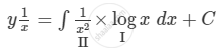
\[ \Rightarrow \frac{y}{x} = \log x\int\frac{1}{x^2}dx - \int\left[ \frac{d}{dx}\left( \log x \right)\int\frac{1}{x^2}dx \right]dx + C\]
\[ \Rightarrow \frac{y}{x} = - \frac{\log x}{x} + \int\frac{1}{x^2}dx + C\]
\[ \Rightarrow \frac{y}{x} = - \frac{\log x}{x} - \frac{1}{x} + C\]
\[ \Rightarrow y = - \log x - 1 + Cx . . . . . . . . . \left( 2 \right)\]
Now,
\[y\left( 1 \right) = 0\]
\[ \therefore 0 = - 0 - 1 + C\left( 1 \right)\]
\[ \Rightarrow C = 1\]
\[\text{ Putting the value of C in }\left( 2 \right),\text{ we get }\]
\[y = - \log x - 1 + x\]
\[ \Rightarrow y = x - 1 - \log x\]
\[\text{ Hence, }y = x - 1 - \log x\text{ is the required solution .}\]
APPEARS IN
संबंधित प्रश्न
Verify that y = cx + 2c2 is a solution of the differential equation
Show that y = e−x + ax + b is solution of the differential equation\[e^x \frac{d^2 y}{d x^2} = 1\]
Differential equation \[x\frac{dy}{dx} = 1, y\left( 1 \right) = 0\]
Function y = log x
(sin x + cos x) dy + (cos x − sin x) dx = 0
tan y dx + sec2 y tan x dy = 0
Find the solution of the differential equation cos y dy + cos x sin y dx = 0 given that y = \[\frac{\pi}{2}\], when x = \[\frac{\pi}{2}\]
\[\frac{dy}{dx} = \frac{y}{x} + \sin\left( \frac{y}{x} \right)\]
Solve the following initial value problem:-
\[\frac{dy}{dx} + y\cot x = 2\cos x, y\left( \frac{\pi}{2} \right) = 0\]
A bank pays interest by continuous compounding, that is, by treating the interest rate as the instantaneous rate of change of principal. Suppose in an account interest accrues at 8% per year, compounded continuously. Calculate the percentage increase in such an account over one year.
Find the equation of the curve such that the portion of the x-axis cut off between the origin and the tangent at a point is twice the abscissa and which passes through the point (1, 2).
The x-intercept of the tangent line to a curve is equal to the ordinate of the point of contact. Find the particular curve through the point (1, 1).
Write the differential equation representing the family of straight lines y = Cx + 5, where C is an arbitrary constant.
Write the differential equation obtained eliminating the arbitrary constant C in the equation xy = C2.
Integrating factor of the differential equation cos \[x\frac{dy}{dx} + y\] sin x = 1, is
The integrating factor of the differential equation \[x\frac{dy}{dx} - y = 2 x^2\]
In the following example, verify that the given function is a solution of the corresponding differential equation.
| Solution | D.E. |
| xy = log y + k | y' (1 - xy) = y2 |
In the following example, verify that the given function is a solution of the corresponding differential equation.
| Solution | D.E. |
| y = xn | `x^2(d^2y)/dx^2 - n xx (xdy)/dx + ny =0` |
For the following differential equation find the particular solution.
`(x + 1) dy/dx − 1 = 2e^(−y)`,
when y = 0, x = 1
The differential equation of `y = k_1e^x+ k_2 e^-x` is ______.
x2y dx – (x3 + y3) dy = 0
Solve: ydx – xdy = x2ydx.
Solve: `("d"y)/("d"x) = cos(x + y) + sin(x + y)`. [Hint: Substitute x + y = z]
Which of the following is an example of an ordinary differential equation?
