Advertisements
Advertisements
Question
Solve the following initial value problem:-
\[x\frac{dy}{dx} - y = \log x, y\left( 1 \right) = 0\]
Advertisements
Solution
We have,
\[x\frac{dy}{dx} - y = \log x\]
\[ \Rightarrow \frac{dy}{dx} - \frac{y}{x} = \frac{\log x}{x} . . . . . \left( 1 \right)\]
Clearly, it is a linear differential equation of the form
\[\frac{dy}{dx} + Py = Q\]
\[\text{ where }P = - \frac{1}{x}\text{ and }Q = \frac{\log x}{x}\]
\[ \therefore I.F. = e^{\int P\ dx} \]
\[ = e^{- \int\frac{1}{x} dx} \]
\[ = e^{- \log x} \]
\[ = \frac{1}{x}\]
\[\text{ Multiplying both sides of }\left( 1 \right)\text{ by }I . F . = \frac{1}{x}, \text{ we get }\]
\[\frac{1}{x} \left( \frac{dy}{dx} - \frac{1}{x}y \right) = \frac{1}{x} \times \frac{\log x}{x}\]
\[ \Rightarrow \frac{1}{x}\frac{dy}{dx} - \frac{1}{x^2}y = \frac{\log x}{x^2}\]
Integrating both sides with respect to x, we get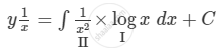
\[ \Rightarrow \frac{y}{x} = \log x\int\frac{1}{x^2}dx - \int\left[ \frac{d}{dx}\left( \log x \right)\int\frac{1}{x^2}dx \right]dx + C\]
\[ \Rightarrow \frac{y}{x} = - \frac{\log x}{x} + \int\frac{1}{x^2}dx + C\]
\[ \Rightarrow \frac{y}{x} = - \frac{\log x}{x} - \frac{1}{x} + C\]
\[ \Rightarrow y = - \log x - 1 + Cx . . . . . . . . . \left( 2 \right)\]
Now,
\[y\left( 1 \right) = 0\]
\[ \therefore 0 = - 0 - 1 + C\left( 1 \right)\]
\[ \Rightarrow C = 1\]
\[\text{ Putting the value of C in }\left( 2 \right),\text{ we get }\]
\[y = - \log x - 1 + x\]
\[ \Rightarrow y = x - 1 - \log x\]
\[\text{ Hence, }y = x - 1 - \log x\text{ is the required solution .}\]
APPEARS IN
RELATED QUESTIONS
If 1, `omega` and `omega^2` are the cube roots of unity, prove `(a + b omega + c omega^2)/(c + s omega + b omega^2) = omega^2`
Verify that \[y = ce^{tan^{- 1}} x\] is a solution of the differential equation \[\left( 1 + x^2 \right)\frac{d^2 y}{d x^2} + \left( 2x - 1 \right)\frac{dy}{dx} = 0\]
For the following differential equation verify that the accompanying function is a solution:
| Differential equation | Function |
|
\[x^3 \frac{d^2 y}{d x^2} = 1\]
|
\[y = ax + b + \frac{1}{2x}\]
|
(ey + 1) cos x dx + ey sin x dy = 0
(y2 + 1) dx − (x2 + 1) dy = 0
Solve the following differential equation:
\[\text{ cosec }x \log y \frac{dy}{dx} + x^2 y^2 = 0\]
Solve the following differential equation:
\[y\left( 1 - x^2 \right)\frac{dy}{dx} = x\left( 1 + y^2 \right)\]
Find the solution of the differential equation cos y dy + cos x sin y dx = 0 given that y = \[\frac{\pi}{2}\], when x = \[\frac{\pi}{2}\]
(x + y) (dx − dy) = dx + dy
Solve the following initial value problem:-
\[\frac{dy}{dx} + 2y \tan x = \sin x; y = 0\text{ when }x = \frac{\pi}{3}\]
Experiments show that radium disintegrates at a rate proportional to the amount of radium present at the moment. Its half-life is 1590 years. What percentage will disappear in one year?
The slope of a curve at each of its points is equal to the square of the abscissa of the point. Find the particular curve through the point (−1, 1).
Find the solution of the differential equation
\[x\sqrt{1 + y^2}dx + y\sqrt{1 + x^2}dy = 0\]
The integrating factor of the differential equation (x log x)
\[\frac{dy}{dx} + y = 2 \log x\], is given by
Which of the following is the integrating factor of (x log x) \[\frac{dy}{dx} + y\] = 2 log x?
In the following verify that the given functions (explicit or implicit) is a solution of the corresponding differential equation:-
`y=sqrt(a^2-x^2)` `x+y(dy/dx)=0`
For the following differential equation find the particular solution.
`(x + 1) dy/dx − 1 = 2e^(−y)`,
when y = 0, x = 1
For the following differential equation find the particular solution.
`dy/ dx = (4x + y + 1),
when y = 1, x = 0
Solve the following differential equation.
`x^2 dy/dx = x^2 +xy - y^2`
`xy dy/dx = x^2 + 2y^2`
Select and write the correct alternative from the given option for the question
Differential equation of the function c + 4yx = 0 is
Solve `("d"y)/("d"x) = (x + y + 1)/(x + y - 1)` when x = `2/3`, y = `1/3`
Solve the differential equation xdx + 2ydy = 0
Solve: `("d"y)/("d"x) + 2/xy` = x2
For the differential equation, find the particular solution
`("d"y)/("d"x)` = (4x +y + 1), when y = 1, x = 0
Solve `x^2 "dy"/"dx" - xy = 1 + cos(y/x)`, x ≠ 0 and x = 1, y = `pi/2`
Integrating factor of the differential equation `x "dy"/"dx" - y` = sinx is ______.
Solve the differential equation `"dy"/"dx" + 2xy` = y
Solve: `("d"y)/("d"x) = cos(x + y) + sin(x + y)`. [Hint: Substitute x + y = z]
