Advertisements
Advertisements
प्रश्न
Solve the following initial value problem:-
\[x\frac{dy}{dx} - y = \log x, y\left( 1 \right) = 0\]
Advertisements
उत्तर
We have,
\[x\frac{dy}{dx} - y = \log x\]
\[ \Rightarrow \frac{dy}{dx} - \frac{y}{x} = \frac{\log x}{x} . . . . . \left( 1 \right)\]
Clearly, it is a linear differential equation of the form
\[\frac{dy}{dx} + Py = Q\]
\[\text{ where }P = - \frac{1}{x}\text{ and }Q = \frac{\log x}{x}\]
\[ \therefore I.F. = e^{\int P\ dx} \]
\[ = e^{- \int\frac{1}{x} dx} \]
\[ = e^{- \log x} \]
\[ = \frac{1}{x}\]
\[\text{ Multiplying both sides of }\left( 1 \right)\text{ by }I . F . = \frac{1}{x}, \text{ we get }\]
\[\frac{1}{x} \left( \frac{dy}{dx} - \frac{1}{x}y \right) = \frac{1}{x} \times \frac{\log x}{x}\]
\[ \Rightarrow \frac{1}{x}\frac{dy}{dx} - \frac{1}{x^2}y = \frac{\log x}{x^2}\]
Integrating both sides with respect to x, we get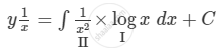
\[ \Rightarrow \frac{y}{x} = \log x\int\frac{1}{x^2}dx - \int\left[ \frac{d}{dx}\left( \log x \right)\int\frac{1}{x^2}dx \right]dx + C\]
\[ \Rightarrow \frac{y}{x} = - \frac{\log x}{x} + \int\frac{1}{x^2}dx + C\]
\[ \Rightarrow \frac{y}{x} = - \frac{\log x}{x} - \frac{1}{x} + C\]
\[ \Rightarrow y = - \log x - 1 + Cx . . . . . . . . . \left( 2 \right)\]
Now,
\[y\left( 1 \right) = 0\]
\[ \therefore 0 = - 0 - 1 + C\left( 1 \right)\]
\[ \Rightarrow C = 1\]
\[\text{ Putting the value of C in }\left( 2 \right),\text{ we get }\]
\[y = - \log x - 1 + x\]
\[ \Rightarrow y = x - 1 - \log x\]
\[\text{ Hence, }y = x - 1 - \log x\text{ is the required solution .}\]
APPEARS IN
संबंधित प्रश्न
If 1, `omega` and `omega^2` are the cube roots of unity, prove `(a + b omega + c omega^2)/(c + s omega + b omega^2) = omega^2`
Show that the differential equation of which y = 2(x2 − 1) + \[c e^{- x^2}\] is a solution, is \[\frac{dy}{dx} + 2xy = 4 x^3\]
Form the differential equation of the family of hyperbolas having foci on x-axis and centre at the origin.
For the following differential equation verify that the accompanying function is a solution:
| Differential equation | Function |
|
\[x + y\frac{dy}{dx} = 0\]
|
\[y = \pm \sqrt{a^2 - x^2}\]
|
For the following differential equation verify that the accompanying function is a solution:
| Differential equation | Function |
|
\[x\frac{dy}{dx} + y = y^2\]
|
\[y = \frac{a}{x + a}\]
|
Differential equation \[\frac{dy}{dx} = y, y\left( 0 \right) = 1\]
Function y = ex
Differential equation \[\frac{d^2 y}{d x^2} + y = 0, y \left( 0 \right) = 1, y' \left( 0 \right) = 1\] Function y = sin x + cos x
Differential equation \[\frac{d^2 y}{d x^2} - y = 0, y \left( 0 \right) = 2, y' \left( 0 \right) = 0\] Function y = ex + e−x
xy (y + 1) dy = (x2 + 1) dx
Solve the differential equation \[x\frac{dy}{dx} + \cot y = 0\] given that \[y = \frac{\pi}{4}\], when \[x=\sqrt{2}\]
(y2 − 2xy) dx = (x2 − 2xy) dy
\[\frac{dy}{dx} = \frac{y}{x} + \sin\left( \frac{y}{x} \right)\]
Solve the following initial value problem:-
\[\frac{dy}{dx} + y \tan x = 2x + x^2 \tan x, y\left( 0 \right) = 1\]
In a culture, the bacteria count is 100000. The number is increased by 10% in 2 hours. In how many hours will the count reach 200000, if the rate of growth of bacteria is proportional to the number present?
Find the equation of the curve which passes through the point (2, 2) and satisfies the differential equation
\[y - x\frac{dy}{dx} = y^2 + \frac{dy}{dx}\]
Find the equation of the curve passing through the point \[\left( 1, \frac{\pi}{4} \right)\] and tangent at any point of which makes an angle tan−1 \[\left( \frac{y}{x} - \cos^2 \frac{y}{x} \right)\] with x-axis.
Find the solution of the differential equation
\[x\sqrt{1 + y^2}dx + y\sqrt{1 + x^2}dy = 0\]
Integrating factor of the differential equation cos \[x\frac{dy}{dx} + y\] sin x = 1, is
The differential equation obtained on eliminating A and B from y = A cos ωt + B sin ωt, is
The equation of the curve whose slope is given by \[\frac{dy}{dx} = \frac{2y}{x}; x > 0, y > 0\] and which passes through the point (1, 1) is
Which of the following transformations reduce the differential equation \[\frac{dz}{dx} + \frac{z}{x}\log z = \frac{z}{x^2} \left( \log z \right)^2\] into the form \[\frac{du}{dx} + P\left( x \right) u = Q\left( x \right)\]
The integrating factor of the differential equation \[x\frac{dy}{dx} - y = 2 x^2\]
The solution of `dy/dx + x^2/y^2 = 0` is ______
x2y dx – (x3 + y3) dy = 0
For the differential equation, find the particular solution (x – y2x) dx – (y + x2y) dy = 0 when x = 2, y = 0
Solve the following differential equation
`x^2 ("d"y)/("d"x)` = x2 + xy − y2
Given that `"dy"/"dx" = "e"^-2x` and y = 0 when x = 5. Find the value of x when y = 3.
Solve the differential equation `"dy"/"dx" + 2xy` = y
There are n students in a school. If r % among the students are 12 years or younger, which of the following expressions represents the number of students who are older than 12?
Solve the differential equation
`y (dy)/(dx) + x` = 0
