Advertisements
Advertisements
प्रश्न
Find the equation of the curve such that the portion of the x-axis cut off between the origin and the tangent at a point is twice the abscissa and which passes through the point (1, 2).
Advertisements
उत्तर
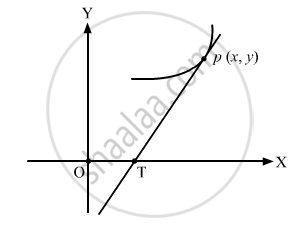
Portion of the x-axis cut off between the origin and tangent at a point \[= x - y \hspace{0.167em} \hspace{0.167em} \frac{dx}{dy} = OT\]
It is given, OT = 2x
\[\begin{array}{l}\therefore \hspace{0.167em} \hspace{0.167em} x - y \hspace{0.167em} \hspace{0.167em} \frac{dx}{dy} = 2x \\ - x = y\frac{dx}{dy} \\ - \int\frac{dx}{x} = \int\frac{dy}{y} \\ \therefore \hspace{0.167em} \hspace{0.167em} xy = k\end{array}\]
Since the curve passes through the point (1, 2)
⇒ at x = 1 ⇒ y = 2
∴ k = 2
∴ xy = 2
APPEARS IN
संबंधित प्रश्न
Show that the differential equation of which y = 2(x2 − 1) + \[c e^{- x^2}\] is a solution, is \[\frac{dy}{dx} + 2xy = 4 x^3\]
Verify that y = − x − 1 is a solution of the differential equation (y − x) dy − (y2 − x2) dx = 0.
Verify that \[y = e^{m \cos^{- 1} x}\] satisfies the differential equation \[\left( 1 - x^2 \right)\frac{d^2 y}{d x^2} - x\frac{dy}{dx} - m^2 y = 0\]
xy (y + 1) dy = (x2 + 1) dx
Solve the following initial value problem:-
\[y' + y = e^x , y\left( 0 \right) = \frac{1}{2}\]
Solve the following initial value problem:-
\[dy = \cos x\left( 2 - y\text{ cosec }x \right)dx\]
The rate of increase in the number of bacteria in a certain bacteria culture is proportional to the number present. Given the number triples in 5 hrs, find how many bacteria will be present after 10 hours. Also find the time necessary for the number of bacteria to be 10 times the number of initial present.
The population of a city increases at a rate proportional to the number of inhabitants present at any time t. If the population of the city was 200000 in 1990 and 250000 in 2000, what will be the population in 2010?
If the marginal cost of manufacturing a certain item is given by C' (x) = \[\frac{dC}{dx}\] = 2 + 0.15 x. Find the total cost function C (x), given that C (0) = 100.
The decay rate of radium at any time t is proportional to its mass at that time. Find the time when the mass will be halved of its initial mass.
Find the equation of the curve passing through the point \[\left( 1, \frac{\pi}{4} \right)\] and tangent at any point of which makes an angle tan−1 \[\left( \frac{y}{x} - \cos^2 \frac{y}{x} \right)\] with x-axis.
Write the differential equation representing the family of straight lines y = Cx + 5, where C is an arbitrary constant.
The differential equation of the ellipse \[\frac{x^2}{a^2} + \frac{y^2}{b^2} = C\] is
The differential equation \[x\frac{dy}{dx} - y = x^2\], has the general solution
In the following verify that the given functions (explicit or implicit) is a solution of the corresponding differential equation:-
y = ex + 1 y'' − y' = 0
Find the equation of the plane passing through the point (1, -2, 1) and perpendicular to the line joining the points A(3, 2, 1) and B(1, 4, 2).
For each of the following differential equations find the particular solution.
(x − y2 x) dx − (y + x2 y) dy = 0, when x = 2, y = 0
For the following differential equation find the particular solution.
`dy/ dx = (4x + y + 1),
when y = 1, x = 0
Solve the following differential equation.
y2 dx + (xy + x2 ) dy = 0
Select and write the correct alternative from the given option for the question
Bacterial increases at the rate proportional to the number present. If original number M doubles in 3 hours, then number of bacteria will be 4M in
For the differential equation, find the particular solution (x – y2x) dx – (y + x2y) dy = 0 when x = 2, y = 0
For the differential equation, find the particular solution
`("d"y)/("d"x)` = (4x +y + 1), when y = 1, x = 0
Choose the correct alternative:
General solution of `y - x ("d"y)/("d"x)` = 0 is
Solve the following differential equation
`y log y ("d"x)/("d"y) + x` = log y
There are n students in a school. If r % among the students are 12 years or younger, which of the following expressions represents the number of students who are older than 12?
A man is moving away from a tower 41.6 m high at a rate of 2 m/s. If the eye level of the man is 1.6 m above the ground, then the rate at which the angle of elevation of the top of the tower changes, when he is at a distance of 30 m from the foot of the tower, is
Which of the following defines a differential equation?
What distinguishes an ordinary differential equation from other types of differential equations?
