Advertisements
Advertisements
प्रश्न
Find the equation of the curve such that the portion of the x-axis cut off between the origin and the tangent at a point is twice the abscissa and which passes through the point (1, 2).
Advertisements
उत्तर
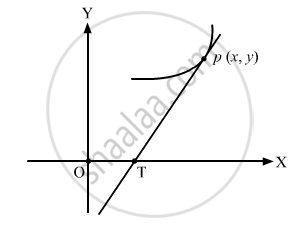
Portion of the x-axis cut off between the origin and tangent at a point \[= x - y \hspace{0.167em} \hspace{0.167em} \frac{dx}{dy} = OT\]
It is given, OT = 2x
\[\begin{array}{l}\therefore \hspace{0.167em} \hspace{0.167em} x - y \hspace{0.167em} \hspace{0.167em} \frac{dx}{dy} = 2x \\ - x = y\frac{dx}{dy} \\ - \int\frac{dx}{x} = \int\frac{dy}{y} \\ \therefore \hspace{0.167em} \hspace{0.167em} xy = k\end{array}\]
Since the curve passes through the point (1, 2)
⇒ at x = 1 ⇒ y = 2
∴ k = 2
∴ xy = 2
APPEARS IN
संबंधित प्रश्न
Show that y = AeBx is a solution of the differential equation
Show that y = e−x + ax + b is solution of the differential equation\[e^x \frac{d^2 y}{d x^2} = 1\]
Differential equation \[\frac{d^2 y}{d x^2} - 2\frac{dy}{dx} + y = 0, y \left( 0 \right) = 1, y' \left( 0 \right) = 2\] Function y = xex + ex
(y + xy) dx + (x − xy2) dy = 0
Solve the differential equation \[\left( 1 + x^2 \right)\frac{dy}{dx} + \left( 1 + y^2 \right) = 0\], given that y = 1, when x = 0.
Find the solution of the differential equation cos y dy + cos x sin y dx = 0 given that y = \[\frac{\pi}{2}\], when x = \[\frac{\pi}{2}\]
In a culture the bacteria count is 100000. The number is increased by 10% in 2 hours. In how many hours will the count reach 200000, if the rate of growth of bacteria is proportional to the number present.
If y(x) is a solution of the different equation \[\left( \frac{2 + \sin x}{1 + y} \right)\frac{dy}{dx} = - \cos x\] and y(0) = 1, then find the value of y(π/2).
(y2 − 2xy) dx = (x2 − 2xy) dy
\[\frac{dy}{dx} = \frac{y}{x} + \sin\left( \frac{y}{x} \right)\]
Solve the following initial value problem:-
\[\tan x\left( \frac{dy}{dx} \right) = 2x\tan x + x^2 - y; \tan x \neq 0\] given that y = 0 when \[x = \frac{\pi}{2}\]
If the interest is compounded continuously at 6% per annum, how much worth Rs 1000 will be after 10 years? How long will it take to double Rs 1000?
The slope of the tangent at a point P (x, y) on a curve is \[\frac{- x}{y}\]. If the curve passes through the point (3, −4), find the equation of the curve.
The tangent at any point (x, y) of a curve makes an angle tan−1(2x + 3y) with x-axis. Find the equation of the curve if it passes through (1, 2).
The normal to a given curve at each point (x, y) on the curve passes through the point (3, 0). If the curve contains the point (3, 4), find its equation.
Radium decomposes at a rate proportional to the quantity of radium present. It is found that in 25 years, approximately 1.1% of a certain quantity of radium has decomposed. Determine approximately how long it will take for one-half of the original amount of radium to decompose?
The differential equation obtained on eliminating A and B from y = A cos ωt + B sin ωt, is
Solve the following differential equation : \[\left( \sqrt{1 + x^2 + y^2 + x^2 y^2} \right) dx + xy \ dy = 0\].
Determine the order and degree of the following differential equations.
| Solution | D.E. |
| y = 1 − logx | `x^2(d^2y)/dx^2 = 1` |
Solve the following differential equation.
`y^3 - dy/dx = x dy/dx`
Solve the following differential equation.
`dy/dx + y` = 3
Solve the following differential equation.
dr + (2r)dθ= 8dθ
Solve the differential equation xdx + 2ydy = 0
For the differential equation, find the particular solution (x – y2x) dx – (y + x2y) dy = 0 when x = 2, y = 0
The differential equation of all non horizontal lines in a plane is `("d"^2x)/("d"y^2)` = 0
Solve the differential equation
`x + y dy/dx` = x2 + y2
The value of `dy/dx` if y = |x – 1| + |x – 4| at x = 3 is ______.
Which of the following is an example of an ordinary differential equation?
