Advertisements
Advertisements
Question
Find the equation of the curve such that the portion of the x-axis cut off between the origin and the tangent at a point is twice the abscissa and which passes through the point (1, 2).
Advertisements
Solution
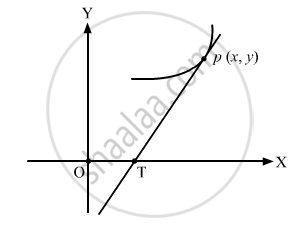
Portion of the x-axis cut off between the origin and tangent at a point \[= x - y \hspace{0.167em} \hspace{0.167em} \frac{dx}{dy} = OT\]
It is given, OT = 2x
\[\begin{array}{l}\therefore \hspace{0.167em} \hspace{0.167em} x - y \hspace{0.167em} \hspace{0.167em} \frac{dx}{dy} = 2x \\ - x = y\frac{dx}{dy} \\ - \int\frac{dx}{x} = \int\frac{dy}{y} \\ \therefore \hspace{0.167em} \hspace{0.167em} xy = k\end{array}\]
Since the curve passes through the point (1, 2)
⇒ at x = 1 ⇒ y = 2
∴ k = 2
∴ xy = 2
APPEARS IN
RELATED QUESTIONS
Assume that a rain drop evaporates at a rate proportional to its surface area. Form a differential equation involving the rate of change of the radius of the rain drop.
Show that the differential equation of which y = 2(x2 − 1) + \[c e^{- x^2}\] is a solution, is \[\frac{dy}{dx} + 2xy = 4 x^3\]
Show that the function y = A cos x + B sin x is a solution of the differential equation \[\frac{d^2 y}{d x^2} + y = 0\]
Show that Ax2 + By2 = 1 is a solution of the differential equation x \[\left\{ y\frac{d^2 y}{d x^2} + \left( \frac{dy}{dx} \right)^2 \right\} = y\frac{dy}{dx}\]
Show that y = e−x + ax + b is solution of the differential equation\[e^x \frac{d^2 y}{d x^2} = 1\]
Differential equation \[x\frac{dy}{dx} = 1, y\left( 1 \right) = 0\]
Function y = log x
Differential equation \[\frac{d^2 y}{d x^2} + y = 0, y \left( 0 \right) = 1, y' \left( 0 \right) = 1\] Function y = sin x + cos x
Solve the following differential equation:
\[y e^\frac{x}{y} dx = \left( x e^\frac{x}{y} + y^2 \right)dy, y \neq 0\]
x2 dy + y (x + y) dx = 0
Solve the following initial value problem:
\[x\frac{dy}{dx} + y = x \cos x + \sin x, y\left( \frac{\pi}{2} \right) = 1\]
A population grows at the rate of 5% per year. How long does it take for the population to double?
The tangent at any point (x, y) of a curve makes an angle tan−1(2x + 3y) with x-axis. Find the equation of the curve if it passes through (1, 2).
Find the equation of the curve which passes through the point (1, 2) and the distance between the foot of the ordinate of the point of contact and the point of intersection of the tangent with x-axis is twice the abscissa of the point of contact.
Write the differential equation representing the family of straight lines y = Cx + 5, where C is an arbitrary constant.
Form the differential equation representing the family of parabolas having vertex at origin and axis along positive direction of x-axis.
In the following example, verify that the given function is a solution of the corresponding differential equation.
| Solution | D.E. |
| xy = log y + k | y' (1 - xy) = y2 |
For each of the following differential equations find the particular solution.
(x − y2 x) dx − (y + x2 y) dy = 0, when x = 2, y = 0
For the following differential equation find the particular solution.
`(x + 1) dy/dx − 1 = 2e^(−y)`,
when y = 0, x = 1
Solve the following differential equation.
x2y dx − (x3 + y3) dy = 0
Choose the correct alternative.
The solution of `x dy/dx = y` log y is
The integrating factor of the differential equation `dy/dx - y = x` is e−x.
Select and write the correct alternative from the given option for the question
Bacterial increases at the rate proportional to the number present. If original number M doubles in 3 hours, then number of bacteria will be 4M in
Given that `"dy"/"dx"` = yex and x = 0, y = e. Find the value of y when x = 1.
The differential equation of all non horizontal lines in a plane is `("d"^2x)/("d"y^2)` = 0
lf the straight lines `ax + by + p` = 0 and `x cos alpha + y sin alpha = p` are inclined at an angle π/4 and concurrent with the straight line `x sin alpha - y cos alpha` = 0, then the value of `a^2 + b^2` is
