Advertisements
Advertisements
प्रश्न
Find the equation of the curve which passes through the point (1, 2) and the distance between the foot of the ordinate of the point of contact and the point of intersection of the tangent with x-axis is twice the abscissa of the point of contact.
Advertisements
उत्तर
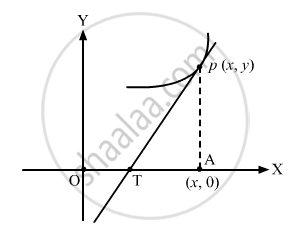
It is given that the distance between the foot of ordinate of point of contact (A) and point of intersection of tangent with x-axis (T) = 2x
\[\text{Coordinate of }T = \left( x - y\frac{dx}{dy}, 0 \right)\]
\[\Rightarrow y - 0 = \frac{dy}{dx}\left(x - \left( x - y \frac{dx}{dy} \right) \right)\]
\[\Rightarrow y \frac{dx}{dy} = 2x\]
\[\Rightarrow \int\frac{dx}{x} = 2\int\frac{dy}{y}\]
\[\Rightarrow \ln x = \ln y^2 + \ln c\]
\[x = c y^2 \]
\[\text{As the circle passes through }\left( 1, 2 \right).\]
\[1 = c \times 2^2 \]
\[ \Rightarrow c = \frac{1}{4}\]
\[ \Rightarrow 4x = y^2\]
APPEARS IN
संबंधित प्रश्न
Show that the function y = A cos x + B sin x is a solution of the differential equation \[\frac{d^2 y}{d x^2} + y = 0\]
Differential equation \[\frac{d^2 y}{d x^2} - \frac{dy}{dx} = 0, y \left( 0 \right) = 2, y'\left( 0 \right) = 1\]
Function y = ex + 1
tan y \[\frac{dy}{dx}\] = sin (x + y) + sin (x − y)
Solve the following differential equation:
\[xy\frac{dy}{dx} = 1 + x + y + xy\]
Find the particular solution of the differential equation
(1 – y2) (1 + log x) dx + 2xy dy = 0, given that y = 0 when x = 1.
\[x^2 \frac{dy}{dx} = x^2 + xy + y^2 \]
The surface area of a balloon being inflated, changes at a rate proportional to time t. If initially its radius is 1 unit and after 3 seconds it is 2 units, find the radius after time t.
Show that the equation of the curve whose slope at any point is equal to y + 2x and which passes through the origin is y + 2 (x + 1) = 2e2x.
Find the equation to the curve satisfying x (x + 1) \[\frac{dy}{dx} - y\] = x (x + 1) and passing through (1, 0).
The slope of the tangent at each point of a curve is equal to the sum of the coordinates of the point. Find the curve that passes through the origin.
Find the equation of the curve passing through the point (0, 1) if the slope of the tangent to the curve at each of its point is equal to the sum of the abscissa and the product of the abscissa and the ordinate of the point.
Write the differential equation obtained eliminating the arbitrary constant C in the equation xy = C2.
The solution of the differential equation \[\frac{dy}{dx} = \frac{ax + g}{by + f}\] represents a circle when
The differential equation satisfied by ax2 + by2 = 1 is
Which of the following differential equations has y = C1 ex + C2 e−x as the general solution?
The integrating factor of the differential equation \[x\frac{dy}{dx} - y = 2 x^2\]
Solve the following differential equation : \[y^2 dx + \left( x^2 - xy + y^2 \right)dy = 0\] .
Form the differential equation of the family of circles having centre on y-axis and radius 3 unit.
Form the differential equation from the relation x2 + 4y2 = 4b2
Solve the following differential equation.
xdx + 2y dx = 0
Solve the following differential equation.
(x2 − y2 ) dx + 2xy dy = 0
Solve the following differential equation.
`x^2 dy/dx = x^2 +xy - y^2`
The differential equation of `y = k_1e^x+ k_2 e^-x` is ______.
The solution of `dy/dx + x^2/y^2 = 0` is ______
A solution of a differential equation which can be obtained from the general solution by giving particular values to the arbitrary constants is called ___________ solution.
The function y = ex is solution ______ of differential equation
Solve the following differential equation
sec2 x tan y dx + sec2 y tan x dy = 0
Solution: sec2 x tan y dx + sec2 y tan x dy = 0
∴ `(sec^2x)/tanx "d"x + square` = 0
Integrating, we get
`square + int (sec^2y)/tany "d"y` = log c
Each of these integral is of the type
`int ("f'"(x))/("f"(x)) "d"x` = log |f(x)| + log c
∴ the general solution is
`square + log |tan y|` = log c
∴ log |tan x . tan y| = log c
`square`
This is the general solution.
`d/(dx)(tan^-1 (sqrt(1 + x^2) - 1)/x)` is equal to:
Why is the equation \[x\frac{dy}{dx} + y = 0\] classified as a differential equation?
Which of the following is an example of an ordinary differential equation?
